Friday, June 24, 2016

Witch & Wizard

Witch and Wizard, by James Patterson and a second author in smaller print, is about a witch and a wizard. Their names are Wisteria and Whitford Allgood, but they usually go by Wisty and Whit. Yes, they are really the All-good family.

Unfortunately for them, "the country" has elected some fellows called the New Order into power, and in "a few months" the New Order has completely destroyed "the old government" and instituted a council to rule over the new authoritarian state and also they've convinced everyone that not only does magic exist but also that it's evil and that it's okay to do terrible things to children and also the Allgoods are the last nice parents on Earth and everyone else is just sorta fine with it except for kids so the New Order just kills children by the hundreds and did I mention EVERYONE IS FINE WITH IT and also there are apparently no countries other than "the country" because everyone is either in the New Order or in the resistance as clearly marked in the map and also the world is flat I guess and there are no oceans but there's also four other levels of reality because why not?

So, yeah, it's set in an alternate reality where that somehow makes sense.

Anyways, Wisty and Whit have somehow missed the fact that the GOVERNMENT IS GONE AND EVERYONE IS EVIL sorry I need a little time to adjust to this premise.

[time passes]

So, Wisty and Whit were not informed about the new government, nor about the existence of magic, nor about the fact that magic is illegal and morally reprehensible. They are then completely surprised when they are arrested by the New Order for the charge of being a witch and a wizard, respectively. They are even more surprised when they start developing magical powers, such as seeing ghosts and being on fire. Slightly less surprising is that they are sentenced to death. Now, Wisty and Whit have to use their magic to escape the torture-prison and find their parents.

The review so far has been a bit ranty, so I feel like I should clarify: I really liked Witch & Wizard. It is fun, and easy to read, and it moves at an incredibly fast pace. The good characters are all likable, and the evil characters are all cartoonishly evil. I'm also okay with the ridiculous setting, because it just emphasizes the whole silly good-vs-bad fun of the story.

So, read this book if you like fast-paced action and fun. Try to ignore my little rant. Honestly, I just made it for fun.

Wednesday, June 15, 2016

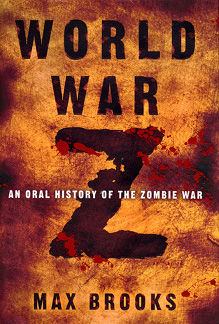
World War Z

The year is like 2026-ish. The world is slowly being rebuilt from the devastating 10-year zombie apocalypse. Max Brooks, of the United Nations Postwar Commission Report, has spent the last few years flying around the world and gathering stories from the survivors. Now, some of their stories have been compiled into World War Z, an oral history of the zombie war.

This is one of my favorite books. It is, as I said, a collection of stories, all in the form of interviews, which together tell the overall story of humanity and it's struggle to overcome this deadly force. It was apparently inspired by a real history book, The Good War, which was told in the same format. I am quickly running out of things to say.

So, I've just read a bunch of other reviews, because I have no ideas of my own. It seems like most of the complaints stem from the strange format, because you cannot connect to the characters and watch their story arcs, because the interview are so short. I can see what they're talking about, but that's not really a problem for me, because I tend to empathize with any character who isn't completely terrible, and most of these characters are likable.

I actually think this format works well, because it emphasizes that the zombie war (and other wars) can't be seen as simply actions of "the masses," and that everyone needs to work together to defeat the zombies. This theme is slightly undercut by the U.S.-centrism which creeps it way into some parts of the book, but it still works overall.

What I like most about World War Z is the fact that Brooks makes so many different kinds of stories. There are quite a few about guilty military personnel, and about how everyone was doing things wrong, but for the most part it was full of diversity. There are some stories about survival, people going insane, a nuclear exchange, the formation of a religious state, plans that pulled humanity back from the brink, people giving their lives to try to cleanse areas from zombies, and gung-ho military operations.

So, If you think you will like it, give it a shot. If not, well, maybe this book is not for you. At least read a few chapters. Oh, and if you liked The Zombie Survival Guide (which uses the same zombies), then you will probably love World War Z, because it is a collection of the kinds of stories you made up while you read the survival guide. That's all I've got.

Tuesday, June 14, 2016

The Rosie Project

The Rosie Project has a million covers, and it was reccommended to me profusely by my mom. It is supposedly a romance between Don, a professor with a rigid schedule and no social skills, and Rosie, a woman on a quest to find the identity of her biological father. It was okay.

I feel like I just didn't "get" the book. The central romance never really resonated with me, and for almost the entire thing I really wanted Don and Rosie to not get together. Apparently there were subtle hints the entire time that they were perfect for each other, but I just didn't notice. Also, my mom says the book was hilarious (as well as the reviewers on the cover, which is not surprising) but I didn't even laugh once. I also didn't cry once. Maybe it ate my feelings.

So, now I'm in the interesting situation that I didn't like the book, but I'm pretty sure that I'm wrong. I suppose, if someone else reccommends this book to you, you should listen to them. I won't stop you from reading it.

Also, it was written by Graeme Simsion. I couldn't figure out how to integrate that into the review.

Friday, May 20, 2016

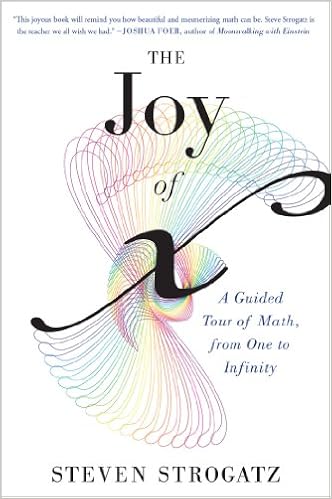
The Joy of X

At this point, I think it's just easier to compare Steven Strogatz's The Joy of X to similar math books I've read. Then again, some people might not have read the other reviews. Okay, here's the deal: if you're looking into The Joy of X, then chances are you will also want to consider two other books: Things to Make and Do in the Fourth Dimension and The Magic of Math.

All three books present themselves to a public with not much math background, but they go about it in different ways. One of the most obvious differences is that The Joy of X (which I'll call Joy from now on) is split into a whole bunch of little chapters of about eight pages. These go through the general topics of arithmetic, algebra, geometry, calculus, statistics, and some other newer ideas in mathematics, in that order.

It is also full of personal anecdotes, which makes the reading more memorable. Things to Make and Do in the Fourth Dimension (which I'll call 4D) had a few anecdotes, and a lot of little activities for you to do yourself, which made it very fun to read. The Magic of Math (Magic) did not have many anecdotes or activities. But, it did have proofs, which 4D lacked and Joy only did a few of.

Of the three books, 4D gives the best impression of an actual tour, guiding the reader through whole areas of mathematics and stopping to marvel at each one. In comparison, Magic seems a bit laid back, with only 12 chapters (4D has 21), but you can really take your time to understand the subjects you're given. As I said before, Joy has short chapters. It is therefore more fast-paced, a whirlwind of "Look at that! Isn't that cool? Now, on to the next thing!"

Personally, I think 4D is the best of the three, with Magic as the second and Joy bringing up the rear. This is not to say that Joy is bad. If you like the style of bite-sized tidbits of math, it will probably be your favorite. You can come to your own conclusion, and pick which book (or books) you want to read.

Monday, May 16, 2016

The Magic of Math

The Magic of Math, by Arthur Benjamin, has so many puns. I feel like I should start with that. Some puns, are bad, and some are worse, but they all are puns. Also it's about, like, math, I guess.

This book, I think, is definitely aimed at more of an everyday audience than other math books I've covered (except, of course, for this one, which you should all read). I think that, as long as you have a decent grasp on basic algebra, you will breeze through the book, especially if you skip the asides which are scattered throughout.

The Magic of Math spends a lot more time on proofs than all the other math books I've read, and I think that works to its benefit. Sometimes the other books state things and expect you to just take them as facts, which works for them, because they are just kinda taking you on a sightseeing tour of different areas of mathematics. However, I like the way Arthur Benjamin proves everything in the book (sometimes in asides), because it means you can take the time to understand what he is saying. This is especially effective because The Magic of Math is a book (how insightful of me!), so you can take your time re-reading things and it won't go anywhere.

In conclusion, if you are slightly interested in reading a book about math, read either The Magic of Math or Things to Make and Do in the Fourth Dimension. The first one is more focused and requires more work on the reader's part (at least if you want to understand everything), while the second is a fun tour on mathematical discoveries and concepts. Choose wisely. Or, you know, just read both.

Sunday, May 08, 2016

The Extraordinary Secrets of April, May, & June

I liked The Extraordinary Secrets of April, May, & June, and my friends make fun of me for it. Yes, it is about girls, and yes, it has elements of romance, and yes, it is very cheesy, but it was fun to read and had an interesting story.

April, May, and June are three sisters, named in chronological order (April is the oldest and June is the youngest). They have just moved to the town of Somewhere Probably because their parents got divorced. Now, they are living with their mom, and about to start school. Already, this has a lot of stuff going for it, but it gets better: on the first day of school, the three sisters get superpowers.

I know, right? So, April gets the power to catch glimpses of the future, May gets the power to turn invisible, and June gets the power to read minds. Now, in a new town, at a new school, and with crazy secret powers, the three girls have to learn to live with their new lives.

The Extraordinary Secrets of April, May, & June was a fun book to read. I was on board with the characters the whole time, and I wanted to see them triumph, and it feels good to share their struggles. If you like fun, cheesy books which are full of heart, then read this book. No matter what your friends say.

Wednesday, April 27, 2016

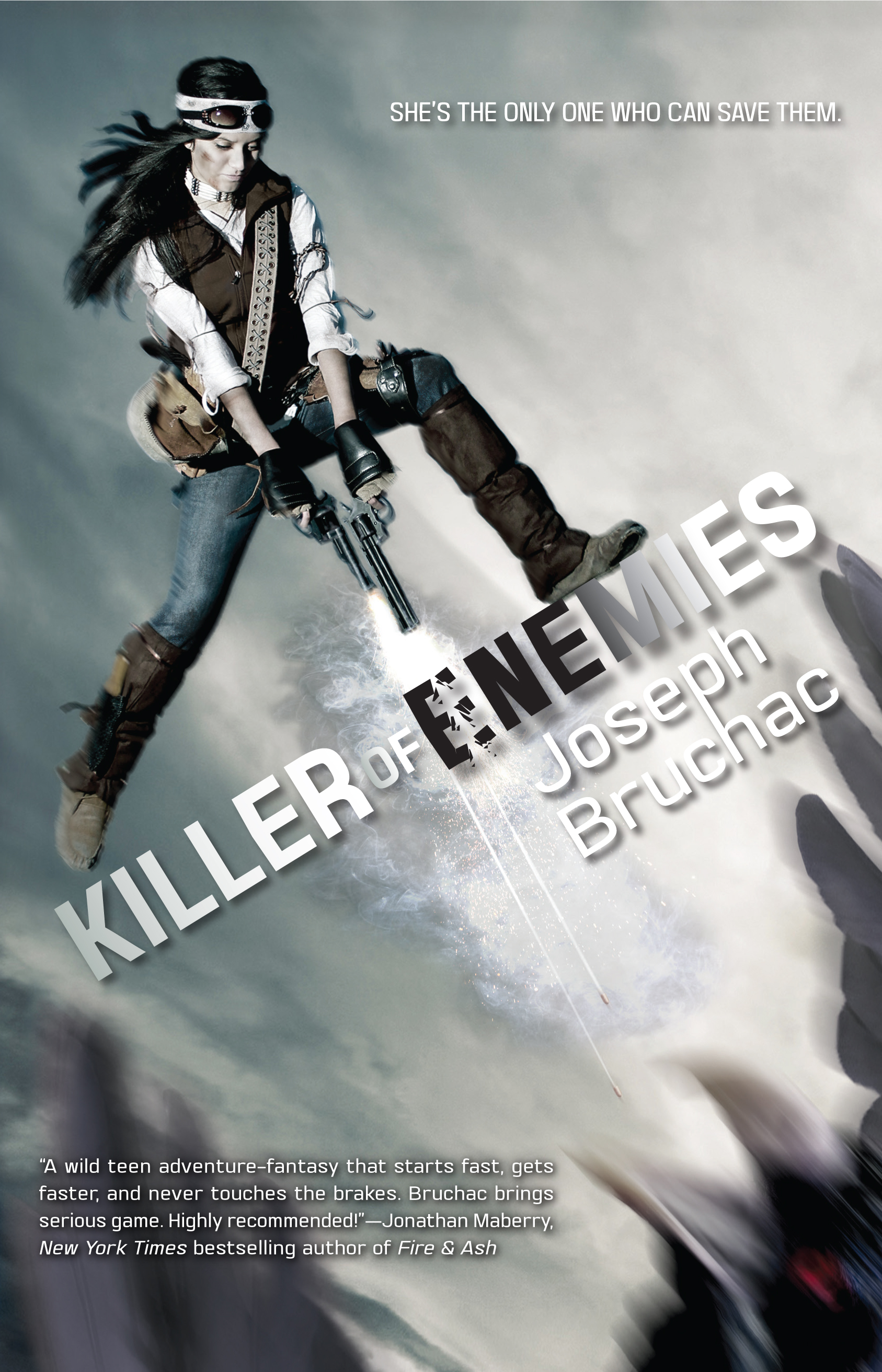
Killer of Enemies

Killer of Enemies is kind of a terrible book and it's great. I initially started reading it because of its ridiculous title, and it lived up to its cover. This is not to say that is was a bad book; I had fun reading it and the world of the story is pretty cool, so I don't feel like I wasted my time or anything. So, what is it about?

Have you ever thought to yourself, "I wonder what it would be like to read about someone playing Monster Hunter or Shadow of the Colossus or a similar game with giant monsters"? Have you ever then immediately thought, "no, wait, that wouldn't be nearly as interesting, I'll just play them myself and that will be more fun"? Well, Joseph Bruchac did not have the second thought, and so Killer of Enemies was born.

The book involves our protagonist, Lozen, who is the best at everything, killing huge genetically modified monsters. This is a post-apocalyptic future, set after the rigidly-divided classist technofuture from so many books. An entity known only as the Cloud has come and turned off all of the electronic devices and engines, but not gunpowder, and also rocket launchers and automatic weapons still work. The rules seem to be kinda fuzzy.

Anyways, all the super rich leaders had electronic implants or nanobots and so they died when the Cloud came. Some survivors who didn't have many implants formed a rigid society with aristocrats as evil dictators. One such society is holding Lozen's parents hostage to make her kill things. She then kills things. Usually huge things. There's more story, but not much.

Killer of Enemies is not high-brow hmmyes fiction, and it doesn't try to be. It really reads like a fanfiction of Shadow of the Colossus, because it mostly involves Lozen outsmarting and then wrecking giants. There is a simple story, which is nice, but it's not the focus. If you like big dumb action, and I certainly do, then you should read Killer of Enemies.

Oh and also there's magic. And zombies. Just thought you should know.

Wednesday, April 20, 2016

Harry Potter and the Methods of Rationality

I ragged on Harry Potter and the Methods of Rationality (sometimes awkwardly abbreviated to HPMOR) quite a bit on my other blog. A lot of my points still stand. The characters start out unlikable, at least to me, to the point where I actually quit reading. Eventually, though... well, here I am, done with the book.

So, what is HPMOR? It is a fan-fiction of Harry Potter composed by Eliezer Yudkowski, He Who Is Not Recognized By Spell-Check. It takes place in an alternate-universe type deal in which Harry was raised by scientists and is a boy genius armed with the powers of Rationality. If that makes you really want to read it, then I doubt I could stop you even if I tried. If not, then... eh. It's cool.

That's it. This post is essentially just to say that I've read HPMOR. To reiterate: your first impression is probably indicative of how much you will like this book. I wouldn't recommend it if you don't buy into the premise. Laters!

Sunday, April 17, 2016

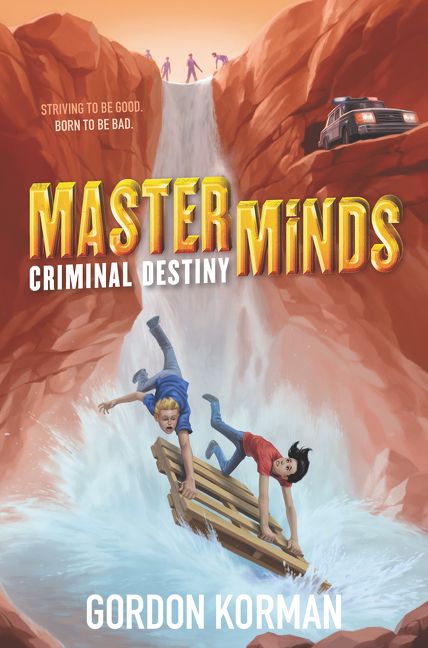
Masterminds: Criminal Destiny

This is the second Masterminds book. If you want to know what I think about it, read my review of the original, because all of the same things apply. I'm not going to write a new review for this one, because there is a chance some of you will not have read the original Masterminds, and you should read it with no spoilers. That said, this book is amazing, so I'm just gonna gush for a while.

EEEEEEEEEEEEEEEEEEEEEEEEEE
EEEEEEEEEEEEEEEEEEEEEEEEEEEEEEEEEEEEEEEEEEEEEEEEEEEEEEEEEEEEEEEEEEEEEEEEEEEEEEEEEEEEEEEEEEEEEEEEEEEEEEEEEEEEEEEEEEEEEEEEEEEEEEEEEEEEEEEEEEEEEEEEEEEEEEEEEEEEEEEEEEEEEEEEEEEEEEEEEEEEEEEEEEEEEEEEEEEEEEEEEEEEEEEEEEEEEEEEEEEEEEEEEEEEEEEEEEEEEEEEEEEEEEEEEEE

Thank you. For reference, I started this book at like 11:00 AM today, and read until it was over. It's super good. As a great man once said, "if you like books about people doing things, you will probably love this book." Couldn't have said it better myself. I mean, I guess there should be a "then" in the second clause. But the point still stands.

READ IT!

Friday, April 15, 2016

Unknown Quantity

Do you like math? No? Chances are, I've already scared you off. For those of you who are still here, I've got a treat for you: John Derbyshire's Unknown Quantity. It's a history book, but about algebra.

Well, there go the rest of you. Now nobody is reading this. Ah, well. I thought it was a good book. It's funny, and informative, and did a swell job of keeping me interested throughout the entire thing. There's not that much else to say about it, because it's literally what it says on the cover. It's a history of algebra.

Well, I suppose it would be a good idea to explain what Derbyshire means by "algebra." Algebra isn't just using symbols like X and Y to stand for variables. At it's heart, algebra is using abstraction to make things easier. As you can imagine, this broad definition encompasses a lot. That's what makes it cool, because you can see the logical progression of ideas over hundreds of years into what algebra is today.

I'd say this is more on the math side than the history side, although it's got a lot of both. You spend quite some time learning about the characters behind the equations and ideas, which I like. Basically, if you are interested in the history of math, or in learning how the dingus people ever came up with this crazy math stuff, then this book is for you.

Saturday, February 20, 2016

Soon I Will Be Invincible

While reading Soon I Will Be Invincible, by Austin Grossman, I get the feeling that I would enjoy it more if I was into that whole comic book superhero type culture. It feels like the book may be full of tropey-type jokes that I just don't get. This means I don't entirely trust my own opinion, here.

Of course, that's not about to stop me. Soon I Will Be Invincible has a great title and two protagonists. Well, two main characters. The first is Doctor Impossible, the Smartest Man Alive, who aims to bust out of prison and take over the world. The second is Fatale (pronounced fuh-toll) the cyborg with a dark past that isn't really there.

Fatale has just been admitted into the Champions, a league of superheroes investigating the disappearance of Superman Legacy The Tick Core-Fire, a charismatic invulnerable flying tank with more abilities than anyone could ever need. Meanwhile, Doctor Impossible has escaped, and is already scheming to take over the world.

I don't really have much to say about this. It has almost nothing in the way of character growth, for anyone other than Fatale. It is riddled with either poorly-executed foreshadowing or terribly-executed exposition. Honestly, those are the only two problems for me, but they seem like big ones. I really think it might just be because I'm not used to books like this.

Blugh. I don't like writing reviews that aren't positive (I've only got one truly negative review). It leaves a bad taste in my mouth. You know what? Don't listen to me. Give Soon I Will Be Invincible a try. It was fun. I read it in a few days, so that's good for something (like, it grabbed my attention or whatever). And, in the end, it does have a pretty sweet title.

Wednesday, December 30, 2015

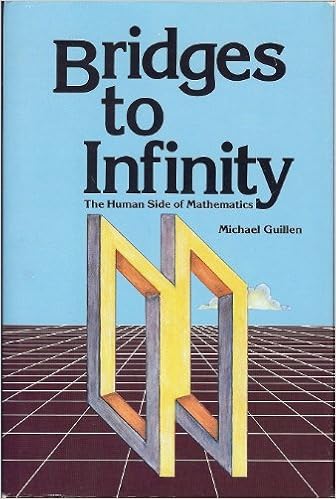
Bridges to Infinity

If I ever meet Michael Guillen, I will punch him in the face. Usually, I don't write negative reviews, but I'm making an exception. We need to get the word out to people. This book is terrible.

The worst part about Bridges to Infinity is that it looks nice. It has a pretty cover, and a nice narrator, and it doesn't jump into any technobabble. This is why it is dangerous. Do NOT, under any circumstances, treat this like a real book.

The most prevalent problem I have with the book is that, sometimes, it's just wrong. It states things that aren't true. It gets its infinities mixed up, and it doesn't even know what group theory is. Do not read it to learn, because you have no way of telling what is true and what is not.

Another problem is that it manages to be condescending and confusing at the same time, which you couldn't do if you tried. As an example, here's an actual sentence from the book: "If we think of equations as being to algebra what sentences are to English, then the roots of an equation correspond to adjectives and a fifth-degree algebraic equation is like a sentence with five adjectives." What? Anyone who knows what adjectives are (words that describe nouns) and what roots are (values where an output is zero) can see that this is nonsense. He never bothers to explain it better. However, using this kind of language is good at placating people who don't want to look further and think better, people who are content just going "ooh, that sounds cool," instead of actually learning.

Also, and this is just a personal gripe, it's a bit too spiritual and pseudoscience-y for me. There's a lot about the sixth sense that is used to feel mathematics, and also some about souls and our place in the universe. However, it's not too prevalent a theme, so it's pretty easy to ignore.

In conclusion, never buy this book. Never read this book. Tell your friends never to buy or read this book. If a friend is reading it, slap it out of their hands. Bridges to Infinity is a scourge upon mathematics.

Tuesday, December 29, 2015

Ruler & Compass

So, here's the deal. I am staying at my grandparent's house right now. And my grandpa is a math teacher at some college. This means he has a lot of math books. Now, I like math. I might be a mathematician when I grow up. So I'm going to review a few books that I read here, and they're all about math. Starting with the infinity one, there's just like three. After that, I'll just take a book home, and then after that no more math books.

I'm making this announcement on Andy Sutton's Ruler and Compass because there's not much to it. If you know about euclidean constructions, well then there you go. The book's about that. If not, then let me explain.

Euclid was a dude who did math back in ancient Greece, and he used logic to prove things in geometry, which was essentially the only mathematics in Greece at the time. Euclid's proofs showed things people could create with just a straight-edge and compass. This book is filled with those things, which are called constructions, so that you can try them for yourself.

Essentially, it's a coloring book for nerds. I've tried a few myself, and it's very satisfying when you get the final result. If you think you'd like this book, then get it.

Friday, December 25, 2015

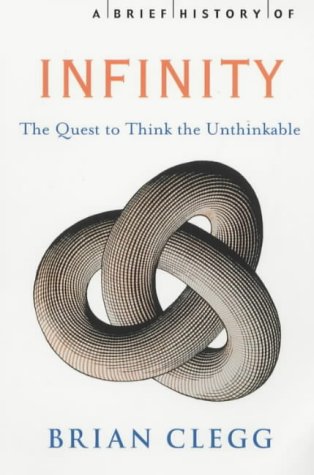
A Brief History of Infinity

I was very confused when I started reading Brian Clegg's A Brief History of Infinity. What I had expected was something like the other mathy books I've reviewed, so I was surprised when it spent a lot of time not talking about infinity. It went on irrelevant tangents, talking about science and people and plagues and things. It wasn't even entirely in chronological order.

I later realized that the reason it was so bad at being a math book was that it was a history book. This book is not about teaching you what infinities are, it's about how the ideas of infinity and the infinitesimal evolved over time, and about what people thought of those ideas. Of course, when it talks about the history of infinity, it also talks about the ideas people had about infinity, because "infinity" has meant different things to different people at different times, and now there are even different kinds of infinity. I guess, given that the subject is so complex, A Brief History of Infinity does a great job of getting it across to you.

If you like the idea of infinity, and you also like reading about people's struggles, then you should read this book. Also, if you want to understand all of the infinities in this link (except maybe surreals), then this book is a really good starting point. Also, it's not that long, so you can read the whole thing over like a weekend. Okay, that's all.

Thursday, December 24, 2015

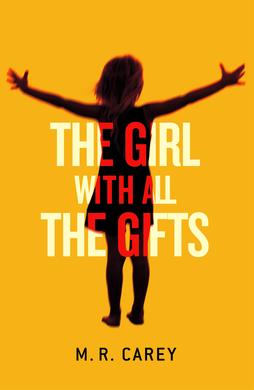
The Girl With All The Gifts

The Girl With All The Gifts is a book about the end of the world. In it, a girl named Melanie is kept in a bunker, underground, sealed off from everyone else. Everyone always treats her as if she's extremely dangerous, along with the someteen other kids who share the bunker wit her. I'm not entirely sure how much I should spoil, because there is a nice little mystery through the first part of the book. One thing I will say is: it's totally zombies.

But then, after the mystery is all worked out, the compound is attacked. Melanie escapes, along with a ragtag group of individuals (I don't want to spoil who), and they all have to make it back to Beacon City, the last human stronghold in all of Great Britain. Along the way, they will have to survive bandits, come to uneasy agreements with each other, and not be eaten by zombies.

The zombies, by the way, are definitely a strong point in The Girl With All The Gifts. They are a variation of the cordyceps fungus (think The Last of Us) which essentially just means, "hey, this is technically possible, and therefore better than those other zombies!"* The zombies (which are called "hungries" by the cast) are thin and pale, and they spend most of their time stock-still. However, as soon as they hear a noise, they snap to attention and run towards it. If a hungry smells a human, it also immediately enters its rage state and runs towards it. This is actually a really clever idea, and it leads to the haunting image of a garden of pale figures, staying perfectly still.

There are, however, complications. There are other rules to the zombies which are revealed along the way, and they... well, honestly, they make absolutely no sense. Some of them, at least. This is the problem I have with the book: plot holes. So many plot holes. None of them are game-breaking, but they are certainly there. For someone as plot-driven as I am, this is a serious problem. I like picking apart exactly why and how things happen; it's one of the reasons I love time-travel stories so much. However, there are just too many things to pick at, here.

That's why, originally, I didn't want to write this. I don't like writing negative reviews. If I read a book and don't like it, I usually will just skip over it. However, this book has all of the things I like. An interesting premise. A hostile environment. Half-believable pseudoscience. Excellent characters. Objectively, this is a good book. But I didn't like it.

So, here's my conclusion: If you like zombies, or children, or adventure, or suspense, or mystery, or heartbreak, and you do not care at all about plot holes (or are not good at spotting them), then you should read this book.


*Really, though, there aren't any realistic zombies, just zombies that are slightly less impossible. The cordyceps fungus affects insects and arthropods, things with skeletons. They breathe through their skin. Humans don't. Also, the cordyceps fungus does not make an organism rant to attack or eat its own kind. That would be wildly inefficient. Instead, the fungus just makes it infiltrate its hive area and try to get into a good vantage point to spread its spores. I don't know of anything that deliberately makes an animal attack another animal. Even rabies just makes the animals angry, aggressive, and confused; as opposed to bloodthirsty. I think 28 Days Later's "rage virus" is the most semi-realistic zombie I've seen. Although the Brooks Zombies will always be the best ones.

tl;dr: Ain't no realistic zombies. Using an actual organism only helps with appearances. If you want a good, realistic interpretation of human cordyceps, take a few minutes to read Up, by Josef K. It's real short.

Wednesday, December 23, 2015

Single Digits

Numbers are cool. Many people, including probably you, are not entirely aware of this. If you never liked math, or you want to know a bit more about math, or you love math and want to celebrate it in a simple way, there is one book you have to get: Things to Make and Do in the Fourth Dimension.

However, if you've already read that, Marc Chamberland's Single Digits might be a good follow-up. It covers all of the digits from one to nine, in numerical order. Although you won't gain any miraculous understanding of the workings of existence, a lot of it is very interesting. Also, I was pleasantly surprised that all of the numbers really did have personalities. It's... rather strange, actually.

All in all, this is a quaint book about numbers. It's nice to pick up and read for a few minutes. If you have already read Things to Make and Do in the Fourth Dimension, and you want more of the same but in bite-sized chucks (and much less brilliant), then give this a shot.

Monday, October 26, 2015

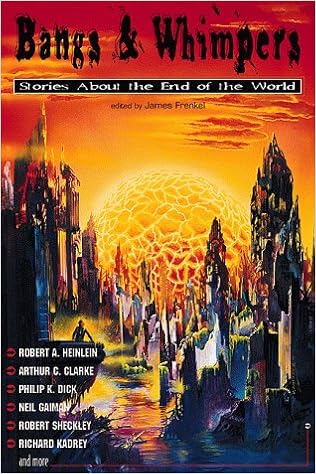
Bangs & Whimpers

Bangs and Whimpers, edited by James Frenkel (I'm not sure how much credit he should get), is exactly what it says in the cover: stories about the end of the world. There are nineteen stories in all, each by a different science fiction author.

There are a surprising amount of different themes in the book, although the sun explodes one time too many, in my opinion. Some of the stories are sad, some dark, some hopeful, and a few actually funny. The only thing they have in common is that, by the end of the story, something very bad has happened. Well, most times. See? So many kinds of stories!

Because they're so different, it's hard to say anything aside from "they're good." I mean, umm... They're short stories, so the longest take at most an afternoon. Most of 'em are science fiction. I love them all, except "Finis," and maybe the lemming one. The cover uses mainly warm colors.

Look, this is too hard. Just... if you have ever enjoyed anything post-apocalyptic, or any story in which everything goes wrong, or sci-fi stories with interesting twists and mechanics, or bleak stories about human weakness, or hopeful stories about human ingenuity, then you will definitely love at least one of the stories in Bangs and Whimpers.

Monday, September 21, 2015

Raptor Red

Robert T. Bakker's Raptor Red is, as far as I know, the first book of its kind, by a long shot. It is not a book about people who bring dinosaurs to life. It is not a book about people with a time machine that travel to the time of the dinosaurs. It's not a book about a hidden land of dinosaurs, protected from time. It's not about cartoonish dinosaurs that generally act like humans. It's not even an informational book about dinosaurs. Nope. Raptor Red is just about dinosaurs.

Red is a Utahraptor lady, and lives during the early Cretaceous period. A land bridge has opened up from Asia to North America, and Red is one of the first Utahraptors to enter this strange land. Red's mate, Doomed-for-death,* dies in the first chapter, leaving Red to fend for herself. For weeks, Red is barely able to scrape by.

Luckily for Red, just when she is on the brink of death, she finds her sister, Run. While they have been separated, Run has managed to get three little raptor chicks: Chuck, Duck, and Hide. Red and Run now have to brave this new land, while protecting the three chicks and facing many perilous perils.

I really like the story, and the characters were all, surprisingly, very memorable. Bakker does a cool thing (like in The Once and Future King) where the animals' speech, mannerisms, and societies are all completely different for different species. You get to see into the minds of crocodiles, turtles, pterosaurs, little mammals, Gastonians, the whole lot of 'em. My only problem is that I think Bakker brings science in a little too much. Every chapter or so, he takes a few paragraphs to describe things scientifically, and it's not really needed.

Raptor Red is still a good book, though. If you like dinosaurs, you basically have to read it, because it's the first true dinosaur book. Actually, if you just like animals in general, you should read it as well, because not even many animal books can pull this off. If you don't like science that much, you can just skim the sciency bits, and it won't take away from the experience at all. This is definitely a book you should read, even just for its premise.

*None of the characters in the book are named except for Red, which makes sense, because she is the point-of-view character, and Utahraptors haven't invented language yet. As such, all the other names I use are ones that I've made up. You are welcome to use them if you want. Also, the guy's name is Sky.

Friday, September 11, 2015

Good Omens

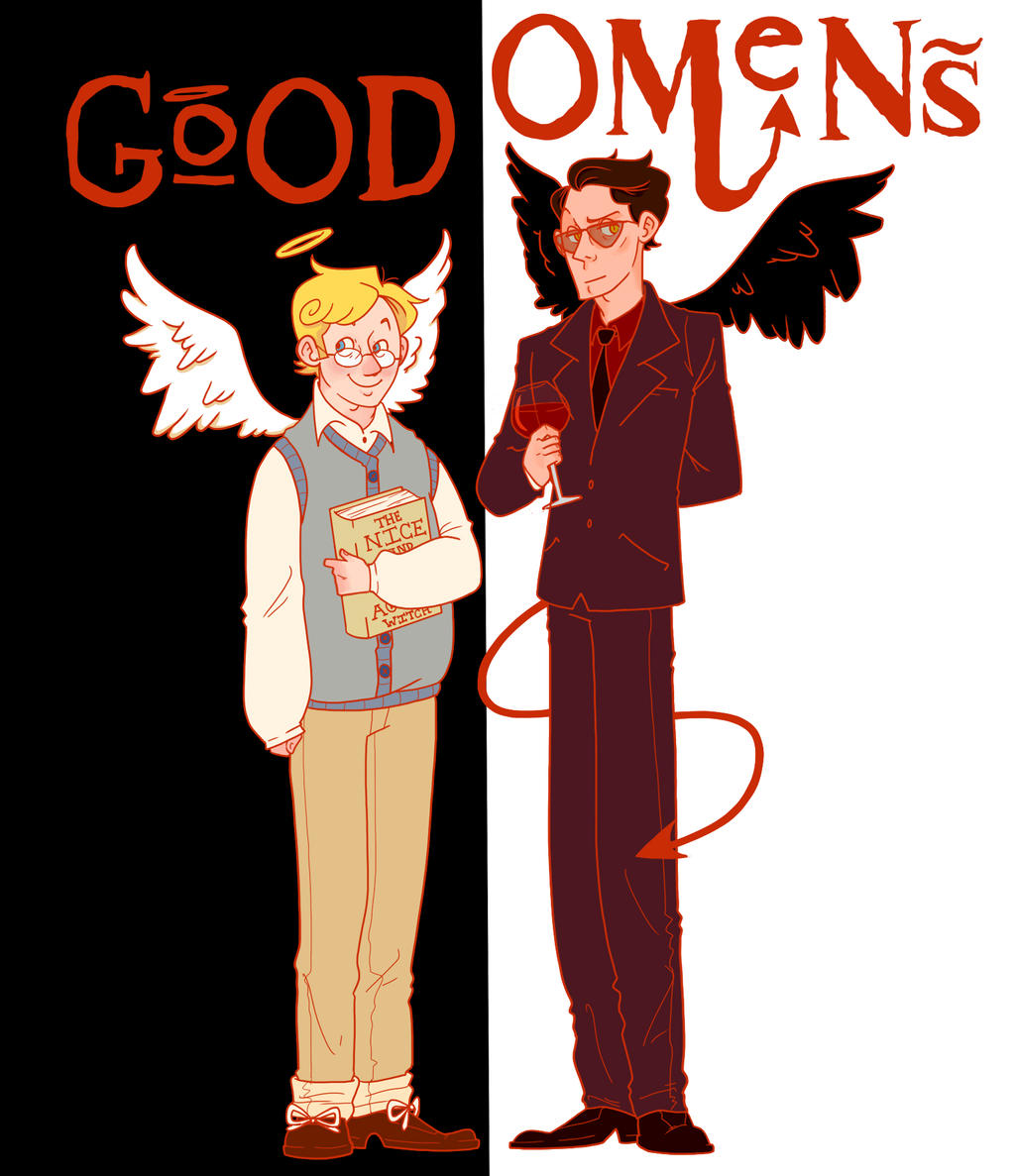
Good Omens, written by both Terry Pratchett and Neil Gaiman, has like a million covers. It has way too many covers. I couldn't find a good photo of the one I read it inside (mostly white with a demon on the front), so I just picked the coolest-looking fan cover. Can't be bothered to sort through all those canonical covers. Just google it.

Anyways, Good Omens is supposed to have the subtitle: The Nice and Accurate Prophecies of Agnes Nutter, Witch. That is the title of a book of prophecies, all of which have come true so far. It also Prophecies the end of the world. Next Saturday.*

Generally, people think this is just hunky-dory. Does anyone say that anymore? Whatever. Two celestial individuals, Crowley the demon and Aziraphale the angel, have taken a liking to the world, and decide that they will try their best to stop it. To do this, they agree to both tutor the Antichrist equally, so that he cannot take a side and the world does not end. This works perfectly, and disaster is averted.

Not really. Things don't exactly go as planned, and now the duo has to find the Antichrist, who has grown up to be Adam, a simple boy from a small town. In that town there lives Anathema Device, a descendant of Agnes Nutter. She is being tracked down by Newton Pulsifer, who works under... you know, there's quite a few characters, actually. The four horsemen show up, too. It's great fun. In fact, I think my only complaint is that Pratchett and Gaiman didn't do more with the characters, towards the end. Then again, that's just about the best complaint to have about a book. I'd give it a read if I were you.

*Off the record, I wouldn't worry too much, because it's implied to have happened in 2004.

Thursday, September 03, 2015

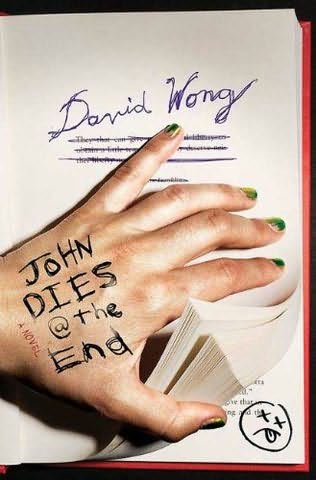
John Dies at the End

John Dies at the End is a book in which, in the final act, a man named John is killed. Seriously, just look at that title, and imagine an entire book written in that tone. That's reasonably close to the truth.

As for the plot, John Dies at the End is about David Wong and his best friend, John. They live in the smallish town of [Undisclosed], and spend their time being obnoxious and sometimes drunk. One day, John takes a drug called Soy Sauce, which makes everything terrible forever, because it exposes him to a dark alternate universe of doom. Dave gets infected as well, and they go on an epic journey to save the world.

There are, like, millions of quotes where people talk about how this book successfully uses humor and horror at the same time. And, yeah, they're pretty much right. I laughed out loud at many parts of the book, and at other parts I was deeply horrified. Very deeply. As such, I think the easiest way to see if you will like it is this:

If any of the following subjects are complete deal-breakers for you, and you would never read a book with them, do not read this book:
Spiders
Cockroaches
Penises
Cursing
Gore
Eyes
Alternate universes
Death
Severed limbs
Fun
Painful transformation
Untied plot threads
Murder
If none of these things immediately make you want to flee from this review, you will probably like the book. If you aren't even bothered by any of these things, you may have found your new favorite book. I, personally, thoroughly enjoyed it, despite feeling very uncomfortable at parts. I'll leave it at that.