So far I haven't reviewed many horror books, and by "many" I of course mean "any at all." I do read and enjoy horror stories, but I mostly go for short horror stories rather than book-length narratives, and even the narratives that I do enjoy tend to effectively be collections of loosly-related stories. See, with longer horror stories, I'm never able to stay within the same frame of mind throughout the entire thing. Eventually I fall out of the story and start nitpicking events, trying to find simple ways for the characters to survive. This quickly unravels the horror, and the book turns into a sub-par action novel.
This did not happen in Jeff VanderMeer's novel, Annihilation. For the entire book, I found myself drawn into the surreal pale-blue world of Area X. (I'm not actually sure what the "pale-blue" in that sentence is exactly referring to, but it seems appropriate somehow.) The oppressive atmosphere of apprehension and tension and offness pervades every single page, and it's as terrifying as it is wonderful.
Annihilation centers around the experience of the narrator, a biologist who remains unnamed. (That's one way VanderMeer keeps his unique atmosphere going: none of the characters are named, and I could probably count the proper nouns in the book with one hand; it makes everything very off-putting.) The biologist is joined by an anthropologist, a psychologist, and a surveyor, and together they explore a mysterious location known only as Area X. You now know about as much as the biologist knows going in. Except, of course, for the fact that the previous 11 expeditions all ended in catastrophic and generally unexplainable failure.
So with that cheery setup, the book opens, with the biologist determined to figure out what this whole thing is about. The four members quickly discover a mysterious "tower" that goes downwards into the ground. This is approximately the point at which everything starts to go terribly, terribly within acceptable parameters and nothing is wrong. Everything then continues to be fine, and eventually the book ends.
Sorry. I had to. So yeah, it doesn't turn out to be a walk in the park for our nameless friends. As they explore Area X, we learn more and more about the biologist's background and the real reason she agreed to go on what was almost certainly a one-way trip. It's not the best characterization I've ever seen, but it helps frame the events of the expedition while somehow maintaining the same ever-present tone.
I realize that Annihilation could be described as Lovecraftian, and I'm sure the comparison has been made before, as the novel certainly has its fair share of cosmic horror. Although it would be accurate, I don't think it quite does Annihilation justice. I've read a lot of Lovecraft's work, and I have to say I think VanderMeer is better at Lovecraft than Lovecraft was. For this and other reasons, I'd propose going the other way: using the term VanderMeerian instead to describe dark, foreboding stories of surreal horror and existential dread.
So there you have it: Annihilation is a book that managed to revive my confidence in long-form horror, and is easily the best horror novel I've read. Needless to say, if you hate horror books, you should probably not read Annihilation. There's not much in the way of character studies or action sequences, either. If, however you are a fan of horror stories great or small, and you would like to explore a new, stranger type of horror, then you should give Annihilation a read.
Showing posts with label short. Show all posts
Thursday, October 18, 2018
Annihilation
Labels:
cryptids/monsters,
dying forever,
horror,
mystery,
nature,
scary,
series,
short,
suspense,
vandermeerian
Saturday, June 24, 2017
The Golden Section
The Golden Section, by Scott Olsen, is not worth your time. It's a book about Phi, the Golden Ratio, (1+√5)/2, 1.618033989ish, the "deepest mystery on earth." It explains none of the many properties of Phi that it presents, in the hopes of selling you on the mystery. Very little of what Olsen says is technically wrong, but it still leaves my with a kind of snake-oil salesman feeling. Of course, it does have pretty pictures, and it's over quick, so that's something. It also has a nice iridescent title.
If you want a small book full of pretty pictures and snake oil, along with some references to actual mathematics, then The Golden Section will do nicely. If you don't want that, then try anything else.
P.S. Man, if only someone would make like a cool series of videos explaining the properties of Phi so that it would seem less mysterious and people wouldn't fall for the snake oil. That would be neat.
If you want a small book full of pretty pictures and snake oil, along with some references to actual mathematics, then The Golden Section will do nicely. If you don't want that, then try anything else.
P.S. Man, if only someone would make like a cool series of videos explaining the properties of Phi so that it would seem less mysterious and people wouldn't fall for the snake oil. That would be neat.
Sunday, February 19, 2017
Flatland
Flatland, by Edwin A. Abbott, is a memoir written by one A. Square, who inhabits the two-dimensional universe known to us as Flatland. The first half of the book is about Flatland itself, and the lives of the people inside it, who live in a strictly ordered society where social class is determined by the number of sides you have. Women, all of which are lines, have the lowest status (even though they are technically really thin quadrilaterals). There's also this freaky thing where kids are beaten into being more regular, and color is not allowed, and it's kind of terrible.
The second half of the book is about A. Square's experience of being visited by a Sphere from Spaceland, which has a third spatial dimension. As A tries to wrap his head around the fact that there can be a third dimension, the reader gets to try to thing about what a fourth dimension could mean. The Sphere also takes A through the first and "zeroth" dimensions, which is fun. Then the Sphere takes A back home, at which point A is promptly thrown in jail for being a lunatic. If you like dystopias and/or thinking about higher dimensions, then Flatland is a book you might like.
Wednesday, November 16, 2016
Adventures in Mathematical Reasoning
Sherman Stein's Adventures in Mathematical Reasoning (which also goes by the title How the Other Half Thinks) is a book which can teach you how a mathematician thinks. I'm not claim that it will teach you, just that it can teach you, if you remain open-minded. For that reason, I think it might me one of the most directly useful math book's I've read.
Adventures in Mathematical Reasoning includes eight chapters, each of which pose a different question at the beginning. All of the chapters involves strings of letters of some sort, although I didn't actually notice until I was almost done with the book. The chapters cover a wide range of topics, from statistics to combinatorics (which is like mixing things up). All of the topics are interesting examples of mathematical ideas, made relatively simple.
The great strength in the book is its ability to show hoe mathematical reasoning works, when actually creating new mathematical theorems. The tricks which Stein uses in these chapters—abstraction, generalization, simplification, or just plain getting data manually—are tricks which can be used in math much more advanced than this. And just about any branch of math would be more advanced. Stein chose topics which can be understood with nothing more than arithmetic, basic geometry (like, "what is pi?" basic), and an open mind.
If you've ever seen a mathematical theorem or idea and thought, "how could they possibly have thought of that?" then you might want to read this book. As long as you take your time to understand everything, and keep trying to guess where things are headed, you should finish the book with a better understanding of how all the work is done. If this sounds good to you, give Adventures in Mathematical Reasoning a read.
P.S.: He usually goes about a similar strategy as is shown in this Numberphile video, so check that out if you want to see an example.
Adventures in Mathematical Reasoning includes eight chapters, each of which pose a different question at the beginning. All of the chapters involves strings of letters of some sort, although I didn't actually notice until I was almost done with the book. The chapters cover a wide range of topics, from statistics to combinatorics (which is like mixing things up). All of the topics are interesting examples of mathematical ideas, made relatively simple.
The great strength in the book is its ability to show hoe mathematical reasoning works, when actually creating new mathematical theorems. The tricks which Stein uses in these chapters—abstraction, generalization, simplification, or just plain getting data manually—are tricks which can be used in math much more advanced than this. And just about any branch of math would be more advanced. Stein chose topics which can be understood with nothing more than arithmetic, basic geometry (like, "what is pi?" basic), and an open mind.
If you've ever seen a mathematical theorem or idea and thought, "how could they possibly have thought of that?" then you might want to read this book. As long as you take your time to understand everything, and keep trying to guess where things are headed, you should finish the book with a better understanding of how all the work is done. If this sounds good to you, give Adventures in Mathematical Reasoning a read.
P.S.: He usually goes about a similar strategy as is shown in this Numberphile video, so check that out if you want to see an example.
Friday, May 20, 2016
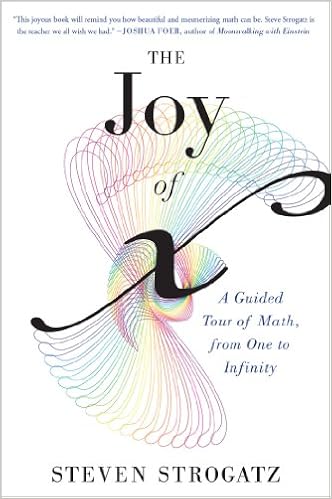
The Joy of X
At this point, I think it's just easier to compare Steven Strogatz's The Joy of X to similar math books I've read. Then again, some people might not have read the other reviews. Okay, here's the deal: if you're looking into The Joy of X, then chances are you will also want to consider two other books: Things to Make and Do in the Fourth Dimension and The Magic of Math.
All three books present themselves to a public with not much math background, but they go about it in different ways. One of the most obvious differences is that The Joy of X (which I'll call Joy from now on) is split into a whole bunch of little chapters of about eight pages. These go through the general topics of arithmetic, algebra, geometry, calculus, statistics, and some other newer ideas in mathematics, in that order.
It is also full of personal anecdotes, which makes the reading more memorable. Things to Make and Do in the Fourth Dimension (which I'll call 4D) had a few anecdotes, and a lot of little activities for you to do yourself, which made it very fun to read. The Magic of Math (Magic) did not have many anecdotes or activities. But, it did have proofs, which 4D lacked and Joy only did a few of.
Of the three books, 4D gives the best impression of an actual tour, guiding the reader through whole areas of mathematics and stopping to marvel at each one. In comparison, Magic seems a bit laid back, with only 12 chapters (4D has 21), but you can really take your time to understand the subjects you're given. As I said before, Joy has short chapters. It is therefore more fast-paced, a whirlwind of "Look at that! Isn't that cool? Now, on to the next thing!"
Personally, I think 4D is the best of the three, with Magic as the second and Joy bringing up the rear. This is not to say that Joy is bad. If you like the style of bite-sized tidbits of math, it will probably be your favorite. You can come to your own conclusion, and pick which book (or books) you want to read.
All three books present themselves to a public with not much math background, but they go about it in different ways. One of the most obvious differences is that The Joy of X (which I'll call Joy from now on) is split into a whole bunch of little chapters of about eight pages. These go through the general topics of arithmetic, algebra, geometry, calculus, statistics, and some other newer ideas in mathematics, in that order.
It is also full of personal anecdotes, which makes the reading more memorable. Things to Make and Do in the Fourth Dimension (which I'll call 4D) had a few anecdotes, and a lot of little activities for you to do yourself, which made it very fun to read. The Magic of Math (Magic) did not have many anecdotes or activities. But, it did have proofs, which 4D lacked and Joy only did a few of.
Of the three books, 4D gives the best impression of an actual tour, guiding the reader through whole areas of mathematics and stopping to marvel at each one. In comparison, Magic seems a bit laid back, with only 12 chapters (4D has 21), but you can really take your time to understand the subjects you're given. As I said before, Joy has short chapters. It is therefore more fast-paced, a whirlwind of "Look at that! Isn't that cool? Now, on to the next thing!"
Personally, I think 4D is the best of the three, with Magic as the second and Joy bringing up the rear. This is not to say that Joy is bad. If you like the style of bite-sized tidbits of math, it will probably be your favorite. You can come to your own conclusion, and pick which book (or books) you want to read.
Monday, October 26, 2015
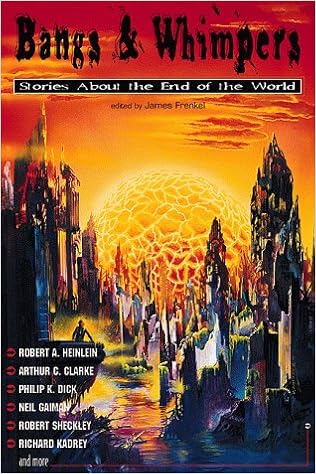
Bangs & Whimpers
Bangs and Whimpers, edited by James Frenkel (I'm not sure how much credit he should get), is exactly what it says in the cover: stories about the end of the world. There are nineteen stories in all, each by a different science fiction author.
There are a surprising amount of different themes in the book, although the sun explodes one time too many, in my opinion. Some of the stories are sad, some dark, some hopeful, and a few actually funny. The only thing they have in common is that, by the end of the story, something very bad has happened. Well, most times. See? So many kinds of stories!
Because they're so different, it's hard to say anything aside from "they're good." I mean, umm... They're short stories, so the longest take at most an afternoon. Most of 'em are science fiction. I love them all, except "Finis," and maybe the lemming one. The cover uses mainly warm colors.
Look, this is too hard. Just... if you have ever enjoyed anything post-apocalyptic, or any story in which everything goes wrong, or sci-fi stories with interesting twists and mechanics, or bleak stories about human weakness, or hopeful stories about human ingenuity, then you will definitely love at least one of the stories in Bangs and Whimpers.
Labels:
bugs,
environment,
fantasy,
future,
humor,
robots,
short,
suspense,
technology,
time travel
Monday, July 14, 2008
Jigsaw Jones Mysteries, by James Preller
Jigsaw Jones is a detective. He solves mysteries. The Jigsaw Jones series (buy volumes, they are cheaper) is all about Jigsaw Jones' many mysteries. I especially like cracking the codes in the stories. Try cracking this one:Blue the breeze can yellow kids stormy you chicken duck red snowy crack boy hats hurricane this dog blanket sunny code.
It looks like gibberish, doesn't it? Let me tell you what is the trick of the code: Look at all the words. Do you notice something? Are there a lot of words of the same kind? The message is in the words after those similar words.
I also like these books because they actually use real books. For example, they are reading Stone Fox at reading hour at school; and Jigsaw is reading Bunnicula at night with his dad. Both real books. I've read both of them; I like both of them.
The stories are short enough that you can read them in a car ride.
If you like mysteries, cracking codes, and good ideas for books to read (except for the creep show books, because they are the only books that aren't real) read this series.
Subscribe to:
Comments (Atom)