Showing posts with label SCIENCE. Show all posts

Tuesday, March 19, 2019

Love & Math

Proper image pending
Love Ampersand Math is an autobiography of sorts. It describes the story of Edward Frenkel, and how he was able to escape the oppression and anti-semitism of mid-1900s Russia (he was Jewish by law) to find a new life overseas. The book describes the discrimination and opposition that he faced, and all of the hurdles that he had to jump to become a mathematician.

And that right there is the catch, huh? Had Frenkel been shooting for a job in engineering or a career in sports or a publisher to take his writing, that story would be enough. A story of overcoming oppression to achieve a dream, a dream that is worth fighting for. But math is different. In the eyes of most people, math is something to be avoided, rather than something to work towards with all of your heart. So, while about half of the book is about Edwards’s story, the other half is a sort of manifesto in defense of and support for mathematics, a sharp rebuke of the idea that other careers and goals are more worthy of love than math is.

Frenkel makes his case by describing one specific project in math and physics, which is called the Langlands Program. I’ll leave the actual description of the Langlands Program for Frenkel, but on its broadest terms the program is an attempt to bring together multiple fields of math which seem completely unrelated to each other. The book goes through the history of the program, and the advancements that were made during (and sometimes because of) Frenkel's journey. This explanation of the program is mixed in with the narrative of Frenkel becoming a mathematician, so that the story and the math can take turns pulling the reader along.

Although Love & Math is on the whole a good read, I will say that it sometimes falls on both sides of the fine line between condescending and confusing. In particular, some of the mathy parts seemed confusing to me towards the end. I must point out, though, that I am particularly susceptible to confusion because I am currently taking a course in Galois Theory so I know exactly of the math to want to know more. The footnotes were very helpful, but still left me wanting for a proper summary or overview of terms. My advice for you is to just not worry about it; an understanding of the actual workings of the math is not necessary to enjoy Love & Math. This is ultimately the story of Edward Frenkel, and it sidesteps the nitty-gritty definitions and such in favor of getting a general sense of the systems involved.

So, yeah. If you're curious as to how and why a boy would scale 20-foot fences and go against the grain for a subject so dry and boring as mathematics, then consider picking up a copy of Love & Math. You might come out of it with a different view of mathematics than before.

Wednesday, February 22, 2017

Zero

Zero is about nothing. By which I mean, it's about the idea of a void, a lack-of-thing, as being a sort of thing itself. It's written by Charles Seife, who also wrote Proofiness. Zero is similar to A Brief History of Infinity, by Brian Clegg, in that it's more of a history book than it is a math or science book. They're also similar because they talk about infinity, because zero is "infinity's twin."

The first six chapters of Zero (or the first seven, depending on how you count them) are about the idea of nothing slowly working its way into the mainstream, followed closely by the idea of the infinite. There was actually a lot of resistance to both of these ideas, especially in the West, which is made even more interesting by Seife's flowery writing. I'm not entirely sure what "flowery writing" actually means, but I'm pretty sure it happens in this book. Zero does technically go into some math, but never in much detail. There's just enough math to make sense of all the pretty pictures.

The last three chapters are about zero in physics, where it likes to cause problems. This second part seems much weaker than the first part; Seife uses quite a bit of hand-waving, and never shows us a single equation. I think that if Seife would show us the actual equations and where the zeros are, we would better understand why zero is to blame for these quirks. That said, I'm sure some people will be glad that the math all but disappears when the physics comes on.

If you wonder how ideas take hold, or like history, or are somewhat confused about zero yourself, then maybe give Zero a try. For what it's worth, I finished it in just three days, so it can't be all that boring. (Although, that probably says more about my schedule than it does about the book.) I think the best way to understand what Zero is like is probably just to read the introduction (which Seife calls "Chapter 0"), so I've just typed it up here. This might be illegal. Don't tell anyone. The point is, he remains that flowery throughout the book, and if you like that section, I think you can enjoy the rest.

Sunday, February 19, 2017

Flatterland

Flatterland is full of puns and science. Really, if it weren't for the name "Ian Stewart" on the front, I'd suspect it had somehow been written by me. Flatterland is a "sequel" of sorts to Edwin A. Abbott's Flatland, which I suppose you should technically read first, although I think Flatterland stands perfectly well on its own. Still, a quick review/summary of Flatland is in order.

Boop. Just did a quick review. Two paragraphs. It doesn't even have a picture of the cover. Go read it, if you'd like.

Anyways, back to Flatterland. As the tagline says, it's like Flatland, only more so. And with a healthy helping of Alice in Wonderland to boot. Flatterland is set about a hundred years after Flatland, and follows the adventures of Victoria "Vikki" Line, a woman who finds her some-number-of-greats-grandfather's book, which is entitled Flatland. (Yes, they are actually the same book.) Anyways, Vikki reads Flatland, and in it finds instructions for summoning a being from Spaceland, in a way that is kind of hilarious.

So, Vikki summons someone from Spaceland. However, she gets a bit more than she bargained for. Instead of the stuffy, boring old Sphere from Flatland, she meets a loud, energetic, grinning creature known as the Space Hopper, who can travel through much more than just stuffy, boring old Spaceland. The Space Hopper equips Vikki with a Virtual Unreality Engine, or VUE, and takes her on a tour of all sorts of spaces and geometries, meeting many strange people along the way. They pay special attention to a strange place called Planiturth, and the fact that its inhabitants don't really know which space they're in.

Personally, I really liked Flatterland. I'm a big fan of puns, and math, and paradoxes, and big toothy grins, and winks directed at the fourth wall, so what's not to like? I think Ian does a good job of describing and explaining all the spaces, and why they're all cool. If I had one complaint, it would be that there aren't enough pictures. Actually, I do have that complaint. A book about geometries should have more pictures in it. But, besides that, it's a fun read, and it stays crazy enough to always keep you guessing. If you like bending your brain a bit, and you don't mind a good pun every once in a while (or a bad pun (or twenty)), then I think you should try Ian Stewart's Flatterland.

Friday, February 10, 2017

Our Mathematical Universe

Our Mathematical Universe is about big questions: Why are we here? What made it all? What's it all made of? Where did we come from? Where will we go? Where did we come from, Cotton Eye Joe? and so forth. More specifically, it is about Max Tegmark's answer to all those questions.

Tegmark takes us on a tour of the extremes of physics, from the epic scales of our entire universe to the smallest scales of atoms and space. The part about cosmology and the beginning of the universe is especially good, because Tegmark has personally worked with the data from satellites investigating the Cosmic Microwave Background Radiation. He also talks about the possibility of multiverses, and identifies four different "levels" of multiverse. I like that he stresses that there is no such thing as a "multiverse theory" in physics; multiverses are not a theory, but a prediction of other theories.

Then he talks about his idea that, in the end, the entire universe is a mathematical object. He makes quite the compelling case for the idea, essentially arguing that for physics to mean anything it has to be true, but in the end he didn't convince me. It's kind of a nice idea, though. A good effort. Anyways, if you'd like to see the structure of the entire book, it's something like this:
Yep. That's taken right out of the book. Tegmark did some of my job for me. Nice of him.

When Tegmark says "my quest for the ultimate nature of reality," he means it. The book is about his quest. Our Mathematical Universe could equally accurately be called Max Tegmark is a Nerd, although I doubt that would sell quite as well. The book is filled with personal anecdotes and little asides, which I think adds to it a lot. Then, of course, there's the whole "reality is math" thing that he believes. Still, he's an interesting person with interesting ideas, so it's fun to go on the "quest" with him. He certainly kept me to the end, at least. If you're also interested in the big questions about what it's all about, and you don't mind having a friend along for the ride, then you would enjoy reading Our Mathematical Universe.

Sunday, August 28, 2016

T. rex and the Crater of Doom

T. rex and the Crater of Doom is a book about science unlike any other I've read. Instead of trying to inform the reader about our current understanding of things, it tells the story about how we got there. In other words, it's not just about science, it's about how science is done. Specifically, it tells the story of how puny humans with short lives were able to figure out that all the dinosaurs were murdered by a massive space rock.

This story is told by Walter Alvarez, one of the geologists who first tried to investigate the strange layer at the K-T boundary, which lies right above where the dinosaurs disappear. Walter noticed that there was something odd about the boundary, and decided he would try to get to the bottom of it. As a result, he finds evidence which might go disprove one of the most basic ideas in geology at the time: the idea that all geologic changes happen gradually.

Although the story is gripping, the real reason I love this book is that it explains how science is actually done, not in the abstract, but with an actual real-world example. Anyone who has ever been doubtful of the claims that geologists or paleontologists make about the past needs to read this book. Anyone who thinks that these areas of science are somehow "lesser" than physics or [insert your favorite field here] needs to read this book. And, of course, anyone wondering how we could have possibly found out about this catastrophic event needs to read this book. T. rex and the Crater of Doom is an experience that everyone should have.

Monday, August 24, 2015

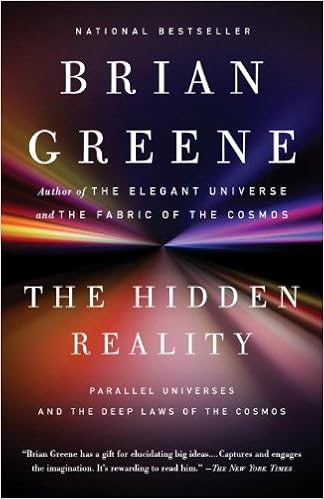
The Hidden Reality

The Hidden Reality, by Brian Greene, is about the physics behind various types of multiverses that are all backed by some sort of science. Does this sound familiar? Well, it should. A book I reviewed earlier, In Search of the Multiverse, has the exact same premise.

Because of that, a lot of what I could say about this book I've already said. If you don't feel like reading the other review, here's a short summary:

"This is a book about what is "sci" and what is "fi" about multiverses. It's got lotsa types and no equations. Certain fancy people agree with the author."

So, what makes The Hidden Reality different from In Search of the Multiverse? Well, In Search of the Multiverse focuses a lot more on visualizations and analogies of the universes described. The Hidden Reality presents things in a slightly more scientific fashion.

Another difference is that The Hidden Reality has grouped it's multiverses into nine categories, all of which are easily found in the contents, that are summarized by Wikipedia. This gives the book a more focused, purposeful narrative (if you can call it that), whereas In Search of the Multiverse feels more like a ramble about the topic (an organized ramble, but a ramble).

You should get whichever book sounds more appealing. Or, if neither sound appealing, why not try Masterminds? It's super good. And, hey, if you want to get both, go ahead. They don't say all of the same things, so they compliment each other well.

P.S.: I, personally, liked The Hidden Reality better. Not only is it delivered in a way that I like more, but it is also written by Brian Green, who wrote and made movies of Fabric of the Cosmos and The Elegant Universe, the first of which I've seen and loved.

P.P.S. I think this is a record for the most links in one post that I've made so far. If not, well now it is.

Thursday, April 23, 2015

In Search of the Multiverse

As some of you may have already guessed, In Search of the Multiverse is about the multiverse (and our search for it). If you've ever wondered how much of the multiverse "science" in sci-fi is real, give it a read.

In Search of the Multiverse outlines the basics of several different kinds of multiverse that actual scientists (or at least the fun ones) think might be possible, without going into the actual workings of equations. Really, he doesn't talk about anything that's not needed to understand whatever multiverse he's explaining.

Some multiverses are pretty silly, in my opinion. Then again, some people think that the idea of a multiverse actually existing at all is silly, so there's really no need to judge.

Without going into details of the specific things he says, that's all I have to say. Actually, there's one more thing: this guy, John Gribbin, has written a heck of a lot of books, and most of them are ones I want to read. Given that, I'm probably not going to read any of them, so that the next seven books on this blog aren't all by John Gribbin. Except maybe Shrödinger's Kittens, because I think I can learn a lot of interesting things from it. But that's all.

So, yeah. If you like the idea of the multiverse, and want to know which bits are not completely ridiculous, give this book a read. Andres is out. Peace!

Sunday, March 01, 2015

Just Six Numbers

This is a book about science. It's about how the universe is the way it is, and why you and I are alive. In my opinion, that's pretty sweet. It does use some big words, but nothing superfluously esoteric (see what I did there?). If this frightens you, you should probably consider coming back when you're older.
Martin Rees' Just Six Numbers is about six numbers in physics and cosmology that don't need to be what they are. In other words, the universe would go on perfectly well with other values for these numbers. These numbers are, in order of appearance:


N: 1,000,000,000,000,000,000,000,000,000,000,000,000: The force of electromagnetism divided by the force of gravity.
ɛ (epsilon): 0.007: The amount of its energy hydrogen loses when converted into helium divided by the amount of energy in hydrogen.
Ω (omega): 0.3: The amount of matter in the universe divided by the amount of matter needed to stop expansion.
λ (lambda): 0.7: The amount of energy in empty space divided by the amount of energy needed to stop expansion.
Q: 0.00001: The energy needed to destroy a supercluster of galaxies divided by the energy of the matter in that supercluster.
D: 3: The number of large (probably infinite) spatial dimensions.

Tada! If that confused you, don't worry, it confused me too. In the book, Martin Rees goes into a lot more detail about the numbers, how we figured them out, and what it would mean if they were different. Really, this is a nerd book for nerds. Unlike Things to Make and Do in the Fourth Dimension, it's written for people who know at least a little science (for example: exponents, powers of ten, and the fact that matter is just condensed energy), instead of anyone who can count and has an open mind.
Still, if you know nothing about cosmology, this is a great book to start out with. I only knew about these things in the context of ordinary physics, and Just Six Numbers basically introduced me to the concept of cosmology.
Anyways, I have school tomorrow, so I'll wrap it up: Science. Numbers. The multiverse. Physics. Life. Thermonuclear explosion. Space. If any of these phrases interested you, you'll probably like this book.
I am out. Peace!