Showing posts with label robots. Show all posts

Sunday, October 21, 2018

All the Birds in the Sky

Patricia Delfine is an ordinary girl living an ordinary childhood in her ordinary home. That is until one day when she decides to help a bird with a broken wing, who tells Patricia she's a witch and leads her to the Parliament of Birds, who give her an Endless Question to prove that she's really a witch. Will she be able to solve the riddle? Will she find a way to deal with her slightly sadistic sister? Will she unlock her true powers and become a protector of nature?

Laurence (with a U, not a W) is a shy kid who spends most of his time at home building things like an almost-functioning supercomputer and a watch that takes him two seconds into the future.  One day, he decides to sneak out of school to see a rocket launch at MIT. Will he use this time-skipping watch to expand on science's understanding of time? Will he succeed in creating a supercomputer? Will anyone ever stop calling him Larry?

The answers to these questions are all "maybe," because all of that happens in the first two chapters and then we immediately skip forwards by several years. Now, Patricia and Laurence both attend Canterbury Academy, a high school in which neither of them quite fit. Fortunately, they find each other, and tentatively start forming a friendship. Before long, the two become fast friends, and have all the sorts of misadventures that you would expect from a feel-good novel about high-school aged kids.

PSYCHE! They're soon separated and don't see each other for ten years, during which they split into their respective separate and irreconcilable worlds! Charlie Jane Anders has fooled you again! So yeah, Laurence is now a fancy science man who does fancy science, and Patricia is now a witch who does witchy things. Like for example assassination? I'm pretty sure Patricia is an assassin now? It's unclear. The point is, fancy science and witchy things can never ever go together, so Patricia and Laurence have an uncrossable rift between them, which they must somehow bridge if they are to ever be friends again.

Fortunately, our two protagonists have all the time they need to get to know each other, because the world is ending. Oh wait no that's bad. Don't worry, there are plans in the works to fix the oncoming apocalypse, which has to do with the climate changing by the way. Patricia's witch squad has proposed the worst plan in the universe, so that's maybe a bad idea. Fortunately, Laurence's science squad has proposed an alternative, which is also a bad plan but is preferable in that it is not the worst plan in the universe. The actual contents of both plans are kinda spoilers so I won't go into them here, but I mean really could they not like try any non-last-resort ideas given that they are not yet at a last-resort stage of the apocalypse?

Okay, I'm being a bit mean here. All the Birds in the Sky is a fun book, even if it does get somewhat pushed around by fridge logic. Laurence's science inventions are all pretty cool, even though they never get to a super useful practical level, much less an Iron Man level (with one spoilerish exception). Patricia's magic spells are rich and varied, and the associated costs keep them from feeling too overpowered. All in all, it's a pretty well-done balance of tech and magic.

If I do have any complaints, and I do, they're mostly about elements of the world, and in particular its portrayal of "the science side." First off, the idea of an uncrossable rift between magic and science bothers me. This is probably because of my obsession familiarity with science. See, science is a process and a lens through which you can see the world, and even if it doesn't entirely work you can at least try to apply science to magic. I guess I've been spoiled by things like Harry Potter and the Methods of Rationality, Artemis Fowl, Girl Genius, Atomic Robo, (but I'm going to invisible this text so that no one knows that I consider these magic-and-science, the first being science at heart and the last two being magic at heart) and The Entire SCP Wiki. In short, the problem I have is that the driving force of conflict (science vs magic) is something that I think is stupid.

Then, there's the trouble of how the science side in itself is portrayed. It's more of an "I have invented this cool thing now" than an "I am curious about how the universe works and how I can make it work for me." To see what I mean, let's take another look at that time-machine watch. First of all, and I admit this is nit-picky, the book acts as if two seconds is a really short amount of time. Like, Laurence skips forward two seconds and nobody notices because it just looks like he's flickering. This is two seconds: . That doesn't look like flickering to me.

But, more than that, there's the whole concept of the watch itself. Why two seconds? Why can't you jump more or less time? How does the watch know what to move forward and what to not affect? How would it affect a liquid? What reference frame is it using for the output point in space? How much mass can it affect? What happens to the space you used to take up in the two seconds are gone? None of these questions are asked by any of the characters, not even the ones that are meant to be "science people". My point is that an actual scientist would do so much with this, but in All the Birds in the Sky it's dismissed as just another "science thing."

It is, however, pretty clear why these avenues are not explored. All the Birds in the Sky isn't a book about the difficulties of reconciling science and magic. It's a book about Patricia Delfine and Laurence WaitDidHeHaveALastName, and their relationship with each other. The science fiction is of the pulpy magic-but-with-"quantum"-on-it variety. Essentially, in All the Birds in the Sky, "science" is a less effective and less reliable form of magic, with the bonus of not having any apparent costs. The split between the two sides is there only to drive the conflict of the book, and it works.

In conclusion, let this be a lesson to you all that thinking too hard about books can be bad for you. After a thousand words of text, my actual position towards All the Birds in the Sky seems murky. To be clear: I did like the book, although many of its elements ticked me off in just the wrong ways. If you want a deep exploration into whether or not science can be reconciled with magic, then this is probably not the book for you (and, honestly, I can't think of a single book which focuses on that question). If, however, you want to read a relationship drama between two awkward misfits, with the added spice of them being from different worlds and at the start of an apocalypse, then All the Birds in the Sky might be the book for you.

Saturday, February 20, 2016

Soon I Will Be Invincible

While reading Soon I Will Be Invincible, by Austin Grossman, I get the feeling that I would enjoy it more if I was into that whole comic book superhero type culture. It feels like the book may be full of tropey-type jokes that I just don't get. This means I don't entirely trust my own opinion, here.

Of course, that's not about to stop me. Soon I Will Be Invincible has a great title and two protagonists. Well, two main characters. The first is Doctor Impossible, the Smartest Man Alive, who aims to bust out of prison and take over the world. The second is Fatale (pronounced fuh-toll) the cyborg with a dark past that isn't really there.

Fatale has just been admitted into the Champions, a league of superheroes investigating the disappearance of Superman Legacy The Tick Core-Fire, a charismatic invulnerable flying tank with more abilities than anyone could ever need. Meanwhile, Doctor Impossible has escaped, and is already scheming to take over the world.

I don't really have much to say about this. It has almost nothing in the way of character growth, for anyone other than Fatale. It is riddled with either poorly-executed foreshadowing or terribly-executed exposition. Honestly, those are the only two problems for me, but they seem like big ones. I really think it might just be because I'm not used to books like this.

Blugh. I don't like writing reviews that aren't positive (I've only got one truly negative review). It leaves a bad taste in my mouth. You know what? Don't listen to me. Give Soon I Will Be Invincible a try. It was fun. I read it in a few days, so that's good for something (like, it grabbed my attention or whatever). And, in the end, it does have a pretty sweet title.

Monday, October 26, 2015

Bangs & Whimpers

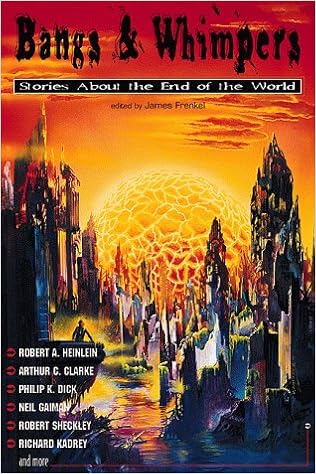
Bangs and Whimpers, edited by James Frenkel (I'm not sure how much credit he should get), is exactly what it says in the cover: stories about the end of the world. There are nineteen stories in all, each by a different science fiction author.

There are a surprising amount of different themes in the book, although the sun explodes one time too many, in my opinion. Some of the stories are sad, some dark, some hopeful, and a few actually funny. The only thing they have in common is that, by the end of the story, something very bad has happened. Well, most times. See? So many kinds of stories!

Because they're so different, it's hard to say anything aside from "they're good." I mean, umm... They're short stories, so the longest take at most an afternoon. Most of 'em are science fiction. I love them all, except "Finis," and maybe the lemming one. The cover uses mainly warm colors.

Look, this is too hard. Just... if you have ever enjoyed anything post-apocalyptic, or any story in which everything goes wrong, or sci-fi stories with interesting twists and mechanics, or bleak stories about human weakness, or hopeful stories about human ingenuity, then you will definitely love at least one of the stories in Bangs and Whimpers.

Wednesday, June 10, 2015

Seveneves

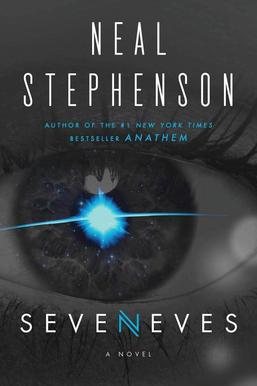
Warning: this is a long story. Seveneves (pronounced "seh-veh-neh-ves") is one of those books that are not only very long but also seem like they have no chapters. The book doesn't have a table of contents, which is understandable, because some chapters are almost three HUNDRED pages long. Still, I've written one up, in case you want it.

Because it's so long, it's almost two separate stories, and the pace basically continues to ramp up throughout the entire story. This eventually lead to a severe loss of sleep. Do not attempt finishing this book if you have important things to do.

Anyways, I've decided to do three different trailer-things, one for each part of the book. I've tried to remove most of the spoilers. Here we go.

Part One: The time is, like now-ish. I think it's an alternate universe or something? Actually, it may be in the future, and technology has remained about the same. I dunno. And then the moon suddenly explodes, all rude and inconsiderate-like. Spoilers: this will lead to life on earth being destroyed. When they realize this, the governments of the world start attempting to create a swarming space station of little space ships, surrounding the International Space Station. Will they succeed? Yes. But it's the journey, not the destination, that matters most.

Part Two: Speaking of journeys, the Cloud Ark has become fully operational and several billion people have died. The 1500 remaining humans now have to endure five thousand years in space. Wait, really? Five thousand? That seems a bit excessive. Anyways, everyone has been shuttled into space, and our heroes are now facing all the hardships usually associated with being in outer space. Marcus has replaced Ivy as the ship's leader, Doc Dubois has stepped out of his media shoes and started helping out, and all is well. But, the inside flap of the book said that "only a handful" of people survive, and that can't be more than 20, so something must be about to go down. And if anyone can reduce the human population from 1500 to 20, it's former president Julia Bliss Flaherty.

Part Three: Five thousand years later. humans have split into seven different races: the smart ones, the strong ones, the heroic ones, the nice ones, the paranoid ones, the super-mutant-power-that-is-actually-a-really-cool-idea ones, and Slytherin. A girl from the super-mutant one, Kath Two, is on a standard survey mission down to Earth's surface when she sees something strange. Before she knows it, she gets wrapped up in a strange mission with an unclear goal and untrustworthy partners. This is where the story really heats up, in a future focused entirely on mechanics, robotics, and genetics, where everything from earlier in the story starts to come into play.

Seveneves is the first book I've read in this whole epic odyssey style. I have to say, I can see what all the hype is about. If you've got some free time, this is definitely a cool science fiction book for you to try out.

Friday, July 11, 2008

Eager, by Helen Fox

At the end of the 21st century, robots are everywhere: there are teacher robots, butler robots, driver robots, and cook robots. Among all these robots, Eager (Model EGR3) is unique. He is the only robot who is not pre-programmed, but rather designed to learn from experience, quite like me or you (if you're a kid). This makes him able to think for himself. For example, pretty much all robots were programmed to not lie, EGR3 has to learn why lying is wrong. Having to learn from experience also means learning from mistakes, like when Eager tried to "clean" a human baby by putting her into the washing machine (NOTE: No babies were harmed in this book). Eager quickly becomes a part of the Bell family, but when the fanciest robots around (the BCD4s) begin to behave a little too much like people, Eager and the two older children of the Bell family are involved in a perilous adventure.

This book is sort of hard to understand at the beginning because the author talks about the world nearly a 100 years from now as if we know exactly what she is talking about. For example, the book starts when Gavin Bell has a conversation with his house. At the beginning of the book you might think, "okay, I'm too young to understand anything this says," but keep on reading and trust me, things will unravel.

Now the typical end for most of my reviews: if you like adventure, mysteries, advanced technology, and thinking about the future, this is the right book for you.