Showing posts with label nature. Show all posts

Sunday, October 21, 2018

All the Birds in the Sky

Patricia Delfine is an ordinary girl living an ordinary childhood in her ordinary home. That is until one day when she decides to help a bird with a broken wing, who tells Patricia she's a witch and leads her to the Parliament of Birds, who give her an Endless Question to prove that she's really a witch. Will she be able to solve the riddle? Will she find a way to deal with her slightly sadistic sister? Will she unlock her true powers and become a protector of nature?

Laurence (with a U, not a W) is a shy kid who spends most of his time at home building things like an almost-functioning supercomputer and a watch that takes him two seconds into the future.  One day, he decides to sneak out of school to see a rocket launch at MIT. Will he use this time-skipping watch to expand on science's understanding of time? Will he succeed in creating a supercomputer? Will anyone ever stop calling him Larry?

The answers to these questions are all "maybe," because all of that happens in the first two chapters and then we immediately skip forwards by several years. Now, Patricia and Laurence both attend Canterbury Academy, a high school in which neither of them quite fit. Fortunately, they find each other, and tentatively start forming a friendship. Before long, the two become fast friends, and have all the sorts of misadventures that you would expect from a feel-good novel about high-school aged kids.

PSYCHE! They're soon separated and don't see each other for ten years, during which they split into their respective separate and irreconcilable worlds! Charlie Jane Anders has fooled you again! So yeah, Laurence is now a fancy science man who does fancy science, and Patricia is now a witch who does witchy things. Like for example assassination? I'm pretty sure Patricia is an assassin now? It's unclear. The point is, fancy science and witchy things can never ever go together, so Patricia and Laurence have an uncrossable rift between them, which they must somehow bridge if they are to ever be friends again.

Fortunately, our two protagonists have all the time they need to get to know each other, because the world is ending. Oh wait no that's bad. Don't worry, there are plans in the works to fix the oncoming apocalypse, which has to do with the climate changing by the way. Patricia's witch squad has proposed the worst plan in the universe, so that's maybe a bad idea. Fortunately, Laurence's science squad has proposed an alternative, which is also a bad plan but is preferable in that it is not the worst plan in the universe. The actual contents of both plans are kinda spoilers so I won't go into them here, but I mean really could they not like try any non-last-resort ideas given that they are not yet at a last-resort stage of the apocalypse?

Okay, I'm being a bit mean here. All the Birds in the Sky is a fun book, even if it does get somewhat pushed around by fridge logic. Laurence's science inventions are all pretty cool, even though they never get to a super useful practical level, much less an Iron Man level (with one spoilerish exception). Patricia's magic spells are rich and varied, and the associated costs keep them from feeling too overpowered. All in all, it's a pretty well-done balance of tech and magic.

If I do have any complaints, and I do, they're mostly about elements of the world, and in particular its portrayal of "the science side." First off, the idea of an uncrossable rift between magic and science bothers me. This is probably because of my obsession familiarity with science. See, science is a process and a lens through which you can see the world, and even if it doesn't entirely work you can at least try to apply science to magic. I guess I've been spoiled by things like Harry Potter and the Methods of Rationality, Artemis Fowl, Girl Genius, Atomic Robo, (but I'm going to invisible this text so that no one knows that I consider these magic-and-science, the first being science at heart and the last two being magic at heart) and The Entire SCP Wiki. In short, the problem I have is that the driving force of conflict (science vs magic) is something that I think is stupid.

Then, there's the trouble of how the science side in itself is portrayed. It's more of an "I have invented this cool thing now" than an "I am curious about how the universe works and how I can make it work for me." To see what I mean, let's take another look at that time-machine watch. First of all, and I admit this is nit-picky, the book acts as if two seconds is a really short amount of time. Like, Laurence skips forward two seconds and nobody notices because it just looks like he's flickering. This is two seconds: . That doesn't look like flickering to me.

But, more than that, there's the whole concept of the watch itself. Why two seconds? Why can't you jump more or less time? How does the watch know what to move forward and what to not affect? How would it affect a liquid? What reference frame is it using for the output point in space? How much mass can it affect? What happens to the space you used to take up in the two seconds are gone? None of these questions are asked by any of the characters, not even the ones that are meant to be "science people". My point is that an actual scientist would do so much with this, but in All the Birds in the Sky it's dismissed as just another "science thing."

It is, however, pretty clear why these avenues are not explored. All the Birds in the Sky isn't a book about the difficulties of reconciling science and magic. It's a book about Patricia Delfine and Laurence WaitDidHeHaveALastName, and their relationship with each other. The science fiction is of the pulpy magic-but-with-"quantum"-on-it variety. Essentially, in All the Birds in the Sky, "science" is a less effective and less reliable form of magic, with the bonus of not having any apparent costs. The split between the two sides is there only to drive the conflict of the book, and it works.

In conclusion, let this be a lesson to you all that thinking too hard about books can be bad for you. After a thousand words of text, my actual position towards All the Birds in the Sky seems murky. To be clear: I did like the book, although many of its elements ticked me off in just the wrong ways. If you want a deep exploration into whether or not science can be reconciled with magic, then this is probably not the book for you (and, honestly, I can't think of a single book which focuses on that question). If, however, you want to read a relationship drama between two awkward misfits, with the added spice of them being from different worlds and at the start of an apocalypse, then All the Birds in the Sky might be the book for you.

Thursday, October 18, 2018

Annihilation

So far I haven't reviewed many horror books, and by "many" I of course mean "any at all." I do read and enjoy horror stories, but I mostly go for short horror stories rather than book-length narratives, and even the narratives that I do enjoy tend to effectively be collections of loosly-related stories. See, with longer horror stories, I'm never able to stay within the same frame of mind throughout the entire thing. Eventually I fall out of the story and start nitpicking events, trying to find simple ways for the characters to survive. This quickly unravels the horror, and the book turns into a sub-par action novel.

This did not happen in Jeff VanderMeer's novel, Annihilation. For the entire book, I found myself drawn into the surreal pale-blue world of Area X. (I'm not actually sure what the "pale-blue" in that sentence is exactly referring to, but it seems appropriate somehow.) The oppressive atmosphere of apprehension and tension and offness pervades every single page, and it's as terrifying as it is wonderful.

Annihilation centers around the experience of the narrator, a biologist who remains unnamed. (That's one way VanderMeer keeps his unique atmosphere going: none of the characters are named, and I could probably count the proper nouns in the book with one hand; it makes everything very off-putting.) The biologist is joined by an anthropologist, a psychologist, and a surveyor, and together they explore a mysterious location known only as Area X. You now know about as much as the biologist knows going in. Except, of course, for the fact that the previous 11 expeditions all ended in catastrophic and generally unexplainable failure.

So with that cheery setup, the book opens, with the biologist determined to figure out what this whole thing is about. The four members quickly discover a mysterious "tower" that goes downwards into the ground. This is approximately the point at which everything starts to go terribly, terribly within acceptable parameters and nothing is wrong. Everything then continues to be fine, and eventually the book ends.

Sorry. I had to. So yeah, it doesn't turn out to be a walk in the park for our nameless friends. As they explore Area X, we learn more and more about the biologist's background and the real reason she agreed to go on what was almost certainly a one-way trip. It's not the best characterization I've ever seen, but it helps frame the events of the expedition while somehow maintaining the same ever-present tone.

I realize that Annihilation could be described as Lovecraftian, and I'm sure the comparison has been made before, as the novel certainly has its fair share of cosmic horror. Although it would be accurate, I don't think it quite does Annihilation justice. I've read a lot of Lovecraft's work, and I have to say I think VanderMeer is better at Lovecraft than Lovecraft was. For this and other reasons, I'd propose going the other way: using the term VanderMeerian instead to describe dark, foreboding stories of surreal horror and existential dread.

So there you have it: Annihilation is a book that managed to revive my confidence in long-form horror, and is easily the best horror novel I've read. Needless to say, if you hate horror books, you should probably not read Annihilation. There's not much in the way of character studies or action sequences, either. If, however you are a fan of horror stories great or small, and you would like to explore a new, stranger type of horror, then you should give Annihilation a read.

Wednesday, July 19, 2017

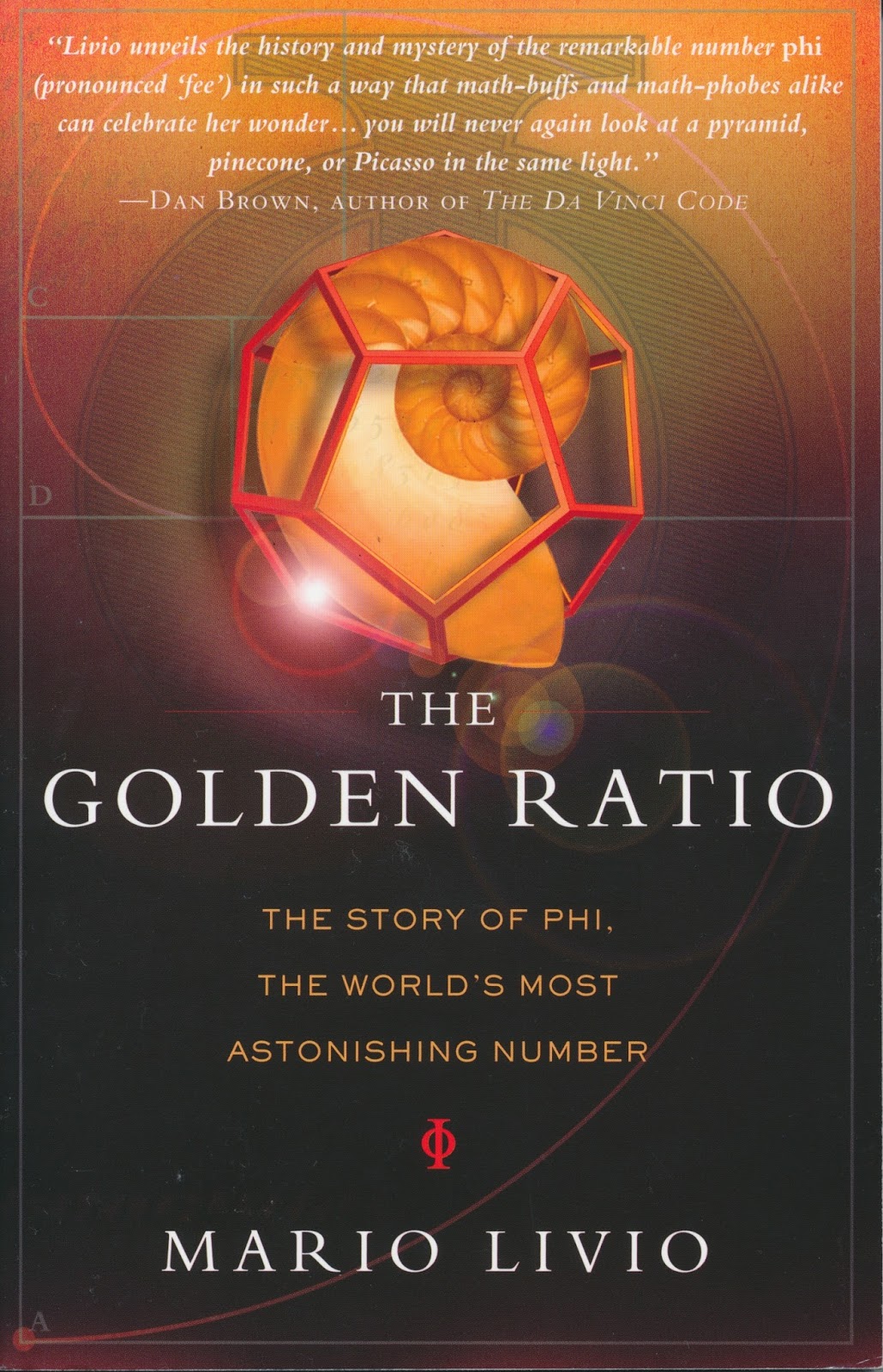
The Golden Ratio

Have you ever heard of the Golden Number? The Divine Proportion? Nature's greatest secret, the deepest mystery on earth, and the world's most astonishing number? No? Well, it might be the second most hyped number after Pi, and it's the subject of such things as this website, this video, and this book. If you believe these sources, then the Golden Number (or Phi) is a mysterious value with strange properties that appears in random places and dictates the rules of all of human civilization and perhaps all of the entire universe as well.

Then, there's The Golden Ratio, a book about Phi which tries to dispel some of the mystique around it. Not all of the mystique, but some of it. It addresses both the mathematical properties of Phi (like its connection with Fibonacci numbers) and the more wiggly properties of Phi (like its use in art as a standard for beauty). I think it does a good job of remaining mostly impartial, denying claims which are probably not true (like that the egyptians built the pyramids using Phi) and verifying claims that are true (such as Phi's prevalence in art after Luca's book The Divine Proportion).

So, if you're looking at all the hype and thinking to yourself wait but no that's not how the universe works, then you might want to give The Golden Ratio a read. And, if you're totally a Phi fanatic, you might want to read it too, just to see what the fuss is about. And, if you've never even heard of this number before, then you can go read something else. I hear Leviathan Wakes is pretty cool.

P.S. One problem is that it doesn't quite explain all of the mathematics in an intuitive way. If only someone were to do that, possibly in some sort of visual episodic format. Alas, that will likely never happen.

Friday, February 10, 2017

Our Mathematical Universe

Our Mathematical Universe is about big questions: Why are we here? What made it all? What's it all made of? Where did we come from? Where will we go? Where did we come from, Cotton Eye Joe? and so forth. More specifically, it is about Max Tegmark's answer to all those questions.

Tegmark takes us on a tour of the extremes of physics, from the epic scales of our entire universe to the smallest scales of atoms and space. The part about cosmology and the beginning of the universe is especially good, because Tegmark has personally worked with the data from satellites investigating the Cosmic Microwave Background Radiation. He also talks about the possibility of multiverses, and identifies four different "levels" of multiverse. I like that he stresses that there is no such thing as a "multiverse theory" in physics; multiverses are not a theory, but a prediction of other theories.

Then he talks about his idea that, in the end, the entire universe is a mathematical object. He makes quite the compelling case for the idea, essentially arguing that for physics to mean anything it has to be true, but in the end he didn't convince me. It's kind of a nice idea, though. A good effort. Anyways, if you'd like to see the structure of the entire book, it's something like this:
Yep. That's taken right out of the book. Tegmark did some of my job for me. Nice of him.

When Tegmark says "my quest for the ultimate nature of reality," he means it. The book is about his quest. Our Mathematical Universe could equally accurately be called Max Tegmark is a Nerd, although I doubt that would sell quite as well. The book is filled with personal anecdotes and little asides, which I think adds to it a lot. Then, of course, there's the whole "reality is math" thing that he believes. Still, he's an interesting person with interesting ideas, so it's fun to go on the "quest" with him. He certainly kept me to the end, at least. If you're also interested in the big questions about what it's all about, and you don't mind having a friend along for the ride, then you would enjoy reading Our Mathematical Universe.

Tuesday, August 23, 2016

Beware The Wild

Natalie C. Parker's Beware the Wild is about a girl named Sterling, who lives in the small town of Sticks, Louisiana. Everything is pretty great in Sticks, so long as you never, under any circumstances, cross the fence and go into the swamp. When the book opens, Sterling is steadily watching the fence for any signs of her only sibling, Phin, who has of course run into the swamp.

Fortunately, her sister, Lenora May, reemerges from the swamp, just in time for her mother to call them in to dinner. There is no problem with this situation and everything is fine. Except for the small detail that Sterling doesn't have a sister. Or, well, she didn't. Everyone in town has excepted Lenora May as if she was always there, and nobody can remember Phin. In fact, Sterling herself distinctly remembers having Lenora May as a sister throughout her whole life.

Now, Sterling has to figure out what's happening, get her brother back, and send Lenora May back where she belongs. Or does she? First, she must play the age-old game of figure-out-who-you-can-trust-or-die. Saying any more about the plot would kinda spoil the fun of the game, so let's just leave it at that.

Beware the Wild is apparently Natalie's first book, and I have to say she's off to a really good start. The way she portrays the insidious replacement of memories is better than any other I've ever seen. I do think that the first half of the book, the aforementioned game of figuring things out, is better than the second half, or the game of ACTION. That's not to say that Beware the Wild ends badly, far from it, it's just that the first parts were so strong that the exciting, high-stakes climax seems just mediocre in comparison.

In conclusion, Beware the Wild is fun and exciting and a good way to spend a weekend. When you pick it up, you will find it difficult to put down. If you like fantasy in a modern setting with a pinch of the surreal, Beware the Wild is the book for you. Well, it's a book for you. You can also read other books. What I'm saying is you'll like it and you should read it.

Monday, September 21, 2015

Raptor Red

Robert T. Bakker's Raptor Red is, as far as I know, the first book of its kind, by a long shot. It is not a book about people who bring dinosaurs to life. It is not a book about people with a time machine that travel to the time of the dinosaurs. It's not a book about a hidden land of dinosaurs, protected from time. It's not about cartoonish dinosaurs that generally act like humans. It's not even an informational book about dinosaurs. Nope. Raptor Red is just about dinosaurs.

Red is a Utahraptor lady, and lives during the early Cretaceous period. A land bridge has opened up from Asia to North America, and Red is one of the first Utahraptors to enter this strange land. Red's mate, Doomed-for-death,* dies in the first chapter, leaving Red to fend for herself. For weeks, Red is barely able to scrape by.

Luckily for Red, just when she is on the brink of death, she finds her sister, Run. While they have been separated, Run has managed to get three little raptor chicks: Chuck, Duck, and Hide. Red and Run now have to brave this new land, while protecting the three chicks and facing many perilous perils.

I really like the story, and the characters were all, surprisingly, very memorable. Bakker does a cool thing (like in The Once and Future King) where the animals' speech, mannerisms, and societies are all completely different for different species. You get to see into the minds of crocodiles, turtles, pterosaurs, little mammals, Gastonians, the whole lot of 'em. My only problem is that I think Bakker brings science in a little too much. Every chapter or so, he takes a few paragraphs to describe things scientifically, and it's not really needed.

Raptor Red is still a good book, though. If you like dinosaurs, you basically have to read it, because it's the first true dinosaur book. Actually, if you just like animals in general, you should read it as well, because not even many animal books can pull this off. If you don't like science that much, you can just skim the sciency bits, and it won't take away from the experience at all. This is definitely a book you should read, even just for its premise.

*None of the characters in the book are named except for Red, which makes sense, because she is the point-of-view character, and Utahraptors haven't invented language yet. As such, all the other names I use are ones that I've made up. You are welcome to use them if you want. Also, the guy's name is Sky.

Sunday, March 08, 2015

Expedition

Expedition: being an account in words and artwork of the 2358 A. D. voyage to Darwin IV. That's the title, because I'm not sure you can read it in the tiny font on the picture.
Anyways, Expedition probably has the coolest alien world I've ever seen. That includes Snaiad, and you know how know how much I love OH WAIT YOU DON'T BECAUSE RAMJET STILL HASN'T MADE A SNAIAD BOOK.
Ahem.
Expedition probably has the coolest alien world I've ever seen. It's called Darwin IV (that's a four) and is a self-consistent planet with an odd ecology and a big ol' map. It's unique among alien worlds in that it doesn't try super hard to make the aliens look weird, they just kinda end up that way.
The story is about the author, Wayne Barlowe, who lives in the dying Earth of the 2300s. Most life on earth is dead, and humans have only survived because of their partnership with the Yma, a friendly alien race.
After receiving a mysterious picture of what appears to be an alien from the faster-than-light satellite on Darwin IV, the Yma and the humans prepare an expedition to the planet. The Yma choose Wayne Barlowe as one of the candidates for the expedition, because of his skill at drawing extinct Earth wildlife.
Barlowe is the artist of the crew. That's nice, because the reader isn't bogged down by the biology and geology of Darwin IV, and can just sit back and read Barlowe's stories about encountering these odd creatures.
The book is in six parts, each with a biome of sorts: Grasslands and Plains, Forest and Periphery, Amoebic Sea and Littoral Zone, Mountains, Tundra, and Air. Each of these sections as a few stories about Barlowe's adventures. Most of these adventures involve large wildlife and strange adaptations, and all are SUPER COOL.
I'm not really sure what else to say. Look, if you like what you heard so far, then read the book. It is super expensive, but I think it's worth it. This book. Is good.

Monday, February 23, 2015

Here Where the Sunbeams are Green

This is a book that I have been reading for, like, three months. It's not hard to get through by any means, but I've always been reading some other book, usually a nonfiction book about science. I finally finished this weekend, and it was great.
Here Where the Sunbeams are Green (or "The Sunbeam Book," to it's friends) is a Sweet Little Book with almost as much Capitalization as the Bible. Okay, not really. But it's up there in the capitalization department.
The story is told by Mad, the girl with the brown hair and the ponytail. She, her mom, and her sister, Roo, are flown to La Lava Resort and Spa to meet their father, who is a bird guy. But Mad thinks that something odd has happened to her father, because the last thing he sent her was a Very Strange and Incredibly Creepy Letter. Will she and Roo ever see their father again? Yes. They see him in, like, Chapter 3.
But there are very strange things happening at La Lava. No one is exactly as they seem. Mad and Roo have to choose wisely who they trust, or they will end up in a whole heap of trouble. And, of course, there's the active volcano. That's not good either.
In closing, The Sunbeam Book is a nice story about some friends trying to figure things out and put things right again. It's been a while since I've read one of those books, and it's good to be back. I like most of the characters, and the ending is pretty great. Overall, I give The Sunbeam Book a reminded-me-of-my-love-for-adventure-books-but-still-kept-things-interesting out of 10. Anyone who likes adventures with a dash of fantasy should definitely read this book.

Monday, July 21, 2008

Hoot, by Carl Hiaasen


Hoot is about a kid named Roy who has just moved to Florida from Montana. In his new school, he is picked on by Dana Matherson, but Roy is the only kid in the history of Trace Middle School who fights back. One day, when Dana is squishing Roy's face against the bus window, Roy sees a strange kid. The kid was running fast with no shoes, as if he was going to the bus stop, except he had no backpack and no books. Roy decides to investigate and soon finds himself, together with the strange boy and his even stranger sister, fighting to save some cute little burrowing owls from the wrath of bulldozers. Their adventure includes killer dogs, pancakes, the police, alligators, cottonmouths, a kind of highly poisonous snake, and two new good friends.

Tuesday, May 08, 2007

The Neverending Story by Michael Ende

Every time I read a book, I want to be in it. That is exactly what happened to Bastian Balthazar Bux. Bastian is a boy that always wanted to be in a book, but when he accidentally goes into a book called The Neverending Story, he finds out he wants the exact opposite. The Neverending Story that Bastian was reading is about when the Childlike Empress, Ruler of Fantastica, is sick and Atreyu, a young Green Skin, is sent on a quest to find a cure. Along the way, Atreyu meets Falkor, a luckdragon. Together, they find out that the only thing that can cure the Childlike Empress is a new name from a human from the outer world. By this time, I think I should explain you this: The book Bastian was reading we already went over, but the book I read is about Bastian reading the book and doing what happened next -- going to Fantastica.

This book is filled with monsters, heroes, extraordinary places and most of all, weird, weird people, or should I say inhabitants of Fantastica. If you like all those four things, plus adventure and excitement and a little bit of sadness, read this book.