Showing posts with label less than positive. Show all posts

Saturday, June 17, 2023

Elder Race

Lynesse Fourth Daughter is brave and true, or as her mother would put it, stupid and gullible. She is the fourth princess in line for the throne, and everyone says as the least likely to make something of herself. But now, finally, she's been given the chance to prove them all wrong. See, there's a demon about, the kind of devastating, potentially world-ending threat that only appears in age-old stories. Lynesse, however, has a plan: if she recruits the famed sorcerer Nyrgoth Elder, he will surely be able to solve the problem.

Nyr Illim Tevitch is tired. Very, very tired. Tired of waiting for contact from Earth, which stopped transmitting signals centuries ago. Tired of shirking and sometimes outright betraying his anthropological duties to survey the planet without interfering with its savage inhabitants. Tired of living with the knowledge that he is quite possibly the last member of his civilization. Mostly, just, tired. But hey, here's a flimsy excuse to wake up from indefinite cryosleep and go for an outing. He's got nothing better to do.

Elder Race tells the tale of these two idiots, together with Lynesse's good friend Esha Free Mark, setting out to find and defeat the demon. Half the chapters are from Lynesse's perspective, and make up a fantasy story; the other half are from Nyr's perspective, and make up a science fiction story. It's an interesting concept, but does it hold up?

Well, it kinda depends on your priorities. If all you want is to see the juxtaposition of two perspectives which view events as science or as magic, then Elder Race absolutely delivers (especially compared to certain other science vs magic books). The technology that Nyr uses is believable as an extension of technology that we have today, and Lynesse's interpretations of these technological marvels makes sense given what she and her culture know of the world. As an exercise in seeing the same thing from two very different pairs of eyes, it succeeds.

My main complaint is with the characters. To be frank, I never really cared about any of them. I couldn't get invested in Lyn's struggle to prove herself as a princess, nor in Nyr's search for meaning in a world that has no place for him in a galaxy that has forgotten him. It's like... have you ever watched a movie and thought, "this would be really great if only it was instead a TV show"? That's the feeling I got reading Elder Race. If only the book was, like, three times its current length, maybe it could have gotten me invested in the characters and story instead of relying entirely on its (admittedly rather clever) worldbuilding.

Also, I could have done with a bit less Anthropology Is Dumb in the book? See, a big part of Nyr's situation is that, as an anthropologist, he's not allowed to speak to the people he studies, nor indeed involve them at all. He's also apparently been taught to be uncomfortably racist against the people he studies. For the first half of the book, I was worried that the author shared his mindset (oh these savages without logic or reason, the only way to be human is to have a telephone, et cetera et cetera), but fortunately toward the end it was made clear that this is a bad thing.

Again I find myself wishing that the book had just a little more time to say its piece. Just another few pages of Nyr discovering that he's a racist little prick. Just another few pages of the characters interacting with each other, making us see them as people worth worrying about. Just another few pages of chatting with people outside our band of heroes, to give the world a real sense of being lived in.

Elder Race does not have the time to do those things, and it doesn't do them. But I mean, the flip side of that is that you can get through the whole book in just one long plane ride, so it's not exactly the biggest waste of time. All things considered, Elder Race had a clever, well-executed concept and nothing more. If that's enough to make you want to read it, then you'll have a good time.

(P.S. For some reason my brain decided that the correct way to pronounce this book's title was El Derrace, as if it were a noun from a romance language. This is irrelevant to the quality of the book, but I thought it was important to note.)

Saturday, June 24, 2017

The Golden Section

The Golden Section, by Scott Olsen, is not worth your time. It's a book about Phi, the Golden Ratio, (1+√5)/2, 1.618033989ish, the "deepest mystery on earth." It explains none of the many properties of Phi that it presents, in the hopes of selling you on the mystery. Very little of what Olsen says is technically wrong, but it still leaves my with a kind of snake-oil salesman feeling. Of course, it does have pretty pictures, and it's over quick, so that's something. It also has a nice iridescent title.

If you want a small book full of pretty pictures and snake oil, along with some references to actual mathematics, then The Golden Section will do nicely. If you don't want that, then try anything else.

P.S. Man, if only someone would make like a cool series of videos explaining the properties of Phi so that it would seem less mysterious and people wouldn't fall for the snake oil. That would be neat.

Thursday, June 01, 2017

The Irrationals

The Irrationals is not good. Don't read it. Okay fellas thanks for your time it's been fun I'll see you in the next review goodbye.

Still here? Huh. Strange. Well, I suppose I could give a bit more information. The Irrationals is written by Julian Havil, and is about the history of irrational numbers (the ones that aren't fractions). If you're not already a huge math person, you will definitely dislike The Irrationals, due to the sheer volume of proofs. Book is like 40% history and 60% proofs. And they've got some serious proofs in there, with elementary calculus and contradictions and the like.

If that was all The Irrationals was, it would be a fine book. A history of the idea of irrationality, including the first proofs that Pi and e are irrational, a proof that Phi is the "most irrational," and other neat goodies, along with some descriptions of what was happening at the time these proofs were discovered. It would be a book meant for math nerds, and as a math nerd I would have enjoyed it. Unfortunately, The Irrationals has another problem that is almost certainly a dealbreaker.

Sometimes, the book is just wrong. It's not that Havil is stating falsehoods, it's that there's sometimes just typos in important places. When reading The Irrationals, you not only have to understand the poorly-explained proofs, you also have to fix mistakes in the proofs so that they make sense. I think anyone who wasn't procrastinating on their review of All The Birds In The Sky would have a hard time getting to the end. I made a list of some of the more serious mistakes I saw, which I'll put in this document, but it'll still be a rough time. Unless you're some kind of math masochist (mathochist?), I recommend staying away from The Irrationals.

Friday, September 16, 2016

Fluke

Fluke is by Joseph Mazur and it's boring. It starts off with an introduction musing about coincidences. Then, it tells ten disjointed stories about coincidences, which can't really have any impact because they are so short and unrelated, so that's boring. Then, he talks about math, and how everything happens eventually, the world is big, yadda yadda yadda. He hints at some cool concepts, and doesn't really go much in depth into them, and it's boring.

Then, he uses this mathematics of probability to give probabilities for the ten stories you read in the beginning. By this time, you've mostly forgotten the stories, but it doesn't matter because he just picks random numbers for the probabilities. And sometimes, he doesn't even do the math right! Like, analyzing the fourth story, he says a probability would be, "1/30 x 1/30 ≈ 0.001, or odds of 998 to 1." Yes, 1/30 x 1/30 = 1/900, which is about 0.001, but that makes the odds 899 to 1. HE FAILS TO FOLLOW THE RULES HE LITERALLY TELLS YOU ABOUT. So, in summary, that section is trash. Then, he has a few essays on probability, risk, and chance which are interesting. That is the only decent part of the book.

In conclusion, read Fluke only if you are very bored.

Tuesday, June 14, 2016

The Rosie Project

The Rosie Project has a million covers, and it was reccommended to me profusely by my mom. It is supposedly a romance between Don, a professor with a rigid schedule and no social skills, and Rosie, a woman on a quest to find the identity of her biological father. It was okay.

I feel like I just didn't "get" the book. The central romance never really resonated with me, and for almost the entire thing I really wanted Don and Rosie to not get together. Apparently there were subtle hints the entire time that they were perfect for each other, but I just didn't notice. Also, my mom says the book was hilarious (as well as the reviewers on the cover, which is not surprising) but I didn't even laugh once. I also didn't cry once. Maybe it ate my feelings.

So, now I'm in the interesting situation that I didn't like the book, but I'm pretty sure that I'm wrong. I suppose, if someone else reccommends this book to you, you should listen to them. I won't stop you from reading it.

Also, it was written by Graeme Simsion. I couldn't figure out how to integrate that into the review.

Saturday, February 20, 2016

Soon I Will Be Invincible

While reading Soon I Will Be Invincible, by Austin Grossman, I get the feeling that I would enjoy it more if I was into that whole comic book superhero type culture. It feels like the book may be full of tropey-type jokes that I just don't get. This means I don't entirely trust my own opinion, here.

Of course, that's not about to stop me. Soon I Will Be Invincible has a great title and two protagonists. Well, two main characters. The first is Doctor Impossible, the Smartest Man Alive, who aims to bust out of prison and take over the world. The second is Fatale (pronounced fuh-toll) the cyborg with a dark past that isn't really there.

Fatale has just been admitted into the Champions, a league of superheroes investigating the disappearance of Superman Legacy The Tick Core-Fire, a charismatic invulnerable flying tank with more abilities than anyone could ever need. Meanwhile, Doctor Impossible has escaped, and is already scheming to take over the world.

I don't really have much to say about this. It has almost nothing in the way of character growth, for anyone other than Fatale. It is riddled with either poorly-executed foreshadowing or terribly-executed exposition. Honestly, those are the only two problems for me, but they seem like big ones. I really think it might just be because I'm not used to books like this.

Blugh. I don't like writing reviews that aren't positive (I've only got one truly negative review). It leaves a bad taste in my mouth. You know what? Don't listen to me. Give Soon I Will Be Invincible a try. It was fun. I read it in a few days, so that's good for something (like, it grabbed my attention or whatever). And, in the end, it does have a pretty sweet title.

Wednesday, December 30, 2015

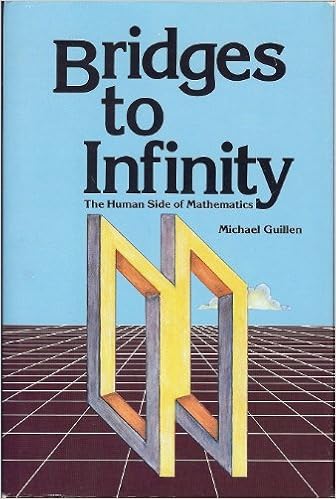
Bridges to Infinity

If I ever meet Michael Guillen, I will punch him in the face. Usually, I don't write negative reviews, but I'm making an exception. We need to get the word out to people. This book is terrible.

The worst part about Bridges to Infinity is that it looks nice. It has a pretty cover, and a nice narrator, and it doesn't jump into any technobabble. This is why it is dangerous. Do NOT, under any circumstances, treat this like a real book.

The most prevalent problem I have with the book is that, sometimes, it's just wrong. It states things that aren't true. It gets its infinities mixed up, and it doesn't even know what group theory is. Do not read it to learn, because you have no way of telling what is true and what is not.

Another problem is that it manages to be condescending and confusing at the same time, which you couldn't do if you tried. As an example, here's an actual sentence from the book: "If we think of equations as being to algebra what sentences are to English, then the roots of an equation correspond to adjectives and a fifth-degree algebraic equation is like a sentence with five adjectives." What? Anyone who knows what adjectives are (words that describe nouns) and what roots are (values where an output is zero) can see that this is nonsense. He never bothers to explain it better. However, using this kind of language is good at placating people who don't want to look further and think better, people who are content just going "ooh, that sounds cool," instead of actually learning.

Also, and this is just a personal gripe, it's a bit too spiritual and pseudoscience-y for me. There's a lot about the sixth sense that is used to feel mathematics, and also some about souls and our place in the universe. However, it's not too prevalent a theme, so it's pretty easy to ignore.

In conclusion, never buy this book. Never read this book. Tell your friends never to buy or read this book. If a friend is reading it, slap it out of their hands. Bridges to Infinity is a scourge upon mathematics.

Thursday, December 24, 2015

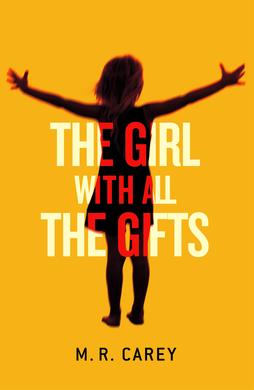
The Girl With All The Gifts

The Girl With All The Gifts is a book about the end of the world. In it, a girl named Melanie is kept in a bunker, underground, sealed off from everyone else. Everyone always treats her as if she's extremely dangerous, along with the someteen other kids who share the bunker wit her. I'm not entirely sure how much I should spoil, because there is a nice little mystery through the first part of the book. One thing I will say is: it's totally zombies.

But then, after the mystery is all worked out, the compound is attacked. Melanie escapes, along with a ragtag group of individuals (I don't want to spoil who), and they all have to make it back to Beacon City, the last human stronghold in all of Great Britain. Along the way, they will have to survive bandits, come to uneasy agreements with each other, and not be eaten by zombies.

The zombies, by the way, are definitely a strong point in The Girl With All The Gifts. They are a variation of the cordyceps fungus (think The Last of Us) which essentially just means, "hey, this is technically possible, and therefore better than those other zombies!"* The zombies (which are called "hungries" by the cast) are thin and pale, and they spend most of their time stock-still. However, as soon as they hear a noise, they snap to attention and run towards it. If a hungry smells a human, it also immediately enters its rage state and runs towards it. This is actually a really clever idea, and it leads to the haunting image of a garden of pale figures, staying perfectly still.

There are, however, complications. There are other rules to the zombies which are revealed along the way, and they... well, honestly, they make absolutely no sense. Some of them, at least. This is the problem I have with the book: plot holes. So many plot holes. None of them are game-breaking, but they are certainly there. For someone as plot-driven as I am, this is a serious problem. I like picking apart exactly why and how things happen; it's one of the reasons I love time-travel stories so much. However, there are just too many things to pick at, here.

That's why, originally, I didn't want to write this. I don't like writing negative reviews. If I read a book and don't like it, I usually will just skip over it. However, this book has all of the things I like. An interesting premise. A hostile environment. Half-believable pseudoscience. Excellent characters. Objectively, this is a good book. But I didn't like it.

So, here's my conclusion: If you like zombies, or children, or adventure, or suspense, or mystery, or heartbreak, and you do not care at all about plot holes (or are not good at spotting them), then you should read this book.


*Really, though, there aren't any realistic zombies, just zombies that are slightly less impossible. The cordyceps fungus affects insects and arthropods, things with skeletons. They breathe through their skin. Humans don't. Also, the cordyceps fungus does not make an organism rant to attack or eat its own kind. That would be wildly inefficient. Instead, the fungus just makes it infiltrate its hive area and try to get into a good vantage point to spread its spores. I don't know of anything that deliberately makes an animal attack another animal. Even rabies just makes the animals angry, aggressive, and confused; as opposed to bloodthirsty. I think 28 Days Later's "rage virus" is the most semi-realistic zombie I've seen. Although the Brooks Zombies will always be the best ones.

tl;dr: Ain't no realistic zombies. Using an actual organism only helps with appearances. If you want a good, realistic interpretation of human cordyceps, take a few minutes to read Up, by Josef K. It's real short.

Friday, September 11, 2015

Good Omens

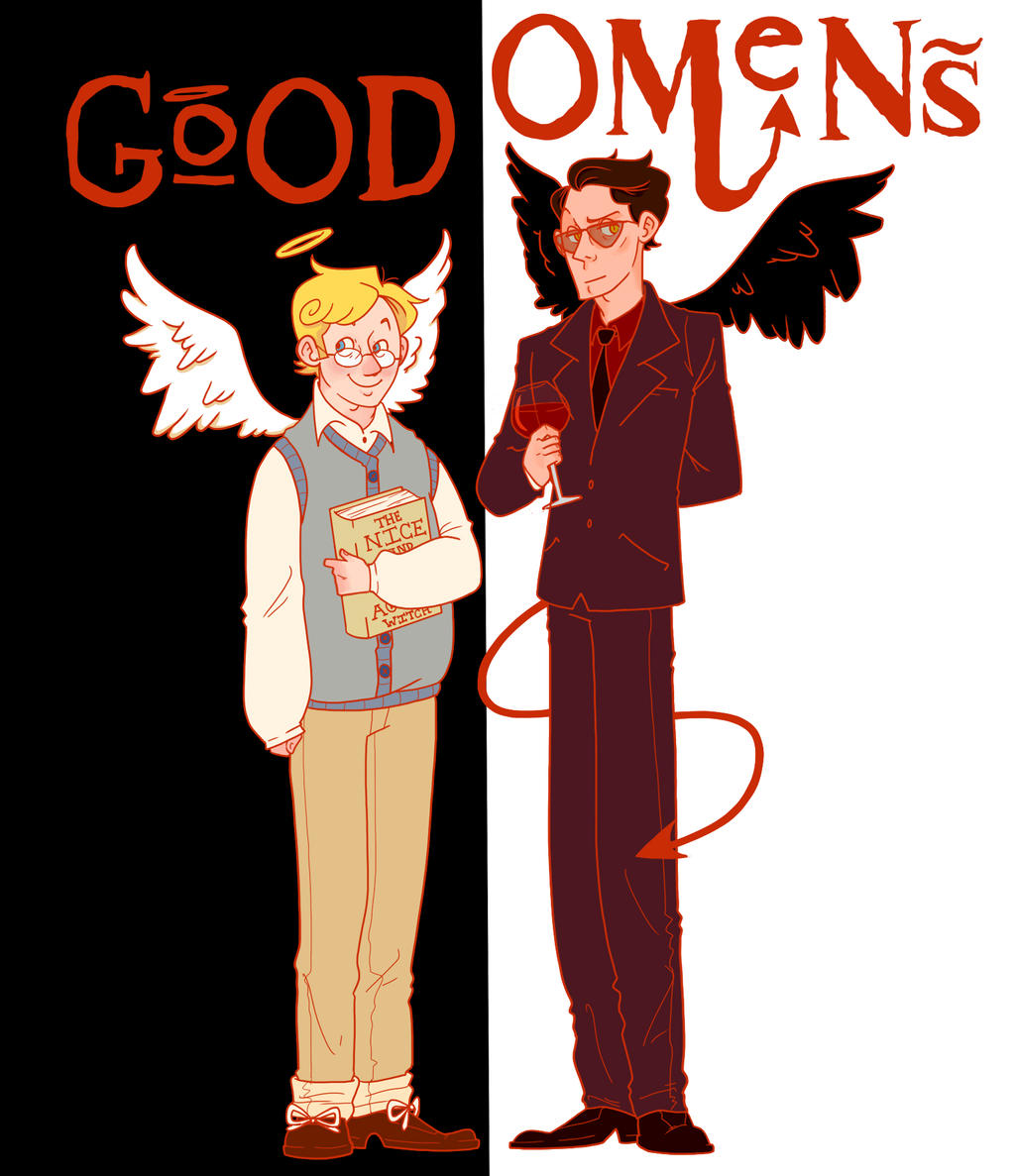
Good Omens, written by both Terry Pratchett and Neil Gaiman, has like a million covers. It has way too many covers. I couldn't find a good photo of the one I read it inside (mostly white with a demon on the front), so I just picked the coolest-looking fan cover. Can't be bothered to sort through all those canonical covers. Just google it.

Anyways, Good Omens is supposed to have the subtitle: The Nice and Accurate Prophecies of Agnes Nutter, Witch. That is the title of a book of prophecies, all of which have come true so far. It also Prophecies the end of the world. Next Saturday.*

Generally, people think this is just hunky-dory. Does anyone say that anymore? Whatever. Two celestial individuals, Crowley the demon and Aziraphale the angel, have taken a liking to the world, and decide that they will try their best to stop it. To do this, they agree to both tutor the Antichrist equally, so that he cannot take a side and the world does not end. This works perfectly, and disaster is averted.

Not really. Things don't exactly go as planned, and now the duo has to find the Antichrist, who has grown up to be Adam, a simple boy from a small town. In that town there lives Anathema Device, a descendant of Agnes Nutter. She is being tracked down by Newton Pulsifer, who works under... you know, there's quite a few characters, actually. The four horsemen show up, too. It's great fun. In fact, I think my only complaint is that Pratchett and Gaiman didn't do more with the characters, towards the end. Then again, that's just about the best complaint to have about a book. I'd give it a read if I were you.

*Off the record, I wouldn't worry too much, because it's implied to have happened in 2004.