Showing posts with label adventures. Show all posts

Sunday, October 21, 2018

All the Birds in the Sky

Patricia Delfine is an ordinary girl living an ordinary childhood in her ordinary home. That is until one day when she decides to help a bird with a broken wing, who tells Patricia she's a witch and leads her to the Parliament of Birds, who give her an Endless Question to prove that she's really a witch. Will she be able to solve the riddle? Will she find a way to deal with her slightly sadistic sister? Will she unlock her true powers and become a protector of nature?

Laurence (with a U, not a W) is a shy kid who spends most of his time at home building things like an almost-functioning supercomputer and a watch that takes him two seconds into the future.  One day, he decides to sneak out of school to see a rocket launch at MIT. Will he use this time-skipping watch to expand on science's understanding of time? Will he succeed in creating a supercomputer? Will anyone ever stop calling him Larry?

The answers to these questions are all "maybe," because all of that happens in the first two chapters and then we immediately skip forwards by several years. Now, Patricia and Laurence both attend Canterbury Academy, a high school in which neither of them quite fit. Fortunately, they find each other, and tentatively start forming a friendship. Before long, the two become fast friends, and have all the sorts of misadventures that you would expect from a feel-good novel about high-school aged kids.

PSYCHE! They're soon separated and don't see each other for ten years, during which they split into their respective separate and irreconcilable worlds! Charlie Jane Anders has fooled you again! So yeah, Laurence is now a fancy science man who does fancy science, and Patricia is now a witch who does witchy things. Like for example assassination? I'm pretty sure Patricia is an assassin now? It's unclear. The point is, fancy science and witchy things can never ever go together, so Patricia and Laurence have an uncrossable rift between them, which they must somehow bridge if they are to ever be friends again.

Fortunately, our two protagonists have all the time they need to get to know each other, because the world is ending. Oh wait no that's bad. Don't worry, there are plans in the works to fix the oncoming apocalypse, which has to do with the climate changing by the way. Patricia's witch squad has proposed the worst plan in the universe, so that's maybe a bad idea. Fortunately, Laurence's science squad has proposed an alternative, which is also a bad plan but is preferable in that it is not the worst plan in the universe. The actual contents of both plans are kinda spoilers so I won't go into them here, but I mean really could they not like try any non-last-resort ideas given that they are not yet at a last-resort stage of the apocalypse?

Okay, I'm being a bit mean here. All the Birds in the Sky is a fun book, even if it does get somewhat pushed around by fridge logic. Laurence's science inventions are all pretty cool, even though they never get to a super useful practical level, much less an Iron Man level (with one spoilerish exception). Patricia's magic spells are rich and varied, and the associated costs keep them from feeling too overpowered. All in all, it's a pretty well-done balance of tech and magic.

If I do have any complaints, and I do, they're mostly about elements of the world, and in particular its portrayal of "the science side." First off, the idea of an uncrossable rift between magic and science bothers me. This is probably because of my obsession familiarity with science. See, science is a process and a lens through which you can see the world, and even if it doesn't entirely work you can at least try to apply science to magic. I guess I've been spoiled by things like Harry Potter and the Methods of Rationality, Artemis Fowl, Girl Genius, Atomic Robo, (but I'm going to invisible this text so that no one knows that I consider these magic-and-science, the first being science at heart and the last two being magic at heart) and The Entire SCP Wiki. In short, the problem I have is that the driving force of conflict (science vs magic) is something that I think is stupid.

Then, there's the trouble of how the science side in itself is portrayed. It's more of an "I have invented this cool thing now" than an "I am curious about how the universe works and how I can make it work for me." To see what I mean, let's take another look at that time-machine watch. First of all, and I admit this is nit-picky, the book acts as if two seconds is a really short amount of time. Like, Laurence skips forward two seconds and nobody notices because it just looks like he's flickering. This is two seconds: . That doesn't look like flickering to me.

But, more than that, there's the whole concept of the watch itself. Why two seconds? Why can't you jump more or less time? How does the watch know what to move forward and what to not affect? How would it affect a liquid? What reference frame is it using for the output point in space? How much mass can it affect? What happens to the space you used to take up in the two seconds are gone? None of these questions are asked by any of the characters, not even the ones that are meant to be "science people". My point is that an actual scientist would do so much with this, but in All the Birds in the Sky it's dismissed as just another "science thing."

It is, however, pretty clear why these avenues are not explored. All the Birds in the Sky isn't a book about the difficulties of reconciling science and magic. It's a book about Patricia Delfine and Laurence WaitDidHeHaveALastName, and their relationship with each other. The science fiction is of the pulpy magic-but-with-"quantum"-on-it variety. Essentially, in All the Birds in the Sky, "science" is a less effective and less reliable form of magic, with the bonus of not having any apparent costs. The split between the two sides is there only to drive the conflict of the book, and it works.

In conclusion, let this be a lesson to you all that thinking too hard about books can be bad for you. After a thousand words of text, my actual position towards All the Birds in the Sky seems murky. To be clear: I did like the book, although many of its elements ticked me off in just the wrong ways. If you want a deep exploration into whether or not science can be reconciled with magic, then this is probably not the book for you (and, honestly, I can't think of a single book which focuses on that question). If, however, you want to read a relationship drama between two awkward misfits, with the added spice of them being from different worlds and at the start of an apocalypse, then All the Birds in the Sky might be the book for you.

Saturday, October 20, 2018

Abaddon's Gate (The Expanse book 3)

It’s still the future, and not thinking about Venus is no longer an option. Y’see, the thing that used to be on Venus seems to have commandeered the planet to create a giant circle in space. A strapping young man by the name of Expendable McPlotPoint pulls the daredevil stunt of the millennium and shoots himself past the Martian Blockade, becoming the first to travel directly through the strange giant circle and into whatever lies on the other side. Spoilers: he doesn’t survive. Not even a little bit.

So that's fun. Oh and Holden is still around by the way, doing his Holdeny thing: leading his crew through space, taking jobs from whoever offers the most spacebucks, and generally holding stuff together. His new ghost friend, whose origins and motive remain mysterious, has told Holden to stay away from the space circle formerly known as Venus. Holden agrees with his ghost friend wholeheartedly, and resolves to give the space circle formerly known as Venus a wide birth. I sure hope that works out for him.

Meanwhile, Annushka Volovodov, a humble space pastor, is having a nice time past-ing space (or whatever it is space pastors do). She gets offered the opportunity of a lifetime: travel with the United Nations (the government of Earth) along with other religious folks and such to witness for herself the glory of the space circle formerly known as Venus. She accepts the offer (which is technically a spoiler but I mean come on) and finds herself well on her way to what is about to be the biggest mess in human history.

Also on his way to this mess is Carlos c de Baca, known as "bull" to his friends, who is in charge of the largest ship in the solar system, which has been creatively named the Behemoth. Just once I want an ultimate mega-warship which is called something innocuous like the Lilac or the Flying Festoon. Anyways, Bull has been personally asked by the leader of the Outer Planets Alliance to keep the Behemoth in shape. After McPlotPoint does his crazy stunt, Bull is ordered to meet with the Earth and Mars forces at the space circle formerly known as Venus, to show them that the OPA are team players.

Rounding off the cast of four we have Petunia Adams-Rogers, a farm girl from Oklahoma who has never stepped out of the Earth's atmosphere, but dreams of traveling the stars. After a surprise visit from an esteemed scientist to her college, she is offered the chance to join Anna in the UN ship set for the space circle formerly known as Venus. She of course agrees, and– yeah okay I think that's enough of this gag.

No, Petunia does not exist. She was probably murdered by Clarissa Mao, so that Clarissa Mao could take her place and pretend to be a protagonist. Clarissa is the sister of Julie Mao (the subject of Miller's search in the first book) and the daughter of Jules-Pierre Mao (one of the richest people in future history), who was taken down by Holden and company in the previous book. Oh, um, I guess that was a spoiler for the second book. Oops. Now, Clarissa has only one goal in her mind: discredit Holden, make everyone think he's garbage, and then kill him. Because he's a paragon, and paragons are immune to ordinary store-bought revenge.

Abaddon's Gate is fun, and I think captures more of the action-drama of the first book. There's still a lot of political drama going on, what with everyone having a look at the space circle formerly known as Venus and all, but there's also plenty of explosions and guns and whatever it is Clarissa Mao does. Speaking of Clarissa, it was very interesting to have an honest-to-god antagonist as a POV character. She's not an antihero, and we're not meant to empathize with her, and she doesn't even have any delusions of righteousness or whatever. She's just an insane murderer, and the fact that we know what she's doing and planning makes us all the more worried for the protagonists, which turns the suspense up to eleven.

As for the rest of the characters, I don't feel like they were really as strong as those from the first and second books. Bull and Anna in particular seemed to get the short end of the characterization stick. I get the sense that, out of the four characters in Abaddon's Gate, Anna is followed the least, but I'm not sure if that's reflective of the actual number of chapters she's in.

Despite these flaws, Abaddon's Gate is still a fast-paced and well-written action drama that keeps you hooked until the very end. I think it is my second favorite of the Expanse books so far, after Leviathan Wakes (the first one). My conclusion is of course that if you liked the second one then you'll like this one, which shouldn't really surprise anyone. I'm not even sure if these count as reviews anymore, because I'm just summarizing the setup and making a few comments. Ah, well, I'll keep doing these regardless. They're fun.

Anyways, yeah. Series are series. Give Abbadon's Gate a shot if and only if you wanna. Peace.

Friday, June 23, 2017

Leviathan Wakes (The Expanse book 1)

Space. The final frontier. Humanity, insatiable in its quest for exploration, tosses itself into the void between worlds, strapped to tin cans with high explosives. What could possibly go wrong? Well, James S. A. Corey (who is actually two people or something) aims to find out in Leviathan Wakes, the first book of a (planned) nine-book series.

Meet James Holden, executive officer on a freighter which brings ice between planets. The solar system is a big place, after all, and people still need water. Unfortunately, when responding to a mysterious distress beacon, the freighter is nuked and almost all of Holden's friends are killed. It's not pretty.

Let's see if Josephus Miller is doing any better. He's a detective on Ceres station, born and raised in the Belt. He's running into some trouble because his partner, Havelock, is from Earth, which means that Belters don't like him so much. Still, everything should be fine, as long as some Earther doesn't inadvertently start a war because someone nuked his freighter and almost all of his friends were killed. But what are the chances of that, am I right?

So, yeah, now a war is brewing. The Earth and Mars are looking at each other all shifty, and the Outer Planets Alliance which claims to represent the belt is making everyone a bit antsy. Also, there's that thing from the introduction which hasn't shown up in a while. Hope that's not important. Now Holden is on a mission to find out who killed his ship, and Miller is on a mission to find a lost girl named Julie, and... well, things get a bit hectic.

Leviathan Wakes is a bangin' book. It's got killer pacing, and characters that are interesting and fun to be with. The world seems real and realistic, even with the crazier things that show up. The tension and the stakes keep getting ramped up, with more and more people being dragged in, and then you remember the title is "Leviathan Wakes" and get really worried. To make things even more intense, we follow Holden and Miller in alternating chapters, so there's almost always a cliffhanger after each chapter even if you don't stop reading, which I think is a really cool way to do things.

If you like high-stakes space drama mystery action, or if you want to become lost in a world which might be about to lose itself, or if you want to get to know interesting characters which could all die at any moment, then you should read Leviathan Wakes. And probably the rest of The Expanse.

Tuesday, January 03, 2017

Romeo and/or Juliet

Romeo and/or Juliet is a choose-your-own-adventure book by Ryan North. It has not only one, but several plots, as is typical of a choose-your-own-adventure book. Because of this, I can't really do a plot-focused review, and so I have been putting this off for like two months, because I don't really know what to say.

Romeo and/or Juliet is funny. It makes fun of the original Shakespeare work, pointing out the silly parts of the story and usually replacing them with even sillier ones. The narrator is more of a character than most of the characters, and likes to make anachronistic remarks. When reading, I pictured the narrator as a flying red fairy. You can also do this, if you want.

Well, that's all I've got. Next time, remind me to review a book with a stationary topic. If you like dumb laughs and/or Shakespeare, then you should read this book. Or, I guess I mean you should play it. Interact with it. Read sections of it, and then at the end of those sections make a decision between the offered choices and turn to the appropriate section, and then repeat this process until you get an ending.

See, this is why I had trouble.

Wednesday, November 16, 2016

Adventures in Mathematical Reasoning

Sherman Stein's Adventures in Mathematical Reasoning (which also goes by the title How the Other Half Thinks) is a book which can teach you how a mathematician thinks. I'm not claim that it will teach you, just that it can teach you, if you remain open-minded. For that reason, I think it might me one of the most directly useful math book's I've read.

Adventures in Mathematical Reasoning includes eight chapters, each of which pose a different question at the beginning. All of the chapters involves strings of letters of some sort, although I didn't actually notice until I was almost done with the book. The chapters cover a wide range of topics, from statistics to combinatorics (which is like mixing things up). All of the topics are interesting examples of mathematical ideas, made relatively simple.

The great strength in the book is its ability to show hoe mathematical reasoning works, when actually creating new mathematical theorems. The tricks which Stein uses in these chapters—abstraction, generalization, simplification, or just plain getting data manually—are tricks which can be used in math much more advanced than this. And just about any branch of math would be more advanced. Stein chose topics which can be understood with nothing more than arithmetic, basic geometry (like, "what is pi?" basic), and an open mind.

If you've ever seen a mathematical theorem or idea and thought, "how could they possibly have thought of that?" then you might want to read this book. As long as you take your time to understand everything, and keep trying to guess where things are headed, you should finish the book with a better understanding of how all the work is done. If this sounds good to you, give Adventures in Mathematical Reasoning a read.

P.S.: He usually goes about a similar strategy as is shown in this Numberphile video, so check that out if you want to see an example.

Saturday, October 29, 2016

The Rest Of Us Just Live Here

The Rest Of Us Just Live Here is about the life of a boy named Mikey during his last few weeks of high school. He hangs out with his sister Mel, his best friend Jared, and his not-girlfriend Henna. He's just trying to live his normal life and come to terms with leaving his friends and family to go to college. And, hopefully, finally ask Henna out on a date.

Then, there's also that whole teen adventure thing going on. Something to do with blue light and immortals and whatnot. But, that's not Mikey's problem. The indie kids can deal with that, like they always have, and eventually one of them will become the chosen one or whatever and save the world. Mikey and his friends? Background characters. Nothing they can do. As long as the indie kids can keep their problems to themselves, Mikey's got bigger things to worry about (like that new kid Nathan? What's his deal??).

I love everything about this book. First of all, I love the premise of it being a story about the background characters in a teen adventure novel. It's amazing how well Patrick Ness gets that theme across without making it seem like a gimmick. Somehow, he makes the presence of the "indie kids" (protagonists) seem like "a fact of life" but not "'just a fact of life." I also love all of the characters, and how relatable they are, and just how alive they feel. Every single one of them. Well, except the immortals, but they don't entirely count. I love the ending so much that I won't say anything more about it. It's just so great.

If you like good books which might make you cry, then read this book. I really can't recommend it enough. This is my new favorite book, and I love it so much that I can't really explain why I love it this much. I have so much to say that I don't want to say anything. Please read it, as a favor to me.

Monday, September 05, 2016

The Hike

The Hike, by Drew Magary, is about a man who gets well and truly lost. The man in question is Ben, a thirty-eight year old with a wife and three kids and a house and an important business meeting to get to. Before he goes to the meeting, he decides to take a walk. The walk turn into a hike. The hike turns into a mad sprint for his life. Then he gets lost.

The hotel is gone, as is the road, and all traces of human civilization. The only thing left is a path, and, seeing no other options, Ben follows this path, in the hopes that it will take him somewhere eventually. Then, strange things start to happen, and they keep getting stranger. Only one thing is clear: If Ben goes off the path, then he will die. As long as he stays on the path, he - well, the point is he should stay on the path.

The Hike is a beautifully written page-turner with memorable characters and one of the best endings I've ever seen. Honestly, I think The Hike is my favorite book now. It's hard to find words to express this fully. There's just nothing about it that I don't like. It has a great little mystery and a few twists which not only genuinely caught me by surprise but also made me completely change the way I framed the whole thing. I love it so much.

If you like good books, then you should read this book.

Friday, June 24, 2016

Witch & Wizard

Witch and Wizard, by James Patterson and a second author in smaller print, is about a witch and a wizard. Their names are Wisteria and Whitford Allgood, but they usually go by Wisty and Whit. Yes, they are really the All-good family.

Unfortunately for them, "the country" has elected some fellows called the New Order into power, and in "a few months" the New Order has completely destroyed "the old government" and instituted a council to rule over the new authoritarian state and also they've convinced everyone that not only does magic exist but also that it's evil and that it's okay to do terrible things to children and also the Allgoods are the last nice parents on Earth and everyone else is just sorta fine with it except for kids so the New Order just kills children by the hundreds and did I mention EVERYONE IS FINE WITH IT and also there are apparently no countries other than "the country" because everyone is either in the New Order or in the resistance as clearly marked in the map and also the world is flat I guess and there are no oceans but there's also four other levels of reality because why not?

So, yeah, it's set in an alternate reality where that somehow makes sense.

Anyways, Wisty and Whit have somehow missed the fact that the GOVERNMENT IS GONE AND EVERYONE IS EVIL sorry I need a little time to adjust to this premise.

[time passes]

So, Wisty and Whit were not informed about the new government, nor about the existence of magic, nor about the fact that magic is illegal and morally reprehensible. They are then completely surprised when they are arrested by the New Order for the charge of being a witch and a wizard, respectively. They are even more surprised when they start developing magical powers, such as seeing ghosts and being on fire. Slightly less surprising is that they are sentenced to death. Now, Wisty and Whit have to use their magic to escape the torture-prison and find their parents.

The review so far has been a bit ranty, so I feel like I should clarify: I really liked Witch & Wizard. It is fun, and easy to read, and it moves at an incredibly fast pace. The good characters are all likable, and the evil characters are all cartoonishly evil. I'm also okay with the ridiculous setting, because it just emphasizes the whole silly good-vs-bad fun of the story.

So, read this book if you like fast-paced action and fun. Try to ignore my little rant. Honestly, I just made it for fun.

Wednesday, April 20, 2016

Harry Potter and the Methods of Rationality

I ragged on Harry Potter and the Methods of Rationality (sometimes awkwardly abbreviated to HPMOR) quite a bit on my other blog. A lot of my points still stand. The characters start out unlikable, at least to me, to the point where I actually quit reading. Eventually, though... well, here I am, done with the book.

So, what is HPMOR? It is a fan-fiction of Harry Potter composed by Eliezer Yudkowski, He Who Is Not Recognized By Spell-Check. It takes place in an alternate-universe type deal in which Harry was raised by scientists and is a boy genius armed with the powers of Rationality. If that makes you really want to read it, then I doubt I could stop you even if I tried. If not, then... eh. It's cool.

That's it. This post is essentially just to say that I've read HPMOR. To reiterate: your first impression is probably indicative of how much you will like this book. I wouldn't recommend it if you don't buy into the premise. Laters!

Sunday, April 17, 2016

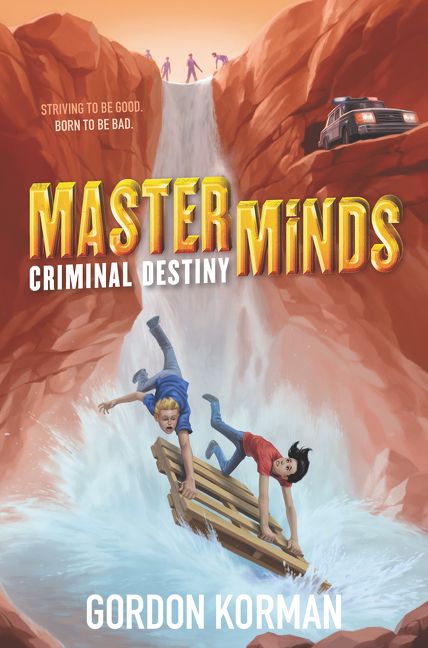
Masterminds: Criminal Destiny

This is the second Masterminds book. If you want to know what I think about it, read my review of the original, because all of the same things apply. I'm not going to write a new review for this one, because there is a chance some of you will not have read the original Masterminds, and you should read it with no spoilers. That said, this book is amazing, so I'm just gonna gush for a while.

EEEEEEEEEEEEEEEEEEEEEEEEEE
EEEEEEEEEEEEEEEEEEEEEEEEEEEEEEEEEEEEEEEEEEEEEEEEEEEEEEEEEEEEEEEEEEEEEEEEEEEEEEEEEEEEEEEEEEEEEEEEEEEEEEEEEEEEEEEEEEEEEEEEEEEEEEEEEEEEEEEEEEEEEEEEEEEEEEEEEEEEEEEEEEEEEEEEEEEEEEEEEEEEEEEEEEEEEEEEEEEEEEEEEEEEEEEEEEEEEEEEEEEEEEEEEEEEEEEEEEEEEEEEEEEEEEEEEEE

Thank you. For reference, I started this book at like 11:00 AM today, and read until it was over. It's super good. As a great man once said, "if you like books about people doing things, you will probably love this book." Couldn't have said it better myself. I mean, I guess there should be a "then" in the second clause. But the point still stands.

READ IT!

Monday, September 21, 2015

Raptor Red

Robert T. Bakker's Raptor Red is, as far as I know, the first book of its kind, by a long shot. It is not a book about people who bring dinosaurs to life. It is not a book about people with a time machine that travel to the time of the dinosaurs. It's not a book about a hidden land of dinosaurs, protected from time. It's not about cartoonish dinosaurs that generally act like humans. It's not even an informational book about dinosaurs. Nope. Raptor Red is just about dinosaurs.

Red is a Utahraptor lady, and lives during the early Cretaceous period. A land bridge has opened up from Asia to North America, and Red is one of the first Utahraptors to enter this strange land. Red's mate, Doomed-for-death,* dies in the first chapter, leaving Red to fend for herself. For weeks, Red is barely able to scrape by.

Luckily for Red, just when she is on the brink of death, she finds her sister, Run. While they have been separated, Run has managed to get three little raptor chicks: Chuck, Duck, and Hide. Red and Run now have to brave this new land, while protecting the three chicks and facing many perilous perils.

I really like the story, and the characters were all, surprisingly, very memorable. Bakker does a cool thing (like in The Once and Future King) where the animals' speech, mannerisms, and societies are all completely different for different species. You get to see into the minds of crocodiles, turtles, pterosaurs, little mammals, Gastonians, the whole lot of 'em. My only problem is that I think Bakker brings science in a little too much. Every chapter or so, he takes a few paragraphs to describe things scientifically, and it's not really needed.

Raptor Red is still a good book, though. If you like dinosaurs, you basically have to read it, because it's the first true dinosaur book. Actually, if you just like animals in general, you should read it as well, because not even many animal books can pull this off. If you don't like science that much, you can just skim the sciency bits, and it won't take away from the experience at all. This is definitely a book you should read, even just for its premise.

*None of the characters in the book are named except for Red, which makes sense, because she is the point-of-view character, and Utahraptors haven't invented language yet. As such, all the other names I use are ones that I've made up. You are welcome to use them if you want. Also, the guy's name is Sky.

Thursday, September 03, 2015

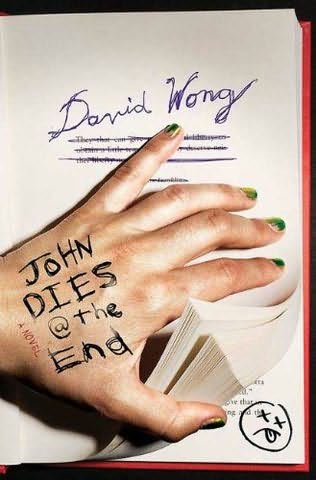
John Dies at the End

John Dies at the End is a book in which, in the final act, a man named John is killed. Seriously, just look at that title, and imagine an entire book written in that tone. That's reasonably close to the truth.

As for the plot, John Dies at the End is about David Wong and his best friend, John. They live in the smallish town of [Undisclosed], and spend their time being obnoxious and sometimes drunk. One day, John takes a drug called Soy Sauce, which makes everything terrible forever, because it exposes him to a dark alternate universe of doom. Dave gets infected as well, and they go on an epic journey to save the world.

There are, like, millions of quotes where people talk about how this book successfully uses humor and horror at the same time. And, yeah, they're pretty much right. I laughed out loud at many parts of the book, and at other parts I was deeply horrified. Very deeply. As such, I think the easiest way to see if you will like it is this:

If any of the following subjects are complete deal-breakers for you, and you would never read a book with them, do not read this book:
Spiders
Cockroaches
Penises
Cursing
Gore
Eyes
Alternate universes
Death
Severed limbs
Fun
Painful transformation
Untied plot threads
Murder
If none of these things immediately make you want to flee from this review, you will probably like the book. If you aren't even bothered by any of these things, you may have found your new favorite book. I, personally, thoroughly enjoyed it, despite feeling very uncomfortable at parts. I'll leave it at that.

Friday, May 15, 2015

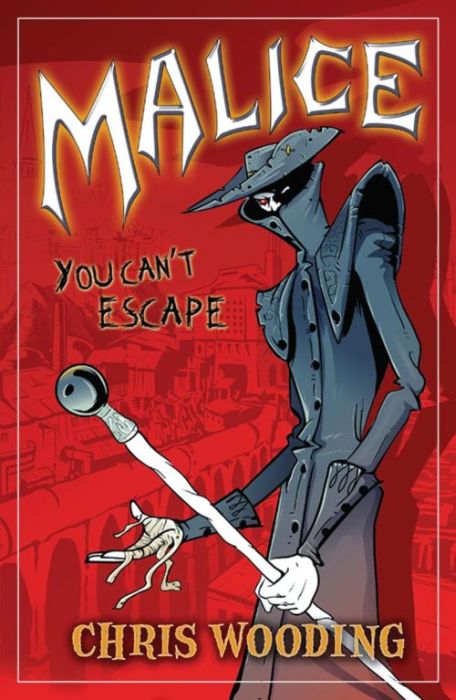
Malice

Life is going kinda meh for Seth Somethingorother right now. Nothing ever seems to happen in the town of Loughborough (which has far too many "ugh"s in it, in Seth's opinion). That is, until is best friend, Luke, disappears.

All of the adults think that Luke has run away. Spoilers: he most definitely has not. Tall Jake has taken him to the world of Malice, where kids and teenagers struggle to escape, most things are deadly, and everything is serialized in comics that are given to the outside world. Naturally, Seth and his friend Kady have to figure everything out.

As for the book Malice, the story is told in a mixture of text, comic panels, and Chris Wooding trying to simulate teenagers Instant Messaging. Don't expect too much comic, though; almost all of the book is just text.

The parts of the book that are comic, however, are really well done (not that the rest of it is bad). I like the art style, and I like how the comic actually fits in with the narrative. This is a nice adventure story in which more questions are raised than answered. Some might be answered in book two, Havoc, which I haven't read yet.

I don't think I'm gonna be able to say anything smart right now, so: if you like monsters, alternate worlds, and vague questions about human nature, read this book.

Tuesday, April 28, 2015

The Secret Series (The Name of This Book is Secret)

Here's a quick one. The Secret Series is one of my favorite book series. Probably in the top five. It's funny, smart(ish), charming, and chocolatey. The books come in five delicious flavors: The Name of This Book is Secret; If You're Reading This, It's Too Late; This Book is not Good for You; This Isn't What It Looks Like; and You Have to Stop This.

That's a quite of books (sorry for my grammar, I'm tired and sick). All in all, it's a whole quintilogy. Or a pentology? Whatever. I just finished rereading the series, and I loved it again. It stars Cass and Max-Ernest, two students who attend The School In Which Things Happen. There are also a whole host of cool, quirky side characters, none of which I will write about because I'm sick and tired.

I realise I'm not doing a great job of selling this, but trust me. The Secret Series is a few million times better than what I make it seem like it is. Wow, my sentences aren't even entirely coherent anymore. Look, I love these books. They were probably my favorite series for a while. If you like humor, magic and... the other stuff under "labels," give this series a try.

In conclusion. These books are real good. Read 'em. That's all I have the brain for today.

Thursday, April 23, 2015

Masterminds

OH MY GOD IS MASTERMINDS A GOOD BOOK. Seriously, I started reading it on Monday, and finished today (Wednesday, or three days later, for you lazy folks). This book gives a new meaning to the phrase "page-turner", the pages practically turn themselves.  As one-of-the-dudes-from-the-back-of-the-book said: "Reading this book while doing anything else is dangerous."

Anyways. Adulation over. Masterminds follows five kids: Eli, Amber, Malik, Hector, and Tori. These kids live in the really small town of Serenity, where everything is perfect, except, you've read books before, so you already know that everything is not perfect at all.

It turns out, some of the kids in Serenity are... special, somehow. When Eli goes out of town with his best friend, Randy, he is struck by a crippling pain, while Randy remains fine. Fortunately, he is picked up by the town's army of Purple People Eaters in their nondescript, menacing black helicopter. You know, no biggie.

After the incident, Randy announces that he will be moving out of Serenity to live with his grandmother. But Eli thinks that Randy is acting strange. And then... well, then the book happens. All that stuff basically happens in the first chapter. This is a book that never seems to stop and take its breath, and it works.

In other words, if you have a weekend to kill, reading Masterminds is one of the best ways to do it. If you like books about people doing things, you will probably love this book.

Tuesday, March 03, 2015

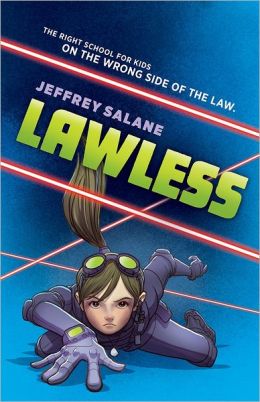
Lawless

Lawless is a fun book. It's about a girl known only as M (which is kinda confusing at the beginning). M is a perfectly normal girl with completely average skills. Okay, that was actually a blatant lie. I mean, look at the cover.
M is recruited (somewhat against her will) to be a student at Lawless, a school whose motto is "sow all the chaos!" (okay, technically it's "Infinitum Chaos Enim," but I've captured their spirit pretty well). Wait. Is it "sow" or "sew"? Sow. But how is it pronounced? Is it sow-like-in-bow or sow-like-in-pew? Wait... are they pronounced the same? that can't be right. Someone broke Google.
Anywho.
Lawless is a school for master criminals, similar to H.I.V.E. in that - wait. Have I never written a post about H.I.V.E.? I need to get on that.
Okay. No more irrelevant tangents allowed. Lawless is a super duper secret school for bad guys, with advanced technology and quirky teachers. M is just thrown into this school, despite the fact that she never even knew that (spoilers) her father was a world-renowned criminal, and her whole life she was groomed to follow his footsteps. I'm pretty sure that is revealed really early, but I don't want to chance it.
At Lawless, M has to make friends she can trust, lie relatively low, and figure out her teachers and mysterious roommate, Zara. And then this whole "heist" dealie shows up. Yeah... things blow up really quickly (mostly figuratively).
The only complaint I have with Lawless is that it is not very good at science. There are very few books that I will say are not good at science, even almost all fantasy and sci-fi, but that bit at the end.... I won't go into detail, but if you have taken Physics 101, you may cringe a bit.
Not that it wasn't cool. Because that was cool.
In conclusion, if you like spy books, high-stakes befriending, and a good mystery-unraveling, this is a good book for you.

Monday, February 23, 2015

Here Where the Sunbeams are Green

This is a book that I have been reading for, like, three months. It's not hard to get through by any means, but I've always been reading some other book, usually a nonfiction book about science. I finally finished this weekend, and it was great.
Here Where the Sunbeams are Green (or "The Sunbeam Book," to it's friends) is a Sweet Little Book with almost as much Capitalization as the Bible. Okay, not really. But it's up there in the capitalization department.
The story is told by Mad, the girl with the brown hair and the ponytail. She, her mom, and her sister, Roo, are flown to La Lava Resort and Spa to meet their father, who is a bird guy. But Mad thinks that something odd has happened to her father, because the last thing he sent her was a Very Strange and Incredibly Creepy Letter. Will she and Roo ever see their father again? Yes. They see him in, like, Chapter 3.
But there are very strange things happening at La Lava. No one is exactly as they seem. Mad and Roo have to choose wisely who they trust, or they will end up in a whole heap of trouble. And, of course, there's the active volcano. That's not good either.
In closing, The Sunbeam Book is a nice story about some friends trying to figure things out and put things right again. It's been a while since I've read one of those books, and it's good to be back. I like most of the characters, and the ending is pretty great. Overall, I give The Sunbeam Book a reminded-me-of-my-love-for-adventure-books-but-still-kept-things-interesting out of 10. Anyone who likes adventures with a dash of fantasy should definitely read this book.

Thursday, September 18, 2014

Magyk

Magyk (pronounced muh-JIKE [to rhyme with bike] or muh-GERK [to rhyme with work, as the Y makes an "ER" sound]) is a fantasy book about a long-lost princess, her long-lost brother, and some long-lost magic (sorry, magyk).
One day, on his way home, Silas Heap finds a little baby girl in the snow. Silas takes the girl home to his wife, Sarah only to find that his seventh son, Septimus, has died in a poison drinking accident for mysterious reasons. Silas and Sarah take in the baby, who(m?) they name Jenna. A few years later it turns out that Jenna is a princess, she is being hunted, an ancient evil has been set free, and all that good stuff. Jenna, Silas, the ExtraOrdinary wizard, and a handful of Jenna's brothers are forced out of their home and now have to save the world.
So, basically your average fantasy adventure story.
Seriously, though, Magyk is a great book. It's well-written, and has a really nice story. The best part of the book, however, is its predictability.
I know what you're thinking: "Hold on there a moment, dashing and attractive book-reader whose blog I will now follow, predictable books are boring. Books have to have at least some mystery and plot-twistedness, or else there would be no point in reading them."
To this I say that Magyk is different. It's subtle. and you never know exactly what's going to happen, but the clues are all there. I'd give examples, but those would be spoilers, and we don't like those here. Read the book, and you'll understand. The story is basically a love letter to Chekhov's gun; everything that happens could conceivably be predicted (and none of that "Dumbledore said something meaningless and it turned out to be actual information" stuff. While Dumbledore's ramblings can only be understood in retrospect, all of this can be predicted before it happens.) It's like foreshadowing for ninjas.
All in all, Magyk is a clever book, with memorable characters and a nice ending. Definitely a book you should read.

P.S. Usually I end with "If you like X, Y, and Z, then you should read this book." While that is an easy way to end things, now that I'm in high school what I want to do something different. From now on, I'll end with a simple recommendation. This doesn't mean I won't use the XYZ format anymore, but I'll only use it if I think it's a good ending. Otherwise, I'll mix it up a bit.

P.P.S. Given the similarly-designed covers to the right of this book in library shelves, and the fact that the cover says "Book One," I have determined that Magyk has a number of sequels. I have not read any of them, and I don't really plan on it, unless someone tells me to in the comments. Magyk had an incredibly satisfying ending: the loose ends were tied up, the villain did not run off shaking his fist at the heroes, and there was even a section at the end detailing what happened to the minor characters after they left the main story. If that isn't closure, then I don't know what is.

Monday, February 03, 2014

Saga (and also Epic)

Saga is the second book in a series starting with Epic. The series in set in the future, on New Earth (which is like old earth, but fresher). on New Earth, all arguments are settled in a video game called Epic, which is set in a fantasy world. Eric, a boy from New Earth, goes on a quest to become rich and then accidentally saves the world.
This is where the first book ends. In the second book, Saga, a mysterious robot probe replaces Epic with a new game called Saga. Saga is also set in the future, but more so (the people have hover cars, hover boards, holograms, and the like). Citizens in Saga are given a card of a certain color, and better colors get better things. The best colors are given to the people with power, so the people with the worst colors are struggling to survive.
However, something is different with this game. Something is not right. Something is trying to gain immortality, and will stop at nothing to do it.
So, yeah, basically, it's save-the-world time again.
Saga is a fast-paced, exciting book with an interesting story and cool characters. The story is told by Eric, the kid from New Earth; Ghost, a member of the resistance (in the game); and the Dark Queen, the leader of Saga.
Be sure to read the first book (Epic) first. Also, there is killing, (in both books), so be warned. Epic is really cool because it combines fantasy and science fiction really well. If you enjoy suspenseful stories where the book gives you a chance to figure things out before the character, this book is for you.

Monday, July 21, 2008

Hoot, by Carl Hiaasen


Hoot is about a kid named Roy who has just moved to Florida from Montana. In his new school, he is picked on by Dana Matherson, but Roy is the only kid in the history of Trace Middle School who fights back. One day, when Dana is squishing Roy's face against the bus window, Roy sees a strange kid. The kid was running fast with no shoes, as if he was going to the bus stop, except he had no backpack and no books. Roy decides to investigate and soon finds himself, together with the strange boy and his even stranger sister, fighting to save some cute little burrowing owls from the wrath of bulldozers. Their adventure includes killer dogs, pancakes, the police, alligators, cottonmouths, a kind of highly poisonous snake, and two new good friends.