Showing posts with label time travel. Show all posts

Sunday, October 21, 2018

All the Birds in the Sky

Patricia Delfine is an ordinary girl living an ordinary childhood in her ordinary home. That is until one day when she decides to help a bird with a broken wing, who tells Patricia she's a witch and leads her to the Parliament of Birds, who give her an Endless Question to prove that she's really a witch. Will she be able to solve the riddle? Will she find a way to deal with her slightly sadistic sister? Will she unlock her true powers and become a protector of nature?

Laurence (with a U, not a W) is a shy kid who spends most of his time at home building things like an almost-functioning supercomputer and a watch that takes him two seconds into the future.  One day, he decides to sneak out of school to see a rocket launch at MIT. Will he use this time-skipping watch to expand on science's understanding of time? Will he succeed in creating a supercomputer? Will anyone ever stop calling him Larry?

The answers to these questions are all "maybe," because all of that happens in the first two chapters and then we immediately skip forwards by several years. Now, Patricia and Laurence both attend Canterbury Academy, a high school in which neither of them quite fit. Fortunately, they find each other, and tentatively start forming a friendship. Before long, the two become fast friends, and have all the sorts of misadventures that you would expect from a feel-good novel about high-school aged kids.

PSYCHE! They're soon separated and don't see each other for ten years, during which they split into their respective separate and irreconcilable worlds! Charlie Jane Anders has fooled you again! So yeah, Laurence is now a fancy science man who does fancy science, and Patricia is now a witch who does witchy things. Like for example assassination? I'm pretty sure Patricia is an assassin now? It's unclear. The point is, fancy science and witchy things can never ever go together, so Patricia and Laurence have an uncrossable rift between them, which they must somehow bridge if they are to ever be friends again.

Fortunately, our two protagonists have all the time they need to get to know each other, because the world is ending. Oh wait no that's bad. Don't worry, there are plans in the works to fix the oncoming apocalypse, which has to do with the climate changing by the way. Patricia's witch squad has proposed the worst plan in the universe, so that's maybe a bad idea. Fortunately, Laurence's science squad has proposed an alternative, which is also a bad plan but is preferable in that it is not the worst plan in the universe. The actual contents of both plans are kinda spoilers so I won't go into them here, but I mean really could they not like try any non-last-resort ideas given that they are not yet at a last-resort stage of the apocalypse?

Okay, I'm being a bit mean here. All the Birds in the Sky is a fun book, even if it does get somewhat pushed around by fridge logic. Laurence's science inventions are all pretty cool, even though they never get to a super useful practical level, much less an Iron Man level (with one spoilerish exception). Patricia's magic spells are rich and varied, and the associated costs keep them from feeling too overpowered. All in all, it's a pretty well-done balance of tech and magic.

If I do have any complaints, and I do, they're mostly about elements of the world, and in particular its portrayal of "the science side." First off, the idea of an uncrossable rift between magic and science bothers me. This is probably because of my obsession familiarity with science. See, science is a process and a lens through which you can see the world, and even if it doesn't entirely work you can at least try to apply science to magic. I guess I've been spoiled by things like Harry Potter and the Methods of Rationality, Artemis Fowl, Girl Genius, Atomic Robo, (but I'm going to invisible this text so that no one knows that I consider these magic-and-science, the first being science at heart and the last two being magic at heart) and The Entire SCP Wiki. In short, the problem I have is that the driving force of conflict (science vs magic) is something that I think is stupid.

Then, there's the trouble of how the science side in itself is portrayed. It's more of an "I have invented this cool thing now" than an "I am curious about how the universe works and how I can make it work for me." To see what I mean, let's take another look at that time-machine watch. First of all, and I admit this is nit-picky, the book acts as if two seconds is a really short amount of time. Like, Laurence skips forward two seconds and nobody notices because it just looks like he's flickering. This is two seconds: . That doesn't look like flickering to me.

But, more than that, there's the whole concept of the watch itself. Why two seconds? Why can't you jump more or less time? How does the watch know what to move forward and what to not affect? How would it affect a liquid? What reference frame is it using for the output point in space? How much mass can it affect? What happens to the space you used to take up in the two seconds are gone? None of these questions are asked by any of the characters, not even the ones that are meant to be "science people". My point is that an actual scientist would do so much with this, but in All the Birds in the Sky it's dismissed as just another "science thing."

It is, however, pretty clear why these avenues are not explored. All the Birds in the Sky isn't a book about the difficulties of reconciling science and magic. It's a book about Patricia Delfine and Laurence WaitDidHeHaveALastName, and their relationship with each other. The science fiction is of the pulpy magic-but-with-"quantum"-on-it variety. Essentially, in All the Birds in the Sky, "science" is a less effective and less reliable form of magic, with the bonus of not having any apparent costs. The split between the two sides is there only to drive the conflict of the book, and it works.

In conclusion, let this be a lesson to you all that thinking too hard about books can be bad for you. After a thousand words of text, my actual position towards All the Birds in the Sky seems murky. To be clear: I did like the book, although many of its elements ticked me off in just the wrong ways. If you want a deep exploration into whether or not science can be reconciled with magic, then this is probably not the book for you (and, honestly, I can't think of a single book which focuses on that question). If, however, you want to read a relationship drama between two awkward misfits, with the added spice of them being from different worlds and at the start of an apocalypse, then All the Birds in the Sky might be the book for you.

Sunday, February 19, 2017

Flatterland

Flatterland is full of puns and science. Really, if it weren't for the name "Ian Stewart" on the front, I'd suspect it had somehow been written by me. Flatterland is a "sequel" of sorts to Edwin A. Abbott's Flatland, which I suppose you should technically read first, although I think Flatterland stands perfectly well on its own. Still, a quick review/summary of Flatland is in order.

Boop. Just did a quick review. Two paragraphs. It doesn't even have a picture of the cover. Go read it, if you'd like.

Anyways, back to Flatterland. As the tagline says, it's like Flatland, only more so. And with a healthy helping of Alice in Wonderland to boot. Flatterland is set about a hundred years after Flatland, and follows the adventures of Victoria "Vikki" Line, a woman who finds her some-number-of-greats-grandfather's book, which is entitled Flatland. (Yes, they are actually the same book.) Anyways, Vikki reads Flatland, and in it finds instructions for summoning a being from Spaceland, in a way that is kind of hilarious.

So, Vikki summons someone from Spaceland. However, she gets a bit more than she bargained for. Instead of the stuffy, boring old Sphere from Flatland, she meets a loud, energetic, grinning creature known as the Space Hopper, who can travel through much more than just stuffy, boring old Spaceland. The Space Hopper equips Vikki with a Virtual Unreality Engine, or VUE, and takes her on a tour of all sorts of spaces and geometries, meeting many strange people along the way. They pay special attention to a strange place called Planiturth, and the fact that its inhabitants don't really know which space they're in.

Personally, I really liked Flatterland. I'm a big fan of puns, and math, and paradoxes, and big toothy grins, and winks directed at the fourth wall, so what's not to like? I think Ian does a good job of describing and explaining all the spaces, and why they're all cool. If I had one complaint, it would be that there aren't enough pictures. Actually, I do have that complaint. A book about geometries should have more pictures in it. But, besides that, it's a fun read, and it stays crazy enough to always keep you guessing. If you like bending your brain a bit, and you don't mind a good pun every once in a while (or a bad pun (or twenty)), then I think you should try Ian Stewart's Flatterland.

Tuesday, January 03, 2017

Romeo and/or Juliet

Romeo and/or Juliet is a choose-your-own-adventure book by Ryan North. It has not only one, but several plots, as is typical of a choose-your-own-adventure book. Because of this, I can't really do a plot-focused review, and so I have been putting this off for like two months, because I don't really know what to say.

Romeo and/or Juliet is funny. It makes fun of the original Shakespeare work, pointing out the silly parts of the story and usually replacing them with even sillier ones. The narrator is more of a character than most of the characters, and likes to make anachronistic remarks. When reading, I pictured the narrator as a flying red fairy. You can also do this, if you want.

Well, that's all I've got. Next time, remind me to review a book with a stationary topic. If you like dumb laughs and/or Shakespeare, then you should read this book. Or, I guess I mean you should play it. Interact with it. Read sections of it, and then at the end of those sections make a decision between the offered choices and turn to the appropriate section, and then repeat this process until you get an ending.

See, this is why I had trouble.

Wednesday, April 20, 2016

Harry Potter and the Methods of Rationality

I ragged on Harry Potter and the Methods of Rationality (sometimes awkwardly abbreviated to HPMOR) quite a bit on my other blog. A lot of my points still stand. The characters start out unlikable, at least to me, to the point where I actually quit reading. Eventually, though... well, here I am, done with the book.

So, what is HPMOR? It is a fan-fiction of Harry Potter composed by Eliezer Yudkowski, He Who Is Not Recognized By Spell-Check. It takes place in an alternate-universe type deal in which Harry was raised by scientists and is a boy genius armed with the powers of Rationality. If that makes you really want to read it, then I doubt I could stop you even if I tried. If not, then... eh. It's cool.

That's it. This post is essentially just to say that I've read HPMOR. To reiterate: your first impression is probably indicative of how much you will like this book. I wouldn't recommend it if you don't buy into the premise. Laters!

Monday, October 26, 2015

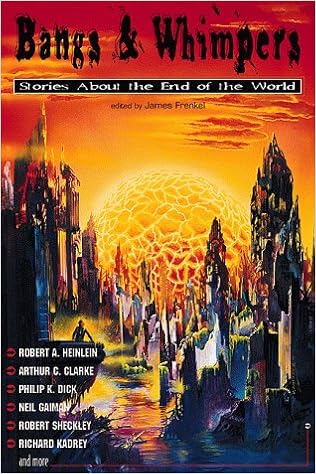
Bangs & Whimpers

Bangs and Whimpers, edited by James Frenkel (I'm not sure how much credit he should get), is exactly what it says in the cover: stories about the end of the world. There are nineteen stories in all, each by a different science fiction author.

There are a surprising amount of different themes in the book, although the sun explodes one time too many, in my opinion. Some of the stories are sad, some dark, some hopeful, and a few actually funny. The only thing they have in common is that, by the end of the story, something very bad has happened. Well, most times. See? So many kinds of stories!

Because they're so different, it's hard to say anything aside from "they're good." I mean, umm... They're short stories, so the longest take at most an afternoon. Most of 'em are science fiction. I love them all, except "Finis," and maybe the lemming one. The cover uses mainly warm colors.

Look, this is too hard. Just... if you have ever enjoyed anything post-apocalyptic, or any story in which everything goes wrong, or sci-fi stories with interesting twists and mechanics, or bleak stories about human weakness, or hopeful stories about human ingenuity, then you will definitely love at least one of the stories in Bangs and Whimpers.

Thursday, September 03, 2015

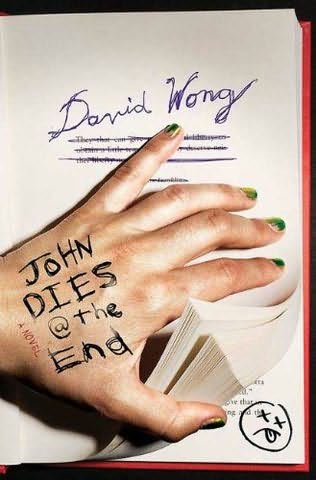
John Dies at the End

John Dies at the End is a book in which, in the final act, a man named John is killed. Seriously, just look at that title, and imagine an entire book written in that tone. That's reasonably close to the truth.

As for the plot, John Dies at the End is about David Wong and his best friend, John. They live in the smallish town of [Undisclosed], and spend their time being obnoxious and sometimes drunk. One day, John takes a drug called Soy Sauce, which makes everything terrible forever, because it exposes him to a dark alternate universe of doom. Dave gets infected as well, and they go on an epic journey to save the world.

There are, like, millions of quotes where people talk about how this book successfully uses humor and horror at the same time. And, yeah, they're pretty much right. I laughed out loud at many parts of the book, and at other parts I was deeply horrified. Very deeply. As such, I think the easiest way to see if you will like it is this:

If any of the following subjects are complete deal-breakers for you, and you would never read a book with them, do not read this book:
Spiders
Cockroaches
Penises
Cursing
Gore
Eyes
Alternate universes
Death
Severed limbs
Fun
Painful transformation
Untied plot threads
Murder
If none of these things immediately make you want to flee from this review, you will probably like the book. If you aren't even bothered by any of these things, you may have found your new favorite book. I, personally, thoroughly enjoyed it, despite feeling very uncomfortable at parts. I'll leave it at that.

Tuesday, April 28, 2015

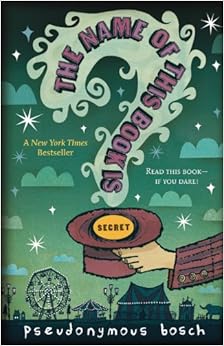
The Secret Series (The Name of This Book is Secret)

Here's a quick one. The Secret Series is one of my favorite book series. Probably in the top five. It's funny, smart(ish), charming, and chocolatey. The books come in five delicious flavors: The Name of This Book is Secret; If You're Reading This, It's Too Late; This Book is not Good for You; This Isn't What It Looks Like; and You Have to Stop This.

That's a quite of books (sorry for my grammar, I'm tired and sick). All in all, it's a whole quintilogy. Or a pentology? Whatever. I just finished rereading the series, and I loved it again. It stars Cass and Max-Ernest, two students who attend The School In Which Things Happen. There are also a whole host of cool, quirky side characters, none of which I will write about because I'm sick and tired.

I realise I'm not doing a great job of selling this, but trust me. The Secret Series is a few million times better than what I make it seem like it is. Wow, my sentences aren't even entirely coherent anymore. Look, I love these books. They were probably my favorite series for a while. If you like humor, magic and... the other stuff under "labels," give this series a try.

In conclusion. These books are real good. Read 'em. That's all I have the brain for today.

Tuesday, June 26, 2007

The Deep Time Diaries, by Gary Raham

Deep time is the time deep in the past. The Deep Time Diaries is about two kids named John and Neesha Olifee and their parents. The Olifees one day found a pair of asteroids, Beta and Alpha. When they went into one of them, Neesha found a "room". One day when she was exploring the room she found what she thought was a bug on the wall. When she looked closely, she found out that the bug was a robot. Then the robot did something weird. He went into a keyboard of some kind and formed itself into one of the keys. Then, Neesha called her family. All four of them tried to pull the bug out but they couldn't do it. Then the accident happened. The room was a space ship. The bug made the ship work, and it zoomed to a wormhole made out of two black wholes in the middle of the asteroids. That was the beginning of the Time Travel Tour.

They measure the times that they have been by jumps. Jump 1 is terators and tar pits. In this jump, they discover a mini buggie in the ship and go out exploring finding lots of species from the ice age. With each jump they go farther back in time and understand more about the ship and the bugs it contains. They go all the way to Jump 8 where they discover a mysterious truth which I will not tell you because you will be looking forward to discovering it at the end of the book, but I will tell you that there is a truth. This book also has a few things for "21st century explorers" to do, like places to visit where you can dig fossils, research projects, and other books to read.

If you like science, prehistoric creatures, getting scared out of your wits (just kidding!), and laughing, read this book.

Wednesday, October 11, 2006

Time Cat, by Lloyd Alexander

This was a good book. I learned a lesson and probably everybody in this book learned a lesson. Some lessons were about cats and some were about humans. This book is about when Jason finds out Gareth, his cat, can actually talk and he can travel back in time and to other places. Come with Time Cat to go to ancient Egypt, Japan, Italy, and other places. I liked this book because in every place Jason and Gareth teach somebody a lesson, like in ancient Egypt the Pharaoh thought that cats should be shouted at and of course that is not true. If you like learning, history, and adventures read this book.