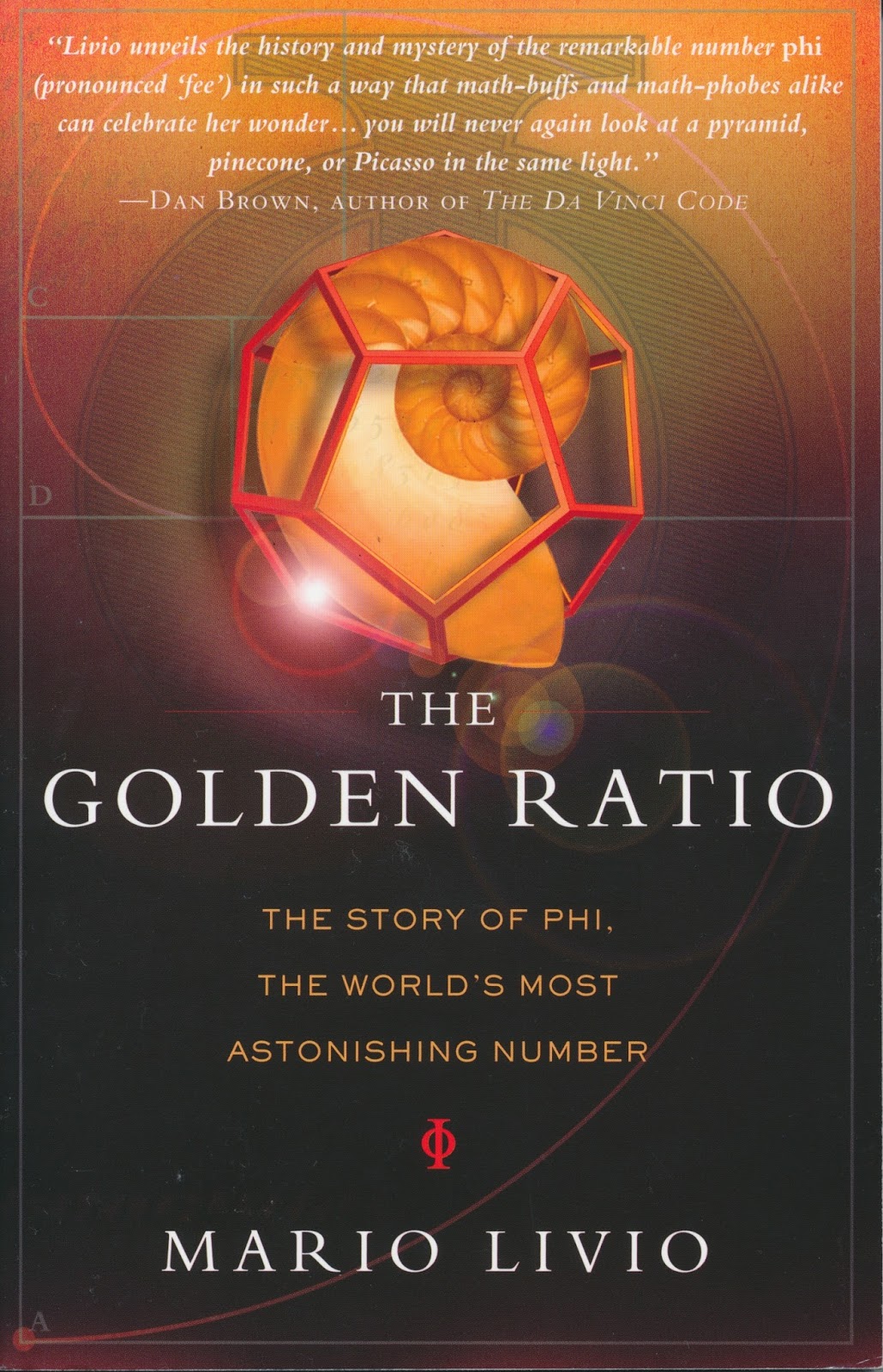
Have you ever heard of the Golden Number? The Divine Proportion? Nature's greatest secret, the deepest mystery on earth, and the world's most astonishing number? No? Well, it might be the second most hyped number after Pi, and it's the subject of such things as this website, this video, and this book. If you believe these sources, then the Golden Number (or Phi) is a mysterious value with strange properties that appears in random places and dictates the rules of all of human civilization and perhaps all of the entire universe as well.
Then, there's The Golden Ratio, a book about Phi which tries to dispel some of the mystique around it. Not all of the mystique, but some of it. It addresses both the mathematical properties of Phi (like its connection with Fibonacci numbers) and the more wiggly properties of Phi (like its use in art as a standard for beauty). I think it does a good job of remaining mostly impartial, denying claims which are probably not true (like that the egyptians built the pyramids using Phi) and verifying claims that are true (such as Phi's prevalence in art after Luca's book The Divine Proportion).
So, if you're looking at all the hype and thinking to yourself wait but no that's not how the universe works, then you might want to give The Golden Ratio a read. And, if you're totally a Phi fanatic, you might want to read it too, just to see what the fuss is about. And, if you've never even heard of this number before, then you can go read something else. I hear Leviathan Wakes is pretty cool.
P.S. One problem is that it doesn't quite explain all of the mathematics in an intuitive way. If only someone were to do that, possibly in some sort of visual episodic format. Alas, that will likely never happen.
Showing posts with label past. Show all posts
Wednesday, July 19, 2017
Thursday, March 09, 2017
Logicomix
Logicomix is the story of the logician Bertrand Russell, as told by the man himself, as told by Apostolos Doxiadis and Christos H. Papadimitriou, drawn by Alecos Papadatos and Annie Di Donna. It is not a book about logic, or the history of logic, or how to live your life in the most logical manner. It really is a story about a real person, and I think it's really well done. For real.
The story follows Bertrand Russell from when he was a very small boy, and was still learning about how to see the world around him. Russell learns of the beauty and elegance in proofs, and sets off to try and prove all the things! This is the meat of the book, and it reads as thrilling a story as any.
This story is told via flashback, as Russell gives a talk to agitated peace protestors during World War II. This, in addition to letting Russell narrate, gives more direction to the story as a whole.
But Logicomix is not just that story. It also tells a part of the story of how Logicomix came to be, showing the day when Christos comes on board to help. Russell's story is presented with the authors and artists talking about what to include in the story. The whole layered narrative thing is fun, partly because so many people can interject, which colors the story just that little bit more. It is very well done.
So, if you think a story about searching for truth told through layered narratives sounds cool, then you should read Logicomix. And also I guess if you like logic or whatever. Or if you're curious about what logic even is, but don't want to actually do any of the hard stuff. Then this is a good book for you. Yep, I am happy with this paragraph's construction.
Wednesday, February 22, 2017
Zero
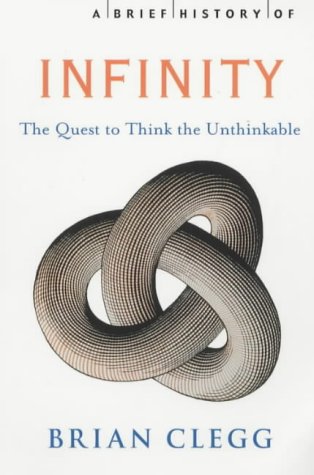
Zero is about nothing. By which I mean, it's about the idea of a void, a lack-of-thing, as being a sort of thing itself. It's written by Charles Seife, who also wrote Proofiness. Zero is similar to A Brief History of Infinity, by Brian Clegg, in that it's more of a history book than it is a math or science book. They're also similar because they talk about infinity, because zero is "infinity's twin."
The first six chapters of Zero (or the first seven, depending on how you count them) are about the idea of nothing slowly working its way into the mainstream, followed closely by the idea of the infinite. There was actually a lot of resistance to both of these ideas, especially in the West, which is made even more interesting by Seife's flowery writing. I'm not entirely sure what "flowery writing" actually means, but I'm pretty sure it happens in this book. Zero does technically go into some math, but never in much detail. There's just enough math to make sense of all the pretty pictures.
The last three chapters are about zero in physics, where it likes to cause problems. This second part seems much weaker than the first part; Seife uses quite a bit of hand-waving, and never shows us a single equation. I think that if Seife would show us the actual equations and where the zeros are, we would better understand why zero is to blame for these quirks. That said, I'm sure some people will be glad that the math all but disappears when the physics comes on.
If you wonder how ideas take hold, or like history, or are somewhat confused about zero yourself, then maybe give Zero a try. For what it's worth, I finished it in just three days, so it can't be all that boring. (Although, that probably says more about my schedule than it does about the book.) I think the best way to understand what Zero is like is probably just to read the introduction (which Seife calls "Chapter 0"), so I've just typed it up here. This might be illegal. Don't tell anyone. The point is, he remains that flowery throughout the book, and if you like that section, I think you can enjoy the rest.
Sunday, February 19, 2017
Flatland
Flatland, by Edwin A. Abbott, is a memoir written by one A. Square, who inhabits the two-dimensional universe known to us as Flatland. The first half of the book is about Flatland itself, and the lives of the people inside it, who live in a strictly ordered society where social class is determined by the number of sides you have. Women, all of which are lines, have the lowest status (even though they are technically really thin quadrilaterals). There's also this freaky thing where kids are beaten into being more regular, and color is not allowed, and it's kind of terrible.
The second half of the book is about A. Square's experience of being visited by a Sphere from Spaceland, which has a third spatial dimension. As A tries to wrap his head around the fact that there can be a third dimension, the reader gets to try to thing about what a fourth dimension could mean. The Sphere also takes A through the first and "zeroth" dimensions, which is fun. Then the Sphere takes A back home, at which point A is promptly thrown in jail for being a lunatic. If you like dystopias and/or thinking about higher dimensions, then Flatland is a book you might like.
Friday, February 10, 2017
Our Mathematical Universe
Our Mathematical Universe is about big questions: Why are we here? What made it all? What's it all made of? Where did we come from? Where will we go? Where did we come from, Cotton Eye Joe? and so forth. More specifically, it is about Max Tegmark's answer to all those questions.
Tegmark takes us on a tour of the extremes of physics, from the epic scales of our entire universe to the smallest scales of atoms and space. The part about cosmology and the beginning of the universe is especially good, because Tegmark has personally worked with the data from satellites investigating the Cosmic Microwave Background Radiation. He also talks about the possibility of multiverses, and identifies four different "levels" of multiverse. I like that he stresses that there is no such thing as a "multiverse theory" in physics; multiverses are not a theory, but a prediction of other theories.
Then he talks about his idea that, in the end, the entire universe is a mathematical object. He makes quite the compelling case for the idea, essentially arguing that for physics to mean anything it has to be true, but in the end he didn't convince me. It's kind of a nice idea, though. A good effort. Anyways, if you'd like to see the structure of the entire book, it's something like this:
Yep. That's taken right out of the book. Tegmark did some of my job for me. Nice of him.
When Tegmark says "my quest for the ultimate nature of reality," he means it. The book is about his quest. Our Mathematical Universe could equally accurately be called Max Tegmark is a Nerd, although I doubt that would sell quite as well. The book is filled with personal anecdotes and little asides, which I think adds to it a lot. Then, of course, there's the whole "reality is math" thing that he believes. Still, he's an interesting person with interesting ideas, so it's fun to go on the "quest" with him. He certainly kept me to the end, at least. If you're also interested in the big questions about what it's all about, and you don't mind having a friend along for the ride, then you would enjoy reading Our Mathematical Universe.
Sunday, January 08, 2017
Prime Obsession
Prime Obsession is written by John Derbyshire, who also wrote Unknown Quantity. Like Unknown Quantity, it is a book about the history of math. Specifically, it's about the Riemann Hypothesis, how it came to be, and what it actually means.
The Riemann Hypothesis is the greatest unsolved problem in mathematics, at least according to the subtitle. It makes a statement about a function (which is described in the book) that has a deep connection with the prime numbers (which is also explained in the book). If you're the kind of person who reads math books, then you've likely already heard of the Riemann Hypothesis. It's one of the six remaining unsolved Millennium Prize puzzles, so proving it to be true or false will make you a million dollars richer.
Prime Obsession is divided into two parts. The odd-numbered chapters are math-heavy, and the even-numbered chapters focus more on history. This is done so that a reader who's just into math can only read the odds, and a reader who's just into history can only read the evens. I don't really like this split; I preferred the structure in Unknown Quantity, where both areas were present throughout the entire book. The split between the chapters removes the interesting math from the interesting stories of the mathematicians. As a more math-leaning person, I found the even chapters a bit slow. Because the people and their stories were not connected with their ideas, a lot of the people become forgettable to me.
All in all, though, I did like the book. Derbyshire explains everything clearly and takes time to ensure that the reader understands what's going on. This is the first source I've found which explains the zeta function's connection to the primes in a way that's clear and satisfying (although it does take a while to get there). I also like that, when Derbyshire does skip a few steps in the math, he takes a moment to explain that and why he is doing so. If you're curious about what this whole "Riemann zeta" business is about, then Prime Obsession is the book to read.
P.S.: You should also watch this video by 3Blue1Brown, which is about visualizing the zeta function. You can consider it a supplement to chapter 13, or you can just watch it because it's pretty.
Tuesday, January 03, 2017
Romeo and/or Juliet
Romeo and/or Juliet is a choose-your-own-adventure book by Ryan North. It has not only one, but several plots, as is typical of a choose-your-own-adventure book. Because of this, I can't really do a plot-focused review, and so I have been putting this off for like two months, because I don't really know what to say.
Romeo and/or Juliet is funny. It makes fun of the original Shakespeare work, pointing out the silly parts of the story and usually replacing them with even sillier ones. The narrator is more of a character than most of the characters, and likes to make anachronistic remarks. When reading, I pictured the narrator as a flying red fairy. You can also do this, if you want.
Well, that's all I've got. Next time, remind me to review a book with a stationary topic. If you like dumb laughs and/or Shakespeare, then you should read this book. Or, I guess I mean you should play it. Interact with it. Read sections of it, and then at the end of those sections make a decision between the offered choices and turn to the appropriate section, and then repeat this process until you get an ending.
See, this is why I had trouble.
Monday, September 05, 2016
The Hike
The hotel is gone, as is the road, and all traces of human civilization. The only thing left is a path, and, seeing no other options, Ben follows this path, in the hopes that it will take him somewhere eventually. Then, strange things start to happen, and they keep getting stranger. Only one thing is clear: If Ben goes off the path, then he will die. As long as he stays on the path, he - well, the point is he should stay on the path.
The Hike is a beautifully written page-turner with memorable characters and one of the best endings I've ever seen. Honestly, I think The Hike is my favorite book now. It's hard to find words to express this fully. There's just nothing about it that I don't like. It has a great little mystery and a few twists which not only genuinely caught me by surprise but also made me completely change the way I framed the whole thing. I love it so much.
If you like good books, then you should read this book.
Labels:
adventures,
bugs,
cryptids/monsters,
fantasy,
friendship,
future,
human-like animals,
humor,
magic,
mystery,
past,
suspense,
technology
Sunday, August 28, 2016
T. rex and the Crater of Doom
T. rex and the Crater of Doom is a book about science unlike any other I've read. Instead of trying to inform the reader about our current understanding of things, it tells the story about how we got there. In other words, it's not just about science, it's about how science is done. Specifically, it tells the story of how puny humans with short lives were able to figure out that all the dinosaurs were murdered by a massive space rock.
This story is told by Walter Alvarez, one of the geologists who first tried to investigate the strange layer at the K-T boundary, which lies right above where the dinosaurs disappear. Walter noticed that there was something odd about the boundary, and decided he would try to get to the bottom of it. As a result, he finds evidence which might go disprove one of the most basic ideas in geology at the time: the idea that all geologic changes happen gradually.
Although the story is gripping, the real reason I love this book is that it explains how science is actually done, not in the abstract, but with an actual real-world example. Anyone who has ever been doubtful of the claims that geologists or paleontologists make about the past needs to read this book. Anyone who thinks that these areas of science are somehow "lesser" than physics or [insert your favorite field here] needs to read this book. And, of course, anyone wondering how we could have possibly found out about this catastrophic event needs to read this book. T. rex and the Crater of Doom is an experience that everyone should have.
Labels:
dinosaurs,
friendship,
non-fiction,
past,
SCIENCE
Friday, April 15, 2016
Unknown Quantity
Do you like math? No? Chances are, I've already scared you off. For those of you who are still here, I've got a treat for you: John Derbyshire's Unknown Quantity. It's a history book, but about algebra.
Well, there go the rest of you. Now nobody is reading this. Ah, well. I thought it was a good book. It's funny, and informative, and did a swell job of keeping me interested throughout the entire thing. There's not that much else to say about it, because it's literally what it says on the cover. It's a history of algebra.
Well, I suppose it would be a good idea to explain what Derbyshire means by "algebra." Algebra isn't just using symbols like X and Y to stand for variables. At it's heart, algebra is using abstraction to make things easier. As you can imagine, this broad definition encompasses a lot. That's what makes it cool, because you can see the logical progression of ideas over hundreds of years into what algebra is today.
I'd say this is more on the math side than the history side, although it's got a lot of both. You spend quite some time learning about the characters behind the equations and ideas, which I like. Basically, if you are interested in the history of math, or in learning how the dingus people ever came up with this crazy math stuff, then this book is for you.
Friday, December 25, 2015
A Brief History of Infinity
I was very confused when I started reading Brian Clegg's A Brief History of Infinity. What I had expected was something like the other mathy books I've reviewed, so I was surprised when it spent a lot of time not talking about infinity. It went on irrelevant tangents, talking about science and people and plagues and things. It wasn't even entirely in chronological order.
I later realized that the reason it was so bad at being a math book was that it was a history book. This book is not about teaching you what infinities are, it's about how the ideas of infinity and the infinitesimal evolved over time, and about what people thought of those ideas. Of course, when it talks about the history of infinity, it also talks about the ideas people had about infinity, because "infinity" has meant different things to different people at different times, and now there are even different kinds of infinity. I guess, given that the subject is so complex, A Brief History of Infinity does a great job of getting it across to you.
If you like the idea of infinity, and you also like reading about people's struggles, then you should read this book. Also, if you want to understand all of the infinities in this link (except maybe surreals), then this book is a really good starting point. Also, it's not that long, so you can read the whole thing over like a weekend. Okay, that's all.
Monday, September 21, 2015
Raptor Red
Robert T. Bakker's Raptor Red is, as far as I know, the first book of its kind, by a long shot. It is not a book about people who bring dinosaurs to life. It is not a book about people with a time machine that travel to the time of the dinosaurs. It's not a book about a hidden land of dinosaurs, protected from time. It's not about cartoonish dinosaurs that generally act like humans. It's not even an informational book about dinosaurs. Nope. Raptor Red is just about dinosaurs.
Red is a Utahraptor lady, and lives during the early Cretaceous period. A land bridge has opened up from Asia to North America, and Red is one of the first Utahraptors to enter this strange land. Red's mate, Doomed-for-death,* dies in the first chapter, leaving Red to fend for herself. For weeks, Red is barely able to scrape by.
Luckily for Red, just when she is on the brink of death, she finds her sister, Run. While they have been separated, Run has managed to get three little raptor chicks: Chuck, Duck, and Hide. Red and Run now have to brave this new land, while protecting the three chicks and facing many perilous perils.
I really like the story, and the characters were all, surprisingly, very memorable. Bakker does a cool thing (like in The Once and Future King) where the animals' speech, mannerisms, and societies are all completely different for different species. You get to see into the minds of crocodiles, turtles, pterosaurs, little mammals, Gastonians, the whole lot of 'em. My only problem is that I think Bakker brings science in a little too much. Every chapter or so, he takes a few paragraphs to describe things scientifically, and it's not really needed.
Raptor Red is still a good book, though. If you like dinosaurs, you basically have to read it, because it's the first true dinosaur book. Actually, if you just like animals in general, you should read it as well, because not even many animal books can pull this off. If you don't like science that much, you can just skim the sciency bits, and it won't take away from the experience at all. This is definitely a book you should read, even just for its premise.
*None of the characters in the book are named except for Red, which makes sense, because she is the point-of-view character, and Utahraptors haven't invented language yet. As such, all the other names I use are ones that I've made up. You are welcome to use them if you want. Also, the guy's name is Sky.
Red is a Utahraptor lady, and lives during the early Cretaceous period. A land bridge has opened up from Asia to North America, and Red is one of the first Utahraptors to enter this strange land. Red's mate, Doomed-for-death,* dies in the first chapter, leaving Red to fend for herself. For weeks, Red is barely able to scrape by.
Luckily for Red, just when she is on the brink of death, she finds her sister, Run. While they have been separated, Run has managed to get three little raptor chicks: Chuck, Duck, and Hide. Red and Run now have to brave this new land, while protecting the three chicks and facing many perilous perils.
I really like the story, and the characters were all, surprisingly, very memorable. Bakker does a cool thing (like in The Once and Future King) where the animals' speech, mannerisms, and societies are all completely different for different species. You get to see into the minds of crocodiles, turtles, pterosaurs, little mammals, Gastonians, the whole lot of 'em. My only problem is that I think Bakker brings science in a little too much. Every chapter or so, he takes a few paragraphs to describe things scientifically, and it's not really needed.
Raptor Red is still a good book, though. If you like dinosaurs, you basically have to read it, because it's the first true dinosaur book. Actually, if you just like animals in general, you should read it as well, because not even many animal books can pull this off. If you don't like science that much, you can just skim the sciency bits, and it won't take away from the experience at all. This is definitely a book you should read, even just for its premise.
*None of the characters in the book are named except for Red, which makes sense, because she is the point-of-view character, and Utahraptors haven't invented language yet. As such, all the other names I use are ones that I've made up. You are welcome to use them if you want. Also, the guy's name is Sky.
Labels:
adventures,
dinosaurs,
friendship,
nature,
past
Tuesday, April 28, 2015
The Secret Series (The Name of This Book is Secret)
Here's a quick one. The Secret Series is one of my favorite book series. Probably in the top five. It's funny, smart(ish), charming, and chocolatey. The books come in five delicious flavors: The Name of This Book is Secret; If You're Reading This, It's Too Late; This Book is not Good for You; This Isn't What It Looks Like; and You Have to Stop This.
That's a quite of books (sorry for my grammar, I'm tired and sick). All in all, it's a whole quintilogy. Or a pentology? Whatever. I just finished rereading the series, and I loved it again. It stars Cass and Max-Ernest, two students who attend The School In Which Things Happen. There are also a whole host of cool, quirky side characters, none of which I will write about because I'm sick and tired.
I realise I'm not doing a great job of selling this, but trust me. The Secret Series is a few million times better than what I make it seem like it is. Wow, my sentences aren't even entirely coherent anymore. Look, I love these books. They were probably my favorite series for a while. If you like humor, magic and... the other stuff under "labels," give this series a try.
In conclusion. These books are real good. Read 'em. That's all I have the brain for today.
Labels:
adventures,
cryptids/monsters,
fantasy,
friendship,
ghosts,
humor,
magic,
mystery,
past,
secret codes,
series,
time travel
Tuesday, June 26, 2007
The Deep Time Diaries, by Gary Raham
Deep time is the time deep in the past. The Deep Time Diaries is about two kids named John and Neesha Olifee and their parents. The Olifees one day found a pair of asteroids, Beta and Alpha. When they went into one of them, Neesha found a "room". One day when she was exploring the room she found what she thought was a bug on the wall. When she looked closely, she found out that the bug was a robot. Then the robot did something weird. He went into a keyboard of some kind and formed itself into one of the keys. Then, Neesha called her family. All four of them tried to pull the bug out but they couldn't do it. Then the accident happened. The room was a space ship. The bug made the ship work, and it zoomed to a wormhole made out of two black wholes in the middle of the asteroids. That was the beginning of the Time Travel Tour. They measure the times that they have been by jumps. Jump 1 is terators and tar pits. In this jump, they discover a mini buggie in the ship and go out exploring finding lots of species from the ice age. With each jump they go farther back in time and understand more about the ship and the bugs it contains. They go all the way to Jump 8 where they discover a mysterious truth which I will not tell you because you will be looking forward to discovering it at the end of the book, but I will tell you that there is a truth. This book also has a few things for "21st century explorers" to do, like places to visit where you can dig fossils, research projects, and other books to read.
If you like science, prehistoric creatures, getting scared out of your wits (just kidding!), and laughing, read this book.
Labels:
dinosaurs,
future,
past,
time travel,
travel log
Thursday, January 25, 2007
Dinosaurs: The world's most terrifying creatures by Veronica Ross
This book was terrific. It tells you about more than just dinosaurs, it's a trip from the Cambrian Period to the 21st century. It'll also tell you about sea monsters and Pterosaurs and other lizards like Coelurosauravus and Diplocaulus and things from the Ice Age like Borhyaena and Colossochelys.This book divided the Cretaceous into two parts.
Wednesday, October 11, 2006
Time Cat, by Lloyd Alexander
This was a good book. I learned a lesson and probably everybody in this book learned a lesson. Some lessons were about cats and some were about humans. This book is about when Jason finds out Gareth, his cat, can actually talk and he can travel back in time and to other places. Come with Time Cat to go to ancient Egypt, Japan, Italy, and other places. I liked this book because in every place Jason and Gareth teach somebody a lesson, like in ancient Egypt the Pharaoh thought that cats should be shouted at and of course that is not true. If you like learning, history, and adventures read this book.
Subscribe to:
Posts (Atom)