Showing posts with label future. Show all posts

Saturday, June 17, 2023

Elder Race

Lynesse Fourth Daughter is brave and true, or as her mother would put it, stupid and gullible. She is the fourth princess in line for the throne, and everyone says as the least likely to make something of herself. But now, finally, she's been given the chance to prove them all wrong. See, there's a demon about, the kind of devastating, potentially world-ending threat that only appears in age-old stories. Lynesse, however, has a plan: if she recruits the famed sorcerer Nyrgoth Elder, he will surely be able to solve the problem.

Nyr Illim Tevitch is tired. Very, very tired. Tired of waiting for contact from Earth, which stopped transmitting signals centuries ago. Tired of shirking and sometimes outright betraying his anthropological duties to survey the planet without interfering with its savage inhabitants. Tired of living with the knowledge that he is quite possibly the last member of his civilization. Mostly, just, tired. But hey, here's a flimsy excuse to wake up from indefinite cryosleep and go for an outing. He's got nothing better to do.

Elder Race tells the tale of these two idiots, together with Lynesse's good friend Esha Free Mark, setting out to find and defeat the demon. Half the chapters are from Lynesse's perspective, and make up a fantasy story; the other half are from Nyr's perspective, and make up a science fiction story. It's an interesting concept, but does it hold up?

Well, it kinda depends on your priorities. If all you want is to see the juxtaposition of two perspectives which view events as science or as magic, then Elder Race absolutely delivers (especially compared to certain other science vs magic books). The technology that Nyr uses is believable as an extension of technology that we have today, and Lynesse's interpretations of these technological marvels makes sense given what she and her culture know of the world. As an exercise in seeing the same thing from two very different pairs of eyes, it succeeds.

My main complaint is with the characters. To be frank, I never really cared about any of them. I couldn't get invested in Lyn's struggle to prove herself as a princess, nor in Nyr's search for meaning in a world that has no place for him in a galaxy that has forgotten him. It's like... have you ever watched a movie and thought, "this would be really great if only it was instead a TV show"? That's the feeling I got reading Elder Race. If only the book was, like, three times its current length, maybe it could have gotten me invested in the characters and story instead of relying entirely on its (admittedly rather clever) worldbuilding.

Also, I could have done with a bit less Anthropology Is Dumb in the book? See, a big part of Nyr's situation is that, as an anthropologist, he's not allowed to speak to the people he studies, nor indeed involve them at all. He's also apparently been taught to be uncomfortably racist against the people he studies. For the first half of the book, I was worried that the author shared his mindset (oh these savages without logic or reason, the only way to be human is to have a telephone, et cetera et cetera), but fortunately toward the end it was made clear that this is a bad thing.

Again I find myself wishing that the book had just a little more time to say its piece. Just another few pages of Nyr discovering that he's a racist little prick. Just another few pages of the characters interacting with each other, making us see them as people worth worrying about. Just another few pages of chatting with people outside our band of heroes, to give the world a real sense of being lived in.

Elder Race does not have the time to do those things, and it doesn't do them. But I mean, the flip side of that is that you can get through the whole book in just one long plane ride, so it's not exactly the biggest waste of time. All things considered, Elder Race had a clever, well-executed concept and nothing more. If that's enough to make you want to read it, then you'll have a good time.

(P.S. For some reason my brain decided that the correct way to pronounce this book's title was El Derrace, as if it were a noun from a romance language. This is irrelevant to the quality of the book, but I thought it was important to note.)

Sunday, October 21, 2018

All the Birds in the Sky

Patricia Delfine is an ordinary girl living an ordinary childhood in her ordinary home. That is until one day when she decides to help a bird with a broken wing, who tells Patricia she's a witch and leads her to the Parliament of Birds, who give her an Endless Question to prove that she's really a witch. Will she be able to solve the riddle? Will she find a way to deal with her slightly sadistic sister? Will she unlock her true powers and become a protector of nature?

Laurence (with a U, not a W) is a shy kid who spends most of his time at home building things like an almost-functioning supercomputer and a watch that takes him two seconds into the future.  One day, he decides to sneak out of school to see a rocket launch at MIT. Will he use this time-skipping watch to expand on science's understanding of time? Will he succeed in creating a supercomputer? Will anyone ever stop calling him Larry?

The answers to these questions are all "maybe," because all of that happens in the first two chapters and then we immediately skip forwards by several years. Now, Patricia and Laurence both attend Canterbury Academy, a high school in which neither of them quite fit. Fortunately, they find each other, and tentatively start forming a friendship. Before long, the two become fast friends, and have all the sorts of misadventures that you would expect from a feel-good novel about high-school aged kids.

PSYCHE! They're soon separated and don't see each other for ten years, during which they split into their respective separate and irreconcilable worlds! Charlie Jane Anders has fooled you again! So yeah, Laurence is now a fancy science man who does fancy science, and Patricia is now a witch who does witchy things. Like for example assassination? I'm pretty sure Patricia is an assassin now? It's unclear. The point is, fancy science and witchy things can never ever go together, so Patricia and Laurence have an uncrossable rift between them, which they must somehow bridge if they are to ever be friends again.

Fortunately, our two protagonists have all the time they need to get to know each other, because the world is ending. Oh wait no that's bad. Don't worry, there are plans in the works to fix the oncoming apocalypse, which has to do with the climate changing by the way. Patricia's witch squad has proposed the worst plan in the universe, so that's maybe a bad idea. Fortunately, Laurence's science squad has proposed an alternative, which is also a bad plan but is preferable in that it is not the worst plan in the universe. The actual contents of both plans are kinda spoilers so I won't go into them here, but I mean really could they not like try any non-last-resort ideas given that they are not yet at a last-resort stage of the apocalypse?

Okay, I'm being a bit mean here. All the Birds in the Sky is a fun book, even if it does get somewhat pushed around by fridge logic. Laurence's science inventions are all pretty cool, even though they never get to a super useful practical level, much less an Iron Man level (with one spoilerish exception). Patricia's magic spells are rich and varied, and the associated costs keep them from feeling too overpowered. All in all, it's a pretty well-done balance of tech and magic.

If I do have any complaints, and I do, they're mostly about elements of the world, and in particular its portrayal of "the science side." First off, the idea of an uncrossable rift between magic and science bothers me. This is probably because of my obsession familiarity with science. See, science is a process and a lens through which you can see the world, and even if it doesn't entirely work you can at least try to apply science to magic. I guess I've been spoiled by things like Harry Potter and the Methods of Rationality, Artemis Fowl, Girl Genius, Atomic Robo, (but I'm going to invisible this text so that no one knows that I consider these magic-and-science, the first being science at heart and the last two being magic at heart) and The Entire SCP Wiki. In short, the problem I have is that the driving force of conflict (science vs magic) is something that I think is stupid.

Then, there's the trouble of how the science side in itself is portrayed. It's more of an "I have invented this cool thing now" than an "I am curious about how the universe works and how I can make it work for me." To see what I mean, let's take another look at that time-machine watch. First of all, and I admit this is nit-picky, the book acts as if two seconds is a really short amount of time. Like, Laurence skips forward two seconds and nobody notices because it just looks like he's flickering. This is two seconds: . That doesn't look like flickering to me.

But, more than that, there's the whole concept of the watch itself. Why two seconds? Why can't you jump more or less time? How does the watch know what to move forward and what to not affect? How would it affect a liquid? What reference frame is it using for the output point in space? How much mass can it affect? What happens to the space you used to take up in the two seconds are gone? None of these questions are asked by any of the characters, not even the ones that are meant to be "science people". My point is that an actual scientist would do so much with this, but in All the Birds in the Sky it's dismissed as just another "science thing."

It is, however, pretty clear why these avenues are not explored. All the Birds in the Sky isn't a book about the difficulties of reconciling science and magic. It's a book about Patricia Delfine and Laurence WaitDidHeHaveALastName, and their relationship with each other. The science fiction is of the pulpy magic-but-with-"quantum"-on-it variety. Essentially, in All the Birds in the Sky, "science" is a less effective and less reliable form of magic, with the bonus of not having any apparent costs. The split between the two sides is there only to drive the conflict of the book, and it works.

In conclusion, let this be a lesson to you all that thinking too hard about books can be bad for you. After a thousand words of text, my actual position towards All the Birds in the Sky seems murky. To be clear: I did like the book, although many of its elements ticked me off in just the wrong ways. If you want a deep exploration into whether or not science can be reconciled with magic, then this is probably not the book for you (and, honestly, I can't think of a single book which focuses on that question). If, however, you want to read a relationship drama between two awkward misfits, with the added spice of them being from different worlds and at the start of an apocalypse, then All the Birds in the Sky might be the book for you.

Saturday, October 20, 2018

Abaddon's Gate (The Expanse book 3)

It’s still the future, and not thinking about Venus is no longer an option. Y’see, the thing that used to be on Venus seems to have commandeered the planet to create a giant circle in space. A strapping young man by the name of Expendable McPlotPoint pulls the daredevil stunt of the millennium and shoots himself past the Martian Blockade, becoming the first to travel directly through the strange giant circle and into whatever lies on the other side. Spoilers: he doesn’t survive. Not even a little bit.

So that's fun. Oh and Holden is still around by the way, doing his Holdeny thing: leading his crew through space, taking jobs from whoever offers the most spacebucks, and generally holding stuff together. His new ghost friend, whose origins and motive remain mysterious, has told Holden to stay away from the space circle formerly known as Venus. Holden agrees with his ghost friend wholeheartedly, and resolves to give the space circle formerly known as Venus a wide birth. I sure hope that works out for him.

Meanwhile, Annushka Volovodov, a humble space pastor, is having a nice time past-ing space (or whatever it is space pastors do). She gets offered the opportunity of a lifetime: travel with the United Nations (the government of Earth) along with other religious folks and such to witness for herself the glory of the space circle formerly known as Venus. She accepts the offer (which is technically a spoiler but I mean come on) and finds herself well on her way to what is about to be the biggest mess in human history.

Also on his way to this mess is Carlos c de Baca, known as "bull" to his friends, who is in charge of the largest ship in the solar system, which has been creatively named the Behemoth. Just once I want an ultimate mega-warship which is called something innocuous like the Lilac or the Flying Festoon. Anyways, Bull has been personally asked by the leader of the Outer Planets Alliance to keep the Behemoth in shape. After McPlotPoint does his crazy stunt, Bull is ordered to meet with the Earth and Mars forces at the space circle formerly known as Venus, to show them that the OPA are team players.

Rounding off the cast of four we have Petunia Adams-Rogers, a farm girl from Oklahoma who has never stepped out of the Earth's atmosphere, but dreams of traveling the stars. After a surprise visit from an esteemed scientist to her college, she is offered the chance to join Anna in the UN ship set for the space circle formerly known as Venus. She of course agrees, and– yeah okay I think that's enough of this gag.

No, Petunia does not exist. She was probably murdered by Clarissa Mao, so that Clarissa Mao could take her place and pretend to be a protagonist. Clarissa is the sister of Julie Mao (the subject of Miller's search in the first book) and the daughter of Jules-Pierre Mao (one of the richest people in future history), who was taken down by Holden and company in the previous book. Oh, um, I guess that was a spoiler for the second book. Oops. Now, Clarissa has only one goal in her mind: discredit Holden, make everyone think he's garbage, and then kill him. Because he's a paragon, and paragons are immune to ordinary store-bought revenge.

Abaddon's Gate is fun, and I think captures more of the action-drama of the first book. There's still a lot of political drama going on, what with everyone having a look at the space circle formerly known as Venus and all, but there's also plenty of explosions and guns and whatever it is Clarissa Mao does. Speaking of Clarissa, it was very interesting to have an honest-to-god antagonist as a POV character. She's not an antihero, and we're not meant to empathize with her, and she doesn't even have any delusions of righteousness or whatever. She's just an insane murderer, and the fact that we know what she's doing and planning makes us all the more worried for the protagonists, which turns the suspense up to eleven.

As for the rest of the characters, I don't feel like they were really as strong as those from the first and second books. Bull and Anna in particular seemed to get the short end of the characterization stick. I get the sense that, out of the four characters in Abaddon's Gate, Anna is followed the least, but I'm not sure if that's reflective of the actual number of chapters she's in.

Despite these flaws, Abaddon's Gate is still a fast-paced and well-written action drama that keeps you hooked until the very end. I think it is my second favorite of the Expanse books so far, after Leviathan Wakes (the first one). My conclusion is of course that if you liked the second one then you'll like this one, which shouldn't really surprise anyone. I'm not even sure if these count as reviews anymore, because I'm just summarizing the setup and making a few comments. Ah, well, I'll keep doing these regardless. They're fun.

Anyways, yeah. Series are series. Give Abbadon's Gate a shot if and only if you wanna. Peace.

Tuesday, July 18, 2017

Caliban's War (The Expanse book 2)

Caliban's War is the second book in the Expanse series. It's still the future, and everything is mostly fine as long as you don't think about Venus so don't think about Venus. The three superpowers (Earth, Mars, and the Belt) are eyeing each other nervously. As long as nobody rocks the boat, and Venus stays quiet, it looks like things will go back to normal soon.

Bobbie Draper is working on Ganymede, a moon where scientists do farming. She's in the Martian military, and her job is to stare at the Earth military while farming happens. Because, seriously, who would attack a farm moon? Then a lanky humanoid with huge hands and a huge head rips through both teams and violently explodes. Bobbie is the only survivor. Now, she's got one thing on her mind: revenge. And also I think she has PTSD.

But, she wasn't the only person on Ganymede. There was also Praxidike Meng, or "Prax," one of the aforementioned farm scientists. Now his science farm has been destroyed, along with most of his life's work. At least he still has his daughter, Amy or somethingMei, who was kidnapped shortly before the monster appeared so okay maybe he doesn't have his daughter. Still, he has a slim hope of finding her, so that's what he'll do.

Back on Earth, Chrisjen Avasarala is hard at work as a politician trying to keep the solar system falling apart. Then this whole Ganymede business happens, and things start really getting bad. Also, Venus seems to be acting up a bit. Try not to think about it. Anyways, she's got to put all the pieces together and figure out who done the monster, and also make some friends.

And James Holden is still there, with his crew, trying to deal with things as best he can. He messes up slightly less in this one. I think he's learning.

So, to be honest, I liked the original book better than this one. First of all, Leviathan Wakes straight-up had more action, and I like my boom boom bang. Second, I feel like only having two main characters, rather than the four in Caliban's War, kept things simpler and more predictable, which I felt was a good thing. There's no character order in Caliban's War, so it sometimes just flips between two characters without addressing the other two, which lessens a bit the feeling of everything is going wrong everywhere.

Still, Caliban's War is a good book, and the new characters are all nice. If you liked Leviathan Wakes, you'll probably like it. Yep, that's my big final rating: "If you liked the first one, you might want to continue the series." Don't I feel smart.

Friday, June 23, 2017

Leviathan Wakes (The Expanse book 1)

Space. The final frontier. Humanity, insatiable in its quest for exploration, tosses itself into the void between worlds, strapped to tin cans with high explosives. What could possibly go wrong? Well, James S. A. Corey (who is actually two people or something) aims to find out in Leviathan Wakes, the first book of a (planned) nine-book series.

Meet James Holden, executive officer on a freighter which brings ice between planets. The solar system is a big place, after all, and people still need water. Unfortunately, when responding to a mysterious distress beacon, the freighter is nuked and almost all of Holden's friends are killed. It's not pretty.

Let's see if Josephus Miller is doing any better. He's a detective on Ceres station, born and raised in the Belt. He's running into some trouble because his partner, Havelock, is from Earth, which means that Belters don't like him so much. Still, everything should be fine, as long as some Earther doesn't inadvertently start a war because someone nuked his freighter and almost all of his friends were killed. But what are the chances of that, am I right?

So, yeah, now a war is brewing. The Earth and Mars are looking at each other all shifty, and the Outer Planets Alliance which claims to represent the belt is making everyone a bit antsy. Also, there's that thing from the introduction which hasn't shown up in a while. Hope that's not important. Now Holden is on a mission to find out who killed his ship, and Miller is on a mission to find a lost girl named Julie, and... well, things get a bit hectic.

Leviathan Wakes is a bangin' book. It's got killer pacing, and characters that are interesting and fun to be with. The world seems real and realistic, even with the crazier things that show up. The tension and the stakes keep getting ramped up, with more and more people being dragged in, and then you remember the title is "Leviathan Wakes" and get really worried. To make things even more intense, we follow Holden and Miller in alternating chapters, so there's almost always a cliffhanger after each chapter even if you don't stop reading, which I think is a really cool way to do things.

If you like high-stakes space drama mystery action, or if you want to become lost in a world which might be about to lose itself, or if you want to get to know interesting characters which could all die at any moment, then you should read Leviathan Wakes. And probably the rest of The Expanse.

Friday, May 19, 2017

Scythe

It's the future. Everything is great. An incredibly powerful AI known only as the Thunderhead has taken over the world, and is hell-bent on making life good for everyone. There's no more war, no more poverty, no more disease, and no more death. With one exception.

The Scythes (pronounced SKITH-ees) are an organization of people who are tasked with keeping the population in check by killing ("gleaning") people. They are the most revered and feared members of society. Citra and Rowan are two of the minority of people who outwardly disapproves of the Scythes, which sucks for them, because a wise old Scythe named Faraday has appointed them as apprentices.

Now, Citra and Rowan have to compete with each other to see who gets to become a Scythe. Except, neither one actually wants the job. But they both kinda do. It's good fun. Also, there's this whole thing with these Scythes who are holding "mass gleanings," which are exactly as terrible as they sound. I hope those guys don't cause any trouble.

Neal Shusterman's Scythe is a pretty fun book. The story is a whirlwind, with mysteries that had me genuinely second-guessing myself throughout the book. Seeing the separate journeys of Citra and Rowan as they learn how to kill is cool. It's apparently the first book in a trilogy, but the ending is actually really satisfying, so it can stand entirely on its own. Scythe also pokes at some really interesting issues about death and longevity and utopia. If you like a bit of action, a bit of mystery, and a lot of murder, then you should pick up Scythe.

Friday, February 10, 2017

Our Mathematical Universe

Our Mathematical Universe is about big questions: Why are we here? What made it all? What's it all made of? Where did we come from? Where will we go? Where did we come from, Cotton Eye Joe? and so forth. More specifically, it is about Max Tegmark's answer to all those questions.

Tegmark takes us on a tour of the extremes of physics, from the epic scales of our entire universe to the smallest scales of atoms and space. The part about cosmology and the beginning of the universe is especially good, because Tegmark has personally worked with the data from satellites investigating the Cosmic Microwave Background Radiation. He also talks about the possibility of multiverses, and identifies four different "levels" of multiverse. I like that he stresses that there is no such thing as a "multiverse theory" in physics; multiverses are not a theory, but a prediction of other theories.

Then he talks about his idea that, in the end, the entire universe is a mathematical object. He makes quite the compelling case for the idea, essentially arguing that for physics to mean anything it has to be true, but in the end he didn't convince me. It's kind of a nice idea, though. A good effort. Anyways, if you'd like to see the structure of the entire book, it's something like this:
Yep. That's taken right out of the book. Tegmark did some of my job for me. Nice of him.

When Tegmark says "my quest for the ultimate nature of reality," he means it. The book is about his quest. Our Mathematical Universe could equally accurately be called Max Tegmark is a Nerd, although I doubt that would sell quite as well. The book is filled with personal anecdotes and little asides, which I think adds to it a lot. Then, of course, there's the whole "reality is math" thing that he believes. Still, he's an interesting person with interesting ideas, so it's fun to go on the "quest" with him. He certainly kept me to the end, at least. If you're also interested in the big questions about what it's all about, and you don't mind having a friend along for the ride, then you would enjoy reading Our Mathematical Universe.

Monday, September 05, 2016

The Hike

The Hike, by Drew Magary, is about a man who gets well and truly lost. The man in question is Ben, a thirty-eight year old with a wife and three kids and a house and an important business meeting to get to. Before he goes to the meeting, he decides to take a walk. The walk turn into a hike. The hike turns into a mad sprint for his life. Then he gets lost.

The hotel is gone, as is the road, and all traces of human civilization. The only thing left is a path, and, seeing no other options, Ben follows this path, in the hopes that it will take him somewhere eventually. Then, strange things start to happen, and they keep getting stranger. Only one thing is clear: If Ben goes off the path, then he will die. As long as he stays on the path, he - well, the point is he should stay on the path.

The Hike is a beautifully written page-turner with memorable characters and one of the best endings I've ever seen. Honestly, I think The Hike is my favorite book now. It's hard to find words to express this fully. There's just nothing about it that I don't like. It has a great little mystery and a few twists which not only genuinely caught me by surprise but also made me completely change the way I framed the whole thing. I love it so much.

If you like good books, then you should read this book.

Friday, June 24, 2016

Witch & Wizard

Witch and Wizard, by James Patterson and a second author in smaller print, is about a witch and a wizard. Their names are Wisteria and Whitford Allgood, but they usually go by Wisty and Whit. Yes, they are really the All-good family.

Unfortunately for them, "the country" has elected some fellows called the New Order into power, and in "a few months" the New Order has completely destroyed "the old government" and instituted a council to rule over the new authoritarian state and also they've convinced everyone that not only does magic exist but also that it's evil and that it's okay to do terrible things to children and also the Allgoods are the last nice parents on Earth and everyone else is just sorta fine with it except for kids so the New Order just kills children by the hundreds and did I mention EVERYONE IS FINE WITH IT and also there are apparently no countries other than "the country" because everyone is either in the New Order or in the resistance as clearly marked in the map and also the world is flat I guess and there are no oceans but there's also four other levels of reality because why not?

So, yeah, it's set in an alternate reality where that somehow makes sense.

Anyways, Wisty and Whit have somehow missed the fact that the GOVERNMENT IS GONE AND EVERYONE IS EVIL sorry I need a little time to adjust to this premise.

[time passes]

So, Wisty and Whit were not informed about the new government, nor about the existence of magic, nor about the fact that magic is illegal and morally reprehensible. They are then completely surprised when they are arrested by the New Order for the charge of being a witch and a wizard, respectively. They are even more surprised when they start developing magical powers, such as seeing ghosts and being on fire. Slightly less surprising is that they are sentenced to death. Now, Wisty and Whit have to use their magic to escape the torture-prison and find their parents.

The review so far has been a bit ranty, so I feel like I should clarify: I really liked Witch & Wizard. It is fun, and easy to read, and it moves at an incredibly fast pace. The good characters are all likable, and the evil characters are all cartoonishly evil. I'm also okay with the ridiculous setting, because it just emphasizes the whole silly good-vs-bad fun of the story.

So, read this book if you like fast-paced action and fun. Try to ignore my little rant. Honestly, I just made it for fun.

Wednesday, June 15, 2016

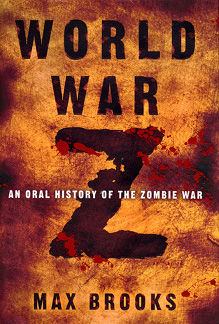
World War Z

The year is like 2026-ish. The world is slowly being rebuilt from the devastating 10-year zombie apocalypse. Max Brooks, of the United Nations Postwar Commission Report, has spent the last few years flying around the world and gathering stories from the survivors. Now, some of their stories have been compiled into World War Z, an oral history of the zombie war.

This is one of my favorite books. It is, as I said, a collection of stories, all in the form of interviews, which together tell the overall story of humanity and it's struggle to overcome this deadly force. It was apparently inspired by a real history book, The Good War, which was told in the same format. I am quickly running out of things to say.

So, I've just read a bunch of other reviews, because I have no ideas of my own. It seems like most of the complaints stem from the strange format, because you cannot connect to the characters and watch their story arcs, because the interview are so short. I can see what they're talking about, but that's not really a problem for me, because I tend to empathize with any character who isn't completely terrible, and most of these characters are likable.

I actually think this format works well, because it emphasizes that the zombie war (and other wars) can't be seen as simply actions of "the masses," and that everyone needs to work together to defeat the zombies. This theme is slightly undercut by the U.S.-centrism which creeps it way into some parts of the book, but it still works overall.

What I like most about World War Z is the fact that Brooks makes so many different kinds of stories. There are quite a few about guilty military personnel, and about how everyone was doing things wrong, but for the most part it was full of diversity. There are some stories about survival, people going insane, a nuclear exchange, the formation of a religious state, plans that pulled humanity back from the brink, people giving their lives to try to cleanse areas from zombies, and gung-ho military operations.

So, If you think you will like it, give it a shot. If not, well, maybe this book is not for you. At least read a few chapters. Oh, and if you liked The Zombie Survival Guide (which uses the same zombies), then you will probably love World War Z, because it is a collection of the kinds of stories you made up while you read the survival guide. That's all I've got.

Wednesday, April 27, 2016

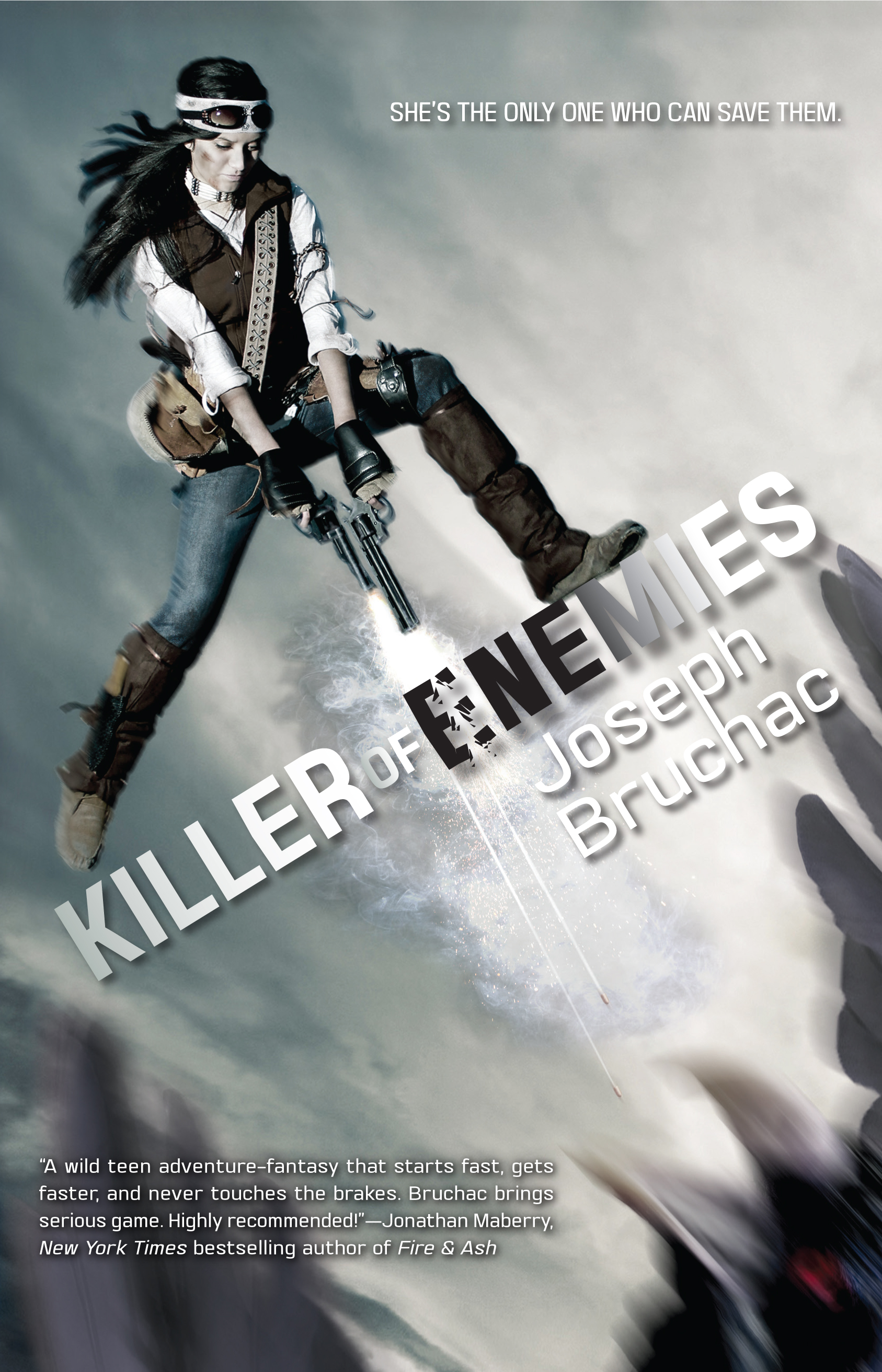
Killer of Enemies

Killer of Enemies is kind of a terrible book and it's great. I initially started reading it because of its ridiculous title, and it lived up to its cover. This is not to say that is was a bad book; I had fun reading it and the world of the story is pretty cool, so I don't feel like I wasted my time or anything. So, what is it about?

Have you ever thought to yourself, "I wonder what it would be like to read about someone playing Monster Hunter or Shadow of the Colossus or a similar game with giant monsters"? Have you ever then immediately thought, "no, wait, that wouldn't be nearly as interesting, I'll just play them myself and that will be more fun"? Well, Joseph Bruchac did not have the second thought, and so Killer of Enemies was born.

The book involves our protagonist, Lozen, who is the best at everything, killing huge genetically modified monsters. This is a post-apocalyptic future, set after the rigidly-divided classist technofuture from so many books. An entity known only as the Cloud has come and turned off all of the electronic devices and engines, but not gunpowder, and also rocket launchers and automatic weapons still work. The rules seem to be kinda fuzzy.

Anyways, all the super rich leaders had electronic implants or nanobots and so they died when the Cloud came. Some survivors who didn't have many implants formed a rigid society with aristocrats as evil dictators. One such society is holding Lozen's parents hostage to make her kill things. She then kills things. Usually huge things. There's more story, but not much.

Killer of Enemies is not high-brow hmmyes fiction, and it doesn't try to be. It really reads like a fanfiction of Shadow of the Colossus, because it mostly involves Lozen outsmarting and then wrecking giants. There is a simple story, which is nice, but it's not the focus. If you like big dumb action, and I certainly do, then you should read Killer of Enemies.

Oh and also there's magic. And zombies. Just thought you should know.

Saturday, February 20, 2016

Soon I Will Be Invincible

While reading Soon I Will Be Invincible, by Austin Grossman, I get the feeling that I would enjoy it more if I was into that whole comic book superhero type culture. It feels like the book may be full of tropey-type jokes that I just don't get. This means I don't entirely trust my own opinion, here.

Of course, that's not about to stop me. Soon I Will Be Invincible has a great title and two protagonists. Well, two main characters. The first is Doctor Impossible, the Smartest Man Alive, who aims to bust out of prison and take over the world. The second is Fatale (pronounced fuh-toll) the cyborg with a dark past that isn't really there.

Fatale has just been admitted into the Champions, a league of superheroes investigating the disappearance of Superman Legacy The Tick Core-Fire, a charismatic invulnerable flying tank with more abilities than anyone could ever need. Meanwhile, Doctor Impossible has escaped, and is already scheming to take over the world.

I don't really have much to say about this. It has almost nothing in the way of character growth, for anyone other than Fatale. It is riddled with either poorly-executed foreshadowing or terribly-executed exposition. Honestly, those are the only two problems for me, but they seem like big ones. I really think it might just be because I'm not used to books like this.

Blugh. I don't like writing reviews that aren't positive (I've only got one truly negative review). It leaves a bad taste in my mouth. You know what? Don't listen to me. Give Soon I Will Be Invincible a try. It was fun. I read it in a few days, so that's good for something (like, it grabbed my attention or whatever). And, in the end, it does have a pretty sweet title.

Thursday, December 24, 2015

The Girl With All The Gifts

The Girl With All The Gifts is a book about the end of the world. In it, a girl named Melanie is kept in a bunker, underground, sealed off from everyone else. Everyone always treats her as if she's extremely dangerous, along with the someteen other kids who share the bunker wit her. I'm not entirely sure how much I should spoil, because there is a nice little mystery through the first part of the book. One thing I will say is: it's totally zombies.

But then, after the mystery is all worked out, the compound is attacked. Melanie escapes, along with a ragtag group of individuals (I don't want to spoil who), and they all have to make it back to Beacon City, the last human stronghold in all of Great Britain. Along the way, they will have to survive bandits, come to uneasy agreements with each other, and not be eaten by zombies.

The zombies, by the way, are definitely a strong point in The Girl With All The Gifts. They are a variation of the cordyceps fungus (think The Last of Us) which essentially just means, "hey, this is technically possible, and therefore better than those other zombies!"* The zombies (which are called "hungries" by the cast) are thin and pale, and they spend most of their time stock-still. However, as soon as they hear a noise, they snap to attention and run towards it. If a hungry smells a human, it also immediately enters its rage state and runs towards it. This is actually a really clever idea, and it leads to the haunting image of a garden of pale figures, staying perfectly still.

There are, however, complications. There are other rules to the zombies which are revealed along the way, and they... well, honestly, they make absolutely no sense. Some of them, at least. This is the problem I have with the book: plot holes. So many plot holes. None of them are game-breaking, but they are certainly there. For someone as plot-driven as I am, this is a serious problem. I like picking apart exactly why and how things happen; it's one of the reasons I love time-travel stories so much. However, there are just too many things to pick at, here.

That's why, originally, I didn't want to write this. I don't like writing negative reviews. If I read a book and don't like it, I usually will just skip over it. However, this book has all of the things I like. An interesting premise. A hostile environment. Half-believable pseudoscience. Excellent characters. Objectively, this is a good book. But I didn't like it.

So, here's my conclusion: If you like zombies, or children, or adventure, or suspense, or mystery, or heartbreak, and you do not care at all about plot holes (or are not good at spotting them), then you should read this book.


*Really, though, there aren't any realistic zombies, just zombies that are slightly less impossible. The cordyceps fungus affects insects and arthropods, things with skeletons. They breathe through their skin. Humans don't. Also, the cordyceps fungus does not make an organism rant to attack or eat its own kind. That would be wildly inefficient. Instead, the fungus just makes it infiltrate its hive area and try to get into a good vantage point to spread its spores. I don't know of anything that deliberately makes an animal attack another animal. Even rabies just makes the animals angry, aggressive, and confused; as opposed to bloodthirsty. I think 28 Days Later's "rage virus" is the most semi-realistic zombie I've seen. Although the Brooks Zombies will always be the best ones.

tl;dr: Ain't no realistic zombies. Using an actual organism only helps with appearances. If you want a good, realistic interpretation of human cordyceps, take a few minutes to read Up, by Josef K. It's real short.

Monday, October 26, 2015

Bangs & Whimpers

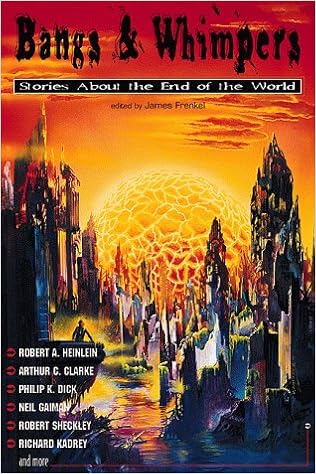
Bangs and Whimpers, edited by James Frenkel (I'm not sure how much credit he should get), is exactly what it says in the cover: stories about the end of the world. There are nineteen stories in all, each by a different science fiction author.

There are a surprising amount of different themes in the book, although the sun explodes one time too many, in my opinion. Some of the stories are sad, some dark, some hopeful, and a few actually funny. The only thing they have in common is that, by the end of the story, something very bad has happened. Well, most times. See? So many kinds of stories!

Because they're so different, it's hard to say anything aside from "they're good." I mean, umm... They're short stories, so the longest take at most an afternoon. Most of 'em are science fiction. I love them all, except "Finis," and maybe the lemming one. The cover uses mainly warm colors.

Look, this is too hard. Just... if you have ever enjoyed anything post-apocalyptic, or any story in which everything goes wrong, or sci-fi stories with interesting twists and mechanics, or bleak stories about human weakness, or hopeful stories about human ingenuity, then you will definitely love at least one of the stories in Bangs and Whimpers.

Saturday, June 27, 2015

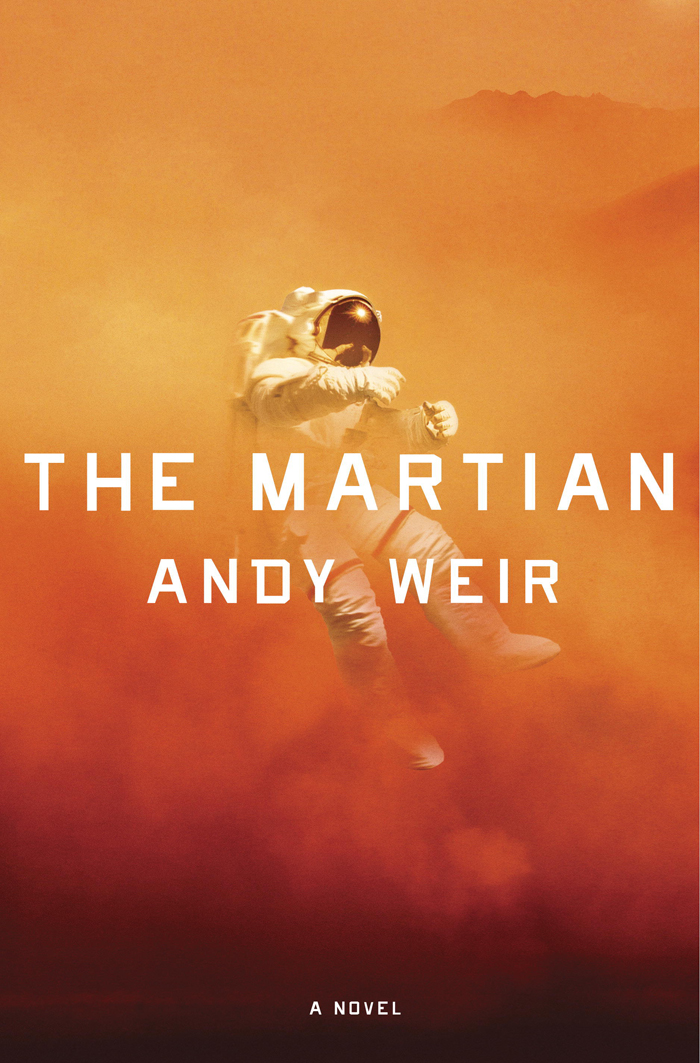
The Martian

First of all, as some of you are probably aware of, The Martian is being adapted into a major motion picture!

Well, that's all I'm saying about that. The Martian, by Andy Weir, is a book about a guy by the name of Mark Watney. Mark Watney has a bit of a problem, in that he is stuck alone on Mars without any way to get off, and everyone back on Earth thinks he's dead. Whoopsie daisy.

Mark now needs to survive in a barren landscape with nothing but years of NASA's hard work and efforts along with millions of dollars worth of resources. Well, that doesn't sound too bad, does it? Yeah... Spoilers: it doesn't work out great. Mark is going to have to do everything he can to survive.

There are other characters, by the way, but they don't show up until, like, the sixth chapter.

Will Mark be able to find enough food? Will the people of Earth be willing to help? Will mark explode violently due to decompression? Is the planet Mars conspiring against him? Will he ever be able to get back? And, most importantly, will the President pardon him for his acts of space piracy? Read to find out.

Or, like, if you are just hyped for the movie, you should read it as well. Or if you enjoy high-stakes engineering. Or extraterrestrial farming. You know what? Just read it. It's super good.

Wednesday, June 10, 2015

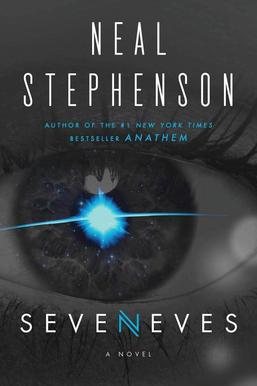
Seveneves

Warning: this is a long story. Seveneves (pronounced "seh-veh-neh-ves") is one of those books that are not only very long but also seem like they have no chapters. The book doesn't have a table of contents, which is understandable, because some chapters are almost three HUNDRED pages long. Still, I've written one up, in case you want it.

Because it's so long, it's almost two separate stories, and the pace basically continues to ramp up throughout the entire story. This eventually lead to a severe loss of sleep. Do not attempt finishing this book if you have important things to do.

Anyways, I've decided to do three different trailer-things, one for each part of the book. I've tried to remove most of the spoilers. Here we go.

Part One: The time is, like now-ish. I think it's an alternate universe or something? Actually, it may be in the future, and technology has remained about the same. I dunno. And then the moon suddenly explodes, all rude and inconsiderate-like. Spoilers: this will lead to life on earth being destroyed. When they realize this, the governments of the world start attempting to create a swarming space station of little space ships, surrounding the International Space Station. Will they succeed? Yes. But it's the journey, not the destination, that matters most.

Part Two: Speaking of journeys, the Cloud Ark has become fully operational and several billion people have died. The 1500 remaining humans now have to endure five thousand years in space. Wait, really? Five thousand? That seems a bit excessive. Anyways, everyone has been shuttled into space, and our heroes are now facing all the hardships usually associated with being in outer space. Marcus has replaced Ivy as the ship's leader, Doc Dubois has stepped out of his media shoes and started helping out, and all is well. But, the inside flap of the book said that "only a handful" of people survive, and that can't be more than 20, so something must be about to go down. And if anyone can reduce the human population from 1500 to 20, it's former president Julia Bliss Flaherty.

Part Three: Five thousand years later. humans have split into seven different races: the smart ones, the strong ones, the heroic ones, the nice ones, the paranoid ones, the super-mutant-power-that-is-actually-a-really-cool-idea ones, and Slytherin. A girl from the super-mutant one, Kath Two, is on a standard survey mission down to Earth's surface when she sees something strange. Before she knows it, she gets wrapped up in a strange mission with an unclear goal and untrustworthy partners. This is where the story really heats up, in a future focused entirely on mechanics, robotics, and genetics, where everything from earlier in the story starts to come into play.

Seveneves is the first book I've read in this whole epic odyssey style. I have to say, I can see what all the hype is about. If you've got some free time, this is definitely a cool science fiction book for you to try out.

Sunday, March 08, 2015

Expedition

Expedition: being an account in words and artwork of the 2358 A. D. voyage to Darwin IV. That's the title, because I'm not sure you can read it in the tiny font on the picture.
Anyways, Expedition probably has the coolest alien world I've ever seen. That includes Snaiad, and you know how know how much I love OH WAIT YOU DON'T BECAUSE RAMJET STILL HASN'T MADE A SNAIAD BOOK.
Ahem.
Expedition probably has the coolest alien world I've ever seen. It's called Darwin IV (that's a four) and is a self-consistent planet with an odd ecology and a big ol' map. It's unique among alien worlds in that it doesn't try super hard to make the aliens look weird, they just kinda end up that way.
The story is about the author, Wayne Barlowe, who lives in the dying Earth of the 2300s. Most life on earth is dead, and humans have only survived because of their partnership with the Yma, a friendly alien race.
After receiving a mysterious picture of what appears to be an alien from the faster-than-light satellite on Darwin IV, the Yma and the humans prepare an expedition to the planet. The Yma choose Wayne Barlowe as one of the candidates for the expedition, because of his skill at drawing extinct Earth wildlife.
Barlowe is the artist of the crew. That's nice, because the reader isn't bogged down by the biology and geology of Darwin IV, and can just sit back and read Barlowe's stories about encountering these odd creatures.
The book is in six parts, each with a biome of sorts: Grasslands and Plains, Forest and Periphery, Amoebic Sea and Littoral Zone, Mountains, Tundra, and Air. Each of these sections as a few stories about Barlowe's adventures. Most of these adventures involve large wildlife and strange adaptations, and all are SUPER COOL.
I'm not really sure what else to say. Look, if you like what you heard so far, then read the book. It is super expensive, but I think it's worth it. This book. Is good.

Monday, February 03, 2014

Saga (and also Epic)

Saga is the second book in a series starting with Epic. The series in set in the future, on New Earth (which is like old earth, but fresher). on New Earth, all arguments are settled in a video game called Epic, which is set in a fantasy world. Eric, a boy from New Earth, goes on a quest to become rich and then accidentally saves the world.
This is where the first book ends. In the second book, Saga, a mysterious robot probe replaces Epic with a new game called Saga. Saga is also set in the future, but more so (the people have hover cars, hover boards, holograms, and the like). Citizens in Saga are given a card of a certain color, and better colors get better things. The best colors are given to the people with power, so the people with the worst colors are struggling to survive.
However, something is different with this game. Something is not right. Something is trying to gain immortality, and will stop at nothing to do it.
So, yeah, basically, it's save-the-world time again.
Saga is a fast-paced, exciting book with an interesting story and cool characters. The story is told by Eric, the kid from New Earth; Ghost, a member of the resistance (in the game); and the Dark Queen, the leader of Saga.
Be sure to read the first book (Epic) first. Also, there is killing, (in both books), so be warned. Epic is really cool because it combines fantasy and science fiction really well. If you enjoy suspenseful stories where the book gives you a chance to figure things out before the character, this book is for you.

Friday, July 11, 2008

Eager, by Helen Fox

At the end of the 21st century, robots are everywhere: there are teacher robots, butler robots, driver robots, and cook robots. Among all these robots, Eager (Model EGR3) is unique. He is the only robot who is not pre-programmed, but rather designed to learn from experience, quite like me or you (if you're a kid). This makes him able to think for himself. For example, pretty much all robots were programmed to not lie, EGR3 has to learn why lying is wrong. Having to learn from experience also means learning from mistakes, like when Eager tried to "clean" a human baby by putting her into the washing machine (NOTE: No babies were harmed in this book). Eager quickly becomes a part of the Bell family, but when the fanciest robots around (the BCD4s) begin to behave a little too much like people, Eager and the two older children of the Bell family are involved in a perilous adventure.

This book is sort of hard to understand at the beginning because the author talks about the world nearly a 100 years from now as if we know exactly what she is talking about. For example, the book starts when Gavin Bell has a conversation with his house. At the beginning of the book you might think, "okay, I'm too young to understand anything this says," but keep on reading and trust me, things will unravel.

Now the typical end for most of my reviews: if you like adventure, mysteries, advanced technology, and thinking about the future, this is the right book for you.

Tuesday, June 26, 2007

The Deep Time Diaries, by Gary Raham

Deep time is the time deep in the past. The Deep Time Diaries is about two kids named John and Neesha Olifee and their parents. The Olifees one day found a pair of asteroids, Beta and Alpha. When they went into one of them, Neesha found a "room". One day when she was exploring the room she found what she thought was a bug on the wall. When she looked closely, she found out that the bug was a robot. Then the robot did something weird. He went into a keyboard of some kind and formed itself into one of the keys. Then, Neesha called her family. All four of them tried to pull the bug out but they couldn't do it. Then the accident happened. The room was a space ship. The bug made the ship work, and it zoomed to a wormhole made out of two black wholes in the middle of the asteroids. That was the beginning of the Time Travel Tour.

They measure the times that they have been by jumps. Jump 1 is terators and tar pits. In this jump, they discover a mini buggie in the ship and go out exploring finding lots of species from the ice age. With each jump they go farther back in time and understand more about the ship and the bugs it contains. They go all the way to Jump 8 where they discover a mysterious truth which I will not tell you because you will be looking forward to discovering it at the end of the book, but I will tell you that there is a truth. This book also has a few things for "21st century explorers" to do, like places to visit where you can dig fossils, research projects, and other books to read.

If you like science, prehistoric creatures, getting scared out of your wits (just kidding!), and laughing, read this book.