Flatland, by Edwin A. Abbott, is a memoir written by one A. Square, who inhabits the two-dimensional universe known to us as Flatland. The first half of the book is about Flatland itself, and the lives of the people inside it, who live in a strictly ordered society where social class is determined by the number of sides you have. Women, all of which are lines, have the lowest status (even though they are technically really thin quadrilaterals). There's also this freaky thing where kids are beaten into being more regular, and color is not allowed, and it's kind of terrible.
The second half of the book is about A. Square's experience of being visited by a Sphere from Spaceland, which has a third spatial dimension. As A tries to wrap his head around the fact that there can be a third dimension, the reader gets to try to thing about what a fourth dimension could mean. The Sphere also takes A through the first and "zeroth" dimensions, which is fun. Then the Sphere takes A back home, at which point A is promptly thrown in jail for being a lunatic. If you like dystopias and/or thinking about higher dimensions, then Flatland is a book you might like.
Showing posts with label pretend non-fiction. Show all posts
Showing posts with label pretend non-fiction. Show all posts
Sunday, February 19, 2017

Wednesday, June 15, 2016
World War Z
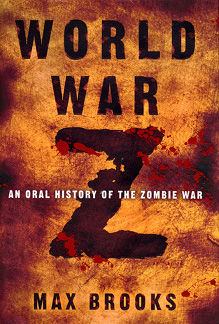
This is one of my favorite books. It is, as I said, a collection of stories, all in the form of interviews, which together tell the overall story of humanity and it's struggle to overcome this deadly force. It was apparently inspired by a real history book, The Good War, which was told in the same format. I am quickly running out of things to say.
So, I've just read a bunch of other reviews, because I have no ideas of my own. It seems like most of the complaints stem from the strange format, because you cannot connect to the characters and watch their story arcs, because the interview are so short. I can see what they're talking about, but that's not really a problem for me, because I tend to empathize with any character who isn't completely terrible, and most of these characters are likable.
I actually think this format works well, because it emphasizes that the zombie war (and other wars) can't be seen as simply actions of "the masses," and that everyone needs to work together to defeat the zombies. This theme is slightly undercut by the U.S.-centrism which creeps it way into some parts of the book, but it still works overall.
What I like most about World War Z is the fact that Brooks makes so many different kinds of stories. There are quite a few about guilty military personnel, and about how everyone was doing things wrong, but for the most part it was full of diversity. There are some stories about survival, people going insane, a nuclear exchange, the formation of a religious state, plans that pulled humanity back from the brink, people giving their lives to try to cleanse areas from zombies, and gung-ho military operations.
So, If you think you will like it, give it a shot. If not, well, maybe this book is not for you. At least read a few chapters. Oh, and if you liked The Zombie Survival Guide (which uses the same zombies), then you will probably love World War Z, because it is a collection of the kinds of stories you made up while you read the survival guide. That's all I've got.
Saturday, May 30, 2015
The Zombie Survival Guide
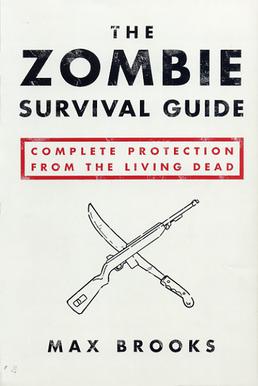
The Zombie Survival Guide is exactly what is said on the cover: a survival guide, in a completely serious and informational tone, for surviving the zombie apocalypse. It details zombie strengths and weaknesses, the best ways to fight them, and other tips and tricks for adapting to the zombie apocalypse.
As for the Brooks Zombies, they are slow, stupid, and uncoordinated. Their only advantage is that they can defy many laws of biology, like the need for oxygen, nutrients, a functioning body, or higher thought. Brooks used his zombies in his other book, World War Z, which I also recommend and will probably talk about later.
If you enjoy losing yourself in another world (perhaps with friends), you should get this book immediately. If you don't, then maybe you can get this book anyways and it can convince you. There is no story arc and no characters, so while reading it you inevitably start imagining yourself in these situations, and even start planning a little. Unless you're a nerd, in which case you plan a lot.
In conclusion: zombies. how to survive them. Thank you for your time.
Sunday, July 13, 2008
The Spiderwick Tie-In Books: A FieldStore Guide
 Arthur's Spiderwick's Field Guide to the Fantastical World Around You, by Tony DiTerlizzi and Holly Black
This book is the actual field guide that they talk about in the Spiderwick Chronicles series. I think it is weird that the Grace kids went into so much trouble to hide the book and now it is being mass-produced! This book is about all the weird fantastical creatures that Arthur Spiderwick studied. It has labeled illustrations and lots of pull-out pages. In The Spiderwick Chronicles, the Grace kids saw many of these creatures, but they didn't see most of them. That is why this book adds a lot to the original series. This book is worth reading and keeping.
 Care and Feeding of Sprites, by Holly Black and Tony DiTerlizzi
This is a book about how to care for sprites, which is really funny because... um.. you know... they don't exist. The pretty much only good thing about it is the poster. There is a fold-out poster on the dust cover. It is also really fun to have specifics of different kinds of sprites, not just the 10 words, "There are many different kinds of sprites in the world," which is about all Arthur's Spiderwicks Field Guide says. It is also fun to read how the author doesn't give a hint that sprites don't exist. This book is worth reading, but is only worth keeping if you: 1) want information on specific types of sprites, 2) want the poster, 3) believe in sprites, or 4) all of the above.
 The Chronicles of Spiderwick, A grand tour of the enchanted world navigated by Thimbletack, by Holly Black
This book is Thimbletack's scrapbook of things he collected as the years went by at the Spiderwick estate. It is a sort of guide to the Spiderwick books including a map of the house, a family tree, and lots of interesting stuff about the people who have been there. This includes things that are not in the original series, like graded homework essays by the Grace kids, newspaper clippings from around the world, letters, pages ripped out of books, diary entries, and family pictures. It is fun to see how all these extra bits fit in with the original series, and it answers some questions you may have had when reading the series. For example, how did Aunt Lucinda convinced the sprites to come? This book has the answer. The Grant Tour book is worth reading, and worth keeping if you are a big Spiderwick fan (e.g., me!).
 Notebook for Fantastical Observations, by Holly Black and Tony DiTerlizzi
This book is full of fun stories and activities organized by magical creature, including dragons, brownies, and lots of other creatures. For example, under dragons, there is a page for "Sketches for two locations where dragons may be found, in the real world and in the fairy world." Some of these activities are easy to complete, others may leave you stumped, such as (under Brownies), "I imagine this creature helping me with chores around my house." This book is definitely worth reading, but only worth keeping if you are willing to do the activities, like me. It is a good way to keep the fantasy going until the next series comes out (and, I assure you, it eventually will).
Subscribe to:
Posts (Atom)