Saturday, June 17, 2023

Elder Race

Lynesse Fourth Daughter is brave and true, or as her mother would put it, stupid and gullible. She is the fourth princess in line for the throne, and everyone says as the least likely to make something of herself. But now, finally, she's been given the chance to prove them all wrong. See, there's a demon about, the kind of devastating, potentially world-ending threat that only appears in age-old stories. Lynesse, however, has a plan: if she recruits the famed sorcerer Nyrgoth Elder, he will surely be able to solve the problem.

Nyr Illim Tevitch is tired. Very, very tired. Tired of waiting for contact from Earth, which stopped transmitting signals centuries ago. Tired of shirking and sometimes outright betraying his anthropological duties to survey the planet without interfering with its savage inhabitants. Tired of living with the knowledge that he is quite possibly the last member of his civilization. Mostly, just, tired. But hey, here's a flimsy excuse to wake up from indefinite cryosleep and go for an outing. He's got nothing better to do.

Elder Race tells the tale of these two idiots, together with Lynesse's good friend Esha Free Mark, setting out to find and defeat the demon. Half the chapters are from Lynesse's perspective, and make up a fantasy story; the other half are from Nyr's perspective, and make up a science fiction story. It's an interesting concept, but does it hold up?

Well, it kinda depends on your priorities. If all you want is to see the juxtaposition of two perspectives which view events as science or as magic, then Elder Race absolutely delivers (especially compared to certain other science vs magic books). The technology that Nyr uses is believable as an extension of technology that we have today, and Lynesse's interpretations of these technological marvels makes sense given what she and her culture know of the world. As an exercise in seeing the same thing from two very different pairs of eyes, it succeeds.

My main complaint is with the characters. To be frank, I never really cared about any of them. I couldn't get invested in Lyn's struggle to prove herself as a princess, nor in Nyr's search for meaning in a world that has no place for him in a galaxy that has forgotten him. It's like... have you ever watched a movie and thought, "this would be really great if only it was instead a TV show"? That's the feeling I got reading Elder Race. If only the book was, like, three times its current length, maybe it could have gotten me invested in the characters and story instead of relying entirely on its (admittedly rather clever) worldbuilding.

Also, I could have done with a bit less Anthropology Is Dumb in the book? See, a big part of Nyr's situation is that, as an anthropologist, he's not allowed to speak to the people he studies, nor indeed involve them at all. He's also apparently been taught to be uncomfortably racist against the people he studies. For the first half of the book, I was worried that the author shared his mindset (oh these savages without logic or reason, the only way to be human is to have a telephone, et cetera et cetera), but fortunately toward the end it was made clear that this is a bad thing.

Again I find myself wishing that the book had just a little more time to say its piece. Just another few pages of Nyr discovering that he's a racist little prick. Just another few pages of the characters interacting with each other, making us see them as people worth worrying about. Just another few pages of chatting with people outside our band of heroes, to give the world a real sense of being lived in.

Elder Race does not have the time to do those things, and it doesn't do them. But I mean, the flip side of that is that you can get through the whole book in just one long plane ride, so it's not exactly the biggest waste of time. All things considered, Elder Race had a clever, well-executed concept and nothing more. If that's enough to make you want to read it, then you'll have a good time.

(P.S. For some reason my brain decided that the correct way to pronounce this book's title was El Derrace, as if it were a noun from a romance language. This is irrelevant to the quality of the book, but I thought it was important to note.)

Tuesday, March 19, 2019

Love & Math

Proper image pending
Love Ampersand Math is an autobiography of sorts. It describes the story of Edward Frenkel, and how he was able to escape the oppression and anti-semitism of mid-1900s Russia (he was Jewish by law) to find a new life overseas. The book describes the discrimination and opposition that he faced, and all of the hurdles that he had to jump to become a mathematician.

And that right there is the catch, huh? Had Frenkel been shooting for a job in engineering or a career in sports or a publisher to take his writing, that story would be enough. A story of overcoming oppression to achieve a dream, a dream that is worth fighting for. But math is different. In the eyes of most people, math is something to be avoided, rather than something to work towards with all of your heart. So, while about half of the book is about Edwards’s story, the other half is a sort of manifesto in defense of and support for mathematics, a sharp rebuke of the idea that other careers and goals are more worthy of love than math is.

Frenkel makes his case by describing one specific project in math and physics, which is called the Langlands Program. I’ll leave the actual description of the Langlands Program for Frenkel, but on its broadest terms the program is an attempt to bring together multiple fields of math which seem completely unrelated to each other. The book goes through the history of the program, and the advancements that were made during (and sometimes because of) Frenkel's journey. This explanation of the program is mixed in with the narrative of Frenkel becoming a mathematician, so that the story and the math can take turns pulling the reader along.

Although Love & Math is on the whole a good read, I will say that it sometimes falls on both sides of the fine line between condescending and confusing. In particular, some of the mathy parts seemed confusing to me towards the end. I must point out, though, that I am particularly susceptible to confusion because I am currently taking a course in Galois Theory so I know exactly of the math to want to know more. The footnotes were very helpful, but still left me wanting for a proper summary or overview of terms. My advice for you is to just not worry about it; an understanding of the actual workings of the math is not necessary to enjoy Love & Math. This is ultimately the story of Edward Frenkel, and it sidesteps the nitty-gritty definitions and such in favor of getting a general sense of the systems involved.

So, yeah. If you're curious as to how and why a boy would scale 20-foot fences and go against the grain for a subject so dry and boring as mathematics, then consider picking up a copy of Love & Math. You might come out of it with a different view of mathematics than before.

Sunday, October 21, 2018

All the Birds in the Sky

Patricia Delfine is an ordinary girl living an ordinary childhood in her ordinary home. That is until one day when she decides to help a bird with a broken wing, who tells Patricia she's a witch and leads her to the Parliament of Birds, who give her an Endless Question to prove that she's really a witch. Will she be able to solve the riddle? Will she find a way to deal with her slightly sadistic sister? Will she unlock her true powers and become a protector of nature?

Laurence (with a U, not a W) is a shy kid who spends most of his time at home building things like an almost-functioning supercomputer and a watch that takes him two seconds into the future.  One day, he decides to sneak out of school to see a rocket launch at MIT. Will he use this time-skipping watch to expand on science's understanding of time? Will he succeed in creating a supercomputer? Will anyone ever stop calling him Larry?

The answers to these questions are all "maybe," because all of that happens in the first two chapters and then we immediately skip forwards by several years. Now, Patricia and Laurence both attend Canterbury Academy, a high school in which neither of them quite fit. Fortunately, they find each other, and tentatively start forming a friendship. Before long, the two become fast friends, and have all the sorts of misadventures that you would expect from a feel-good novel about high-school aged kids.

PSYCHE! They're soon separated and don't see each other for ten years, during which they split into their respective separate and irreconcilable worlds! Charlie Jane Anders has fooled you again! So yeah, Laurence is now a fancy science man who does fancy science, and Patricia is now a witch who does witchy things. Like for example assassination? I'm pretty sure Patricia is an assassin now? It's unclear. The point is, fancy science and witchy things can never ever go together, so Patricia and Laurence have an uncrossable rift between them, which they must somehow bridge if they are to ever be friends again.

Fortunately, our two protagonists have all the time they need to get to know each other, because the world is ending. Oh wait no that's bad. Don't worry, there are plans in the works to fix the oncoming apocalypse, which has to do with the climate changing by the way. Patricia's witch squad has proposed the worst plan in the universe, so that's maybe a bad idea. Fortunately, Laurence's science squad has proposed an alternative, which is also a bad plan but is preferable in that it is not the worst plan in the universe. The actual contents of both plans are kinda spoilers so I won't go into them here, but I mean really could they not like try any non-last-resort ideas given that they are not yet at a last-resort stage of the apocalypse?

Okay, I'm being a bit mean here. All the Birds in the Sky is a fun book, even if it does get somewhat pushed around by fridge logic. Laurence's science inventions are all pretty cool, even though they never get to a super useful practical level, much less an Iron Man level (with one spoilerish exception). Patricia's magic spells are rich and varied, and the associated costs keep them from feeling too overpowered. All in all, it's a pretty well-done balance of tech and magic.

If I do have any complaints, and I do, they're mostly about elements of the world, and in particular its portrayal of "the science side." First off, the idea of an uncrossable rift between magic and science bothers me. This is probably because of my obsession familiarity with science. See, science is a process and a lens through which you can see the world, and even if it doesn't entirely work you can at least try to apply science to magic. I guess I've been spoiled by things like Harry Potter and the Methods of Rationality, Artemis Fowl, Girl Genius, Atomic Robo, (but I'm going to invisible this text so that no one knows that I consider these magic-and-science, the first being science at heart and the last two being magic at heart) and The Entire SCP Wiki. In short, the problem I have is that the driving force of conflict (science vs magic) is something that I think is stupid.

Then, there's the trouble of how the science side in itself is portrayed. It's more of an "I have invented this cool thing now" than an "I am curious about how the universe works and how I can make it work for me." To see what I mean, let's take another look at that time-machine watch. First of all, and I admit this is nit-picky, the book acts as if two seconds is a really short amount of time. Like, Laurence skips forward two seconds and nobody notices because it just looks like he's flickering. This is two seconds: . That doesn't look like flickering to me.

But, more than that, there's the whole concept of the watch itself. Why two seconds? Why can't you jump more or less time? How does the watch know what to move forward and what to not affect? How would it affect a liquid? What reference frame is it using for the output point in space? How much mass can it affect? What happens to the space you used to take up in the two seconds are gone? None of these questions are asked by any of the characters, not even the ones that are meant to be "science people". My point is that an actual scientist would do so much with this, but in All the Birds in the Sky it's dismissed as just another "science thing."

It is, however, pretty clear why these avenues are not explored. All the Birds in the Sky isn't a book about the difficulties of reconciling science and magic. It's a book about Patricia Delfine and Laurence WaitDidHeHaveALastName, and their relationship with each other. The science fiction is of the pulpy magic-but-with-"quantum"-on-it variety. Essentially, in All the Birds in the Sky, "science" is a less effective and less reliable form of magic, with the bonus of not having any apparent costs. The split between the two sides is there only to drive the conflict of the book, and it works.

In conclusion, let this be a lesson to you all that thinking too hard about books can be bad for you. After a thousand words of text, my actual position towards All the Birds in the Sky seems murky. To be clear: I did like the book, although many of its elements ticked me off in just the wrong ways. If you want a deep exploration into whether or not science can be reconciled with magic, then this is probably not the book for you (and, honestly, I can't think of a single book which focuses on that question). If, however, you want to read a relationship drama between two awkward misfits, with the added spice of them being from different worlds and at the start of an apocalypse, then All the Birds in the Sky might be the book for you.

Saturday, October 20, 2018

Abaddon's Gate (The Expanse book 3)

It’s still the future, and not thinking about Venus is no longer an option. Y’see, the thing that used to be on Venus seems to have commandeered the planet to create a giant circle in space. A strapping young man by the name of Expendable McPlotPoint pulls the daredevil stunt of the millennium and shoots himself past the Martian Blockade, becoming the first to travel directly through the strange giant circle and into whatever lies on the other side. Spoilers: he doesn’t survive. Not even a little bit.

So that's fun. Oh and Holden is still around by the way, doing his Holdeny thing: leading his crew through space, taking jobs from whoever offers the most spacebucks, and generally holding stuff together. His new ghost friend, whose origins and motive remain mysterious, has told Holden to stay away from the space circle formerly known as Venus. Holden agrees with his ghost friend wholeheartedly, and resolves to give the space circle formerly known as Venus a wide birth. I sure hope that works out for him.

Meanwhile, Annushka Volovodov, a humble space pastor, is having a nice time past-ing space (or whatever it is space pastors do). She gets offered the opportunity of a lifetime: travel with the United Nations (the government of Earth) along with other religious folks and such to witness for herself the glory of the space circle formerly known as Venus. She accepts the offer (which is technically a spoiler but I mean come on) and finds herself well on her way to what is about to be the biggest mess in human history.

Also on his way to this mess is Carlos c de Baca, known as "bull" to his friends, who is in charge of the largest ship in the solar system, which has been creatively named the Behemoth. Just once I want an ultimate mega-warship which is called something innocuous like the Lilac or the Flying Festoon. Anyways, Bull has been personally asked by the leader of the Outer Planets Alliance to keep the Behemoth in shape. After McPlotPoint does his crazy stunt, Bull is ordered to meet with the Earth and Mars forces at the space circle formerly known as Venus, to show them that the OPA are team players.

Rounding off the cast of four we have Petunia Adams-Rogers, a farm girl from Oklahoma who has never stepped out of the Earth's atmosphere, but dreams of traveling the stars. After a surprise visit from an esteemed scientist to her college, she is offered the chance to join Anna in the UN ship set for the space circle formerly known as Venus. She of course agrees, and– yeah okay I think that's enough of this gag.

No, Petunia does not exist. She was probably murdered by Clarissa Mao, so that Clarissa Mao could take her place and pretend to be a protagonist. Clarissa is the sister of Julie Mao (the subject of Miller's search in the first book) and the daughter of Jules-Pierre Mao (one of the richest people in future history), who was taken down by Holden and company in the previous book. Oh, um, I guess that was a spoiler for the second book. Oops. Now, Clarissa has only one goal in her mind: discredit Holden, make everyone think he's garbage, and then kill him. Because he's a paragon, and paragons are immune to ordinary store-bought revenge.

Abaddon's Gate is fun, and I think captures more of the action-drama of the first book. There's still a lot of political drama going on, what with everyone having a look at the space circle formerly known as Venus and all, but there's also plenty of explosions and guns and whatever it is Clarissa Mao does. Speaking of Clarissa, it was very interesting to have an honest-to-god antagonist as a POV character. She's not an antihero, and we're not meant to empathize with her, and she doesn't even have any delusions of righteousness or whatever. She's just an insane murderer, and the fact that we know what she's doing and planning makes us all the more worried for the protagonists, which turns the suspense up to eleven.

As for the rest of the characters, I don't feel like they were really as strong as those from the first and second books. Bull and Anna in particular seemed to get the short end of the characterization stick. I get the sense that, out of the four characters in Abaddon's Gate, Anna is followed the least, but I'm not sure if that's reflective of the actual number of chapters she's in.

Despite these flaws, Abaddon's Gate is still a fast-paced and well-written action drama that keeps you hooked until the very end. I think it is my second favorite of the Expanse books so far, after Leviathan Wakes (the first one). My conclusion is of course that if you liked the second one then you'll like this one, which shouldn't really surprise anyone. I'm not even sure if these count as reviews anymore, because I'm just summarizing the setup and making a few comments. Ah, well, I'll keep doing these regardless. They're fun.

Anyways, yeah. Series are series. Give Abbadon's Gate a shot if and only if you wanna. Peace.

Friday, October 19, 2018

Algorithms To Live By

Have you ever been a human person? If so, then you should take a look at Algorithms to Live By, a book written by Brian Christian and Tom Griffiths. In it, you will find many concrete answers to problems that are similar to the ones that you have. That, and also assurance that life is, in a provable and scientifically defined sense, hard.

In Algorithms to Live By, each chapter focuses on one type of problem that human people face in their lives. The first chapter, for example, focuses on "optimal stopping," the problem of knowing when to settle for something, even if something better could be just around the corner. Specifically, the setup is this: you have a bunch of opportunities—jobs to work, houses to buy, days to hunt for an apartment, whatever—and when given an opportunity, you can either commit to it or abandon it forever.

The trouble is, you don't know how good all of the opportunities are, and the only time you're introduced to an opportunity is when you're being given the choice to take it or leave it. Going for the first one seems foolish– after all, there's probably a better opportunity out there. But waiting until the last one is pointless– sure, now you know how good all of your options were, but at this point you don't really have a choice in the matter, so you just have to hope the last one is good. What, then, is the best thing to do?

This question does actually have a mathematically correct answer: First, estimate the number of opportunities you will have– jobs that will consider you, houses that you will be able to afford, time available to spend looking for an apartment. Then, multiply that number by 37%. Use those first 37% of opportunities to calibrate your expectations; don't commit to any of them. After that 37%, go ahead and commit to the next opportunity that is better than all the ones you've seen so far.

This strategy will get you the best possible choice, out of all of the seen or unseen options, 37% of the time. Which, when you think about it, is kinda crazy. You start the process knowing nothing, and at each step you only have one choice: commit or press on. And yet, almost two in five times, you'll be able to come out of it just as well as if you'd already known everything when you'd started.

The chapter then goes into possible extensions of the problem: what if there's a cost to waiting longer, or what if you have an idea of what the average opportunity looks like? These slight changes to the problem can often change what the best solution is, and they each have their nuances and complications. Other chapters have similarly broad scopes, and cover topics like how best to tidy things up, how to decide what's worth pursuing, and how in general to deal with other human persons. Each chapter feels like its own attempt to optimize some major facet of life that you never even knew could be optimized.

One of the reasons I like Algorithms to Live By is that it is very matter-of-fact and not at all judgemental. "Yes, this is a problem." "No, the solution is not obvious, which is why it's a problem." It goes into a lot of examples, and often waxes philosophical, but in the end it's really a book about solving problems and being a better human person. Even when there is no good solution, it can be nice just to know that the kinds of decisions you face are sometimes ones that, in a provably true way, have no simple answer. Algorithms to Live By has really boosted my confidence in my own decision making, and I think made my life better as a whole.

Note that I might be biased towards the book in that I am in fact a mathematician, and the idea of something being proven holds a lot of power over me. But, to be clear, this is in no way a math book, nor does it require any mathematical knowledge beyond maybe knowing what a percentage is. I, myself, have no experience with computer science at all, but Algorithms to Live By was still incredibly easy to read and understand.

So if you are currently or have ever been a human person, and would like to maybe be a bit better at doing human person things, then you should pick up Algorithms to Live By. It's interesting, easy to read, and all in all a good way to optimize your human person experience.

Thursday, October 18, 2018

Annihilation

So far I haven't reviewed many horror books, and by "many" I of course mean "any at all." I do read and enjoy horror stories, but I mostly go for short horror stories rather than book-length narratives, and even the narratives that I do enjoy tend to effectively be collections of loosly-related stories. See, with longer horror stories, I'm never able to stay within the same frame of mind throughout the entire thing. Eventually I fall out of the story and start nitpicking events, trying to find simple ways for the characters to survive. This quickly unravels the horror, and the book turns into a sub-par action novel.

This did not happen in Jeff VanderMeer's novel, Annihilation. For the entire book, I found myself drawn into the surreal pale-blue world of Area X. (I'm not actually sure what the "pale-blue" in that sentence is exactly referring to, but it seems appropriate somehow.) The oppressive atmosphere of apprehension and tension and offness pervades every single page, and it's as terrifying as it is wonderful.

Annihilation centers around the experience of the narrator, a biologist who remains unnamed. (That's one way VanderMeer keeps his unique atmosphere going: none of the characters are named, and I could probably count the proper nouns in the book with one hand; it makes everything very off-putting.) The biologist is joined by an anthropologist, a psychologist, and a surveyor, and together they explore a mysterious location known only as Area X. You now know about as much as the biologist knows going in. Except, of course, for the fact that the previous 11 expeditions all ended in catastrophic and generally unexplainable failure.

So with that cheery setup, the book opens, with the biologist determined to figure out what this whole thing is about. The four members quickly discover a mysterious "tower" that goes downwards into the ground. This is approximately the point at which everything starts to go terribly, terribly within acceptable parameters and nothing is wrong. Everything then continues to be fine, and eventually the book ends.

Sorry. I had to. So yeah, it doesn't turn out to be a walk in the park for our nameless friends. As they explore Area X, we learn more and more about the biologist's background and the real reason she agreed to go on what was almost certainly a one-way trip. It's not the best characterization I've ever seen, but it helps frame the events of the expedition while somehow maintaining the same ever-present tone.

I realize that Annihilation could be described as Lovecraftian, and I'm sure the comparison has been made before, as the novel certainly has its fair share of cosmic horror. Although it would be accurate, I don't think it quite does Annihilation justice. I've read a lot of Lovecraft's work, and I have to say I think VanderMeer is better at Lovecraft than Lovecraft was. For this and other reasons, I'd propose going the other way: using the term VanderMeerian instead to describe dark, foreboding stories of surreal horror and existential dread.

So there you have it: Annihilation is a book that managed to revive my confidence in long-form horror, and is easily the best horror novel I've read. Needless to say, if you hate horror books, you should probably not read Annihilation. There's not much in the way of character studies or action sequences, either. If, however you are a fan of horror stories great or small, and you would like to explore a new, stranger type of horror, then you should give Annihilation a read.

Tuesday, August 28, 2018

Weapons of Math Destruction

We all know that the future is dangerous. Nukes, artificial intelligences, superbugs, global warming, military drones, and black hole supercolliders are all competing to see which will ultimately spell the end of humanity. In Weapons of Math Destruction, Cathy O'Neil reveals yet another destructive agent of the future: mathematics itself. Well, not quite. The problems that O'Neil details are much less conspicuous and much more insidious than a hostile takeover of all computers or the collapse of the very foundations of logic. These problems lie in mathematical models, and in the amount of implicit trust we’ve placed in those models.

Mathematical models are all around us, and most of them are unfortunately complicated, confusing, and opaque. Most of us, however, don't often think about these models, or even realize that they exist. If every mathematical model ever used were perfect and wonderful and reflected the world in all the right ways, then this would be fine. The models would chug along, sorting people into and out of jobs and sentencing people in reasonable ways, giving every person what they deserved as we continued our lives none the wiser.

This is of course not what happens. Weapons of Math Destruction reveals the many, many ways that blindly trusting math can cause problems. You see, while no model is perfect, some models are imperfect in ways that undermine their own effectiveness, sometimes with terrible consequences. Models that fall into these traps are called Weapons of Math Destruction, or WMDs for short. Often, these models are unflinching in their imperfections, taking irrelevant factors into account and never learning from their mistakes or successes. To make it worse, many people trust these mathematical models as impartial and infallible just by virtue of them being powered by math.

O'Neil quickly and effectively dispels the notion of math as an all-knowing arbiter and exposes WMDs for the dangers that they truly are. Each chapter of Weapons of Math Destruction focuses on a part of our lives that is becoming increasingly controlled by mathematical models, and how WMDs are making everything worse. The book is full of analogies and examples, but it never strays far from its core argument, that WMDs exist and could well ruin everything if we don't do something about them.

If you are at all curious about anything I've said, or if you are intrigued by the concept of dangerous and biased mathematics, then you should read Weapons of Math Destruction. It goes into far more detail than I have, providing not only real-world examples of WMDs but also strategies for identifying a WMD in the wild. For an extensive introduction to a slightly terrifying facet of our society, look no further than Weapons of Math Destruction.

Wednesday, July 19, 2017

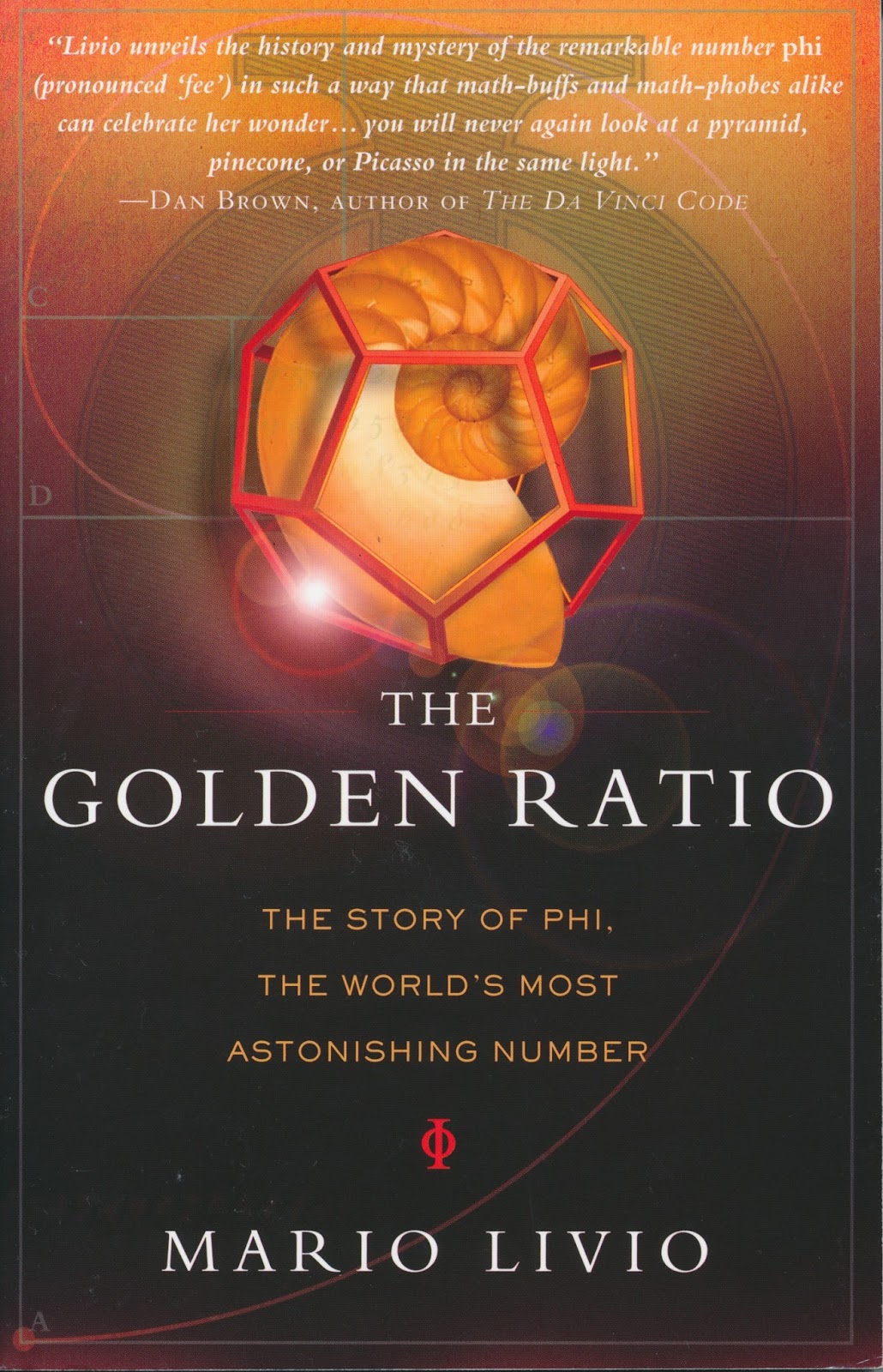
The Golden Ratio

Have you ever heard of the Golden Number? The Divine Proportion? Nature's greatest secret, the deepest mystery on earth, and the world's most astonishing number? No? Well, it might be the second most hyped number after Pi, and it's the subject of such things as this website, this video, and this book. If you believe these sources, then the Golden Number (or Phi) is a mysterious value with strange properties that appears in random places and dictates the rules of all of human civilization and perhaps all of the entire universe as well.

Then, there's The Golden Ratio, a book about Phi which tries to dispel some of the mystique around it. Not all of the mystique, but some of it. It addresses both the mathematical properties of Phi (like its connection with Fibonacci numbers) and the more wiggly properties of Phi (like its use in art as a standard for beauty). I think it does a good job of remaining mostly impartial, denying claims which are probably not true (like that the egyptians built the pyramids using Phi) and verifying claims that are true (such as Phi's prevalence in art after Luca's book The Divine Proportion).

So, if you're looking at all the hype and thinking to yourself wait but no that's not how the universe works, then you might want to give The Golden Ratio a read. And, if you're totally a Phi fanatic, you might want to read it too, just to see what the fuss is about. And, if you've never even heard of this number before, then you can go read something else. I hear Leviathan Wakes is pretty cool.

P.S. One problem is that it doesn't quite explain all of the mathematics in an intuitive way. If only someone were to do that, possibly in some sort of visual episodic format. Alas, that will likely never happen.

Tuesday, July 18, 2017

Caliban's War (The Expanse book 2)

Caliban's War is the second book in the Expanse series. It's still the future, and everything is mostly fine as long as you don't think about Venus so don't think about Venus. The three superpowers (Earth, Mars, and the Belt) are eyeing each other nervously. As long as nobody rocks the boat, and Venus stays quiet, it looks like things will go back to normal soon.

Bobbie Draper is working on Ganymede, a moon where scientists do farming. She's in the Martian military, and her job is to stare at the Earth military while farming happens. Because, seriously, who would attack a farm moon? Then a lanky humanoid with huge hands and a huge head rips through both teams and violently explodes. Bobbie is the only survivor. Now, she's got one thing on her mind: revenge. And also I think she has PTSD.

But, she wasn't the only person on Ganymede. There was also Praxidike Meng, or "Prax," one of the aforementioned farm scientists. Now his science farm has been destroyed, along with most of his life's work. At least he still has his daughter, Amy or somethingMei, who was kidnapped shortly before the monster appeared so okay maybe he doesn't have his daughter. Still, he has a slim hope of finding her, so that's what he'll do.

Back on Earth, Chrisjen Avasarala is hard at work as a politician trying to keep the solar system falling apart. Then this whole Ganymede business happens, and things start really getting bad. Also, Venus seems to be acting up a bit. Try not to think about it. Anyways, she's got to put all the pieces together and figure out who done the monster, and also make some friends.

And James Holden is still there, with his crew, trying to deal with things as best he can. He messes up slightly less in this one. I think he's learning.

So, to be honest, I liked the original book better than this one. First of all, Leviathan Wakes straight-up had more action, and I like my boom boom bang. Second, I feel like only having two main characters, rather than the four in Caliban's War, kept things simpler and more predictable, which I felt was a good thing. There's no character order in Caliban's War, so it sometimes just flips between two characters without addressing the other two, which lessens a bit the feeling of everything is going wrong everywhere.

Still, Caliban's War is a good book, and the new characters are all nice. If you liked Leviathan Wakes, you'll probably like it. Yep, that's my big final rating: "If you liked the first one, you might want to continue the series." Don't I feel smart.

Friday, July 07, 2017

Math for Mystics

Math for Mystics is not really a book about math. It's written by Renna Shesso, a shamanic practitioner and priestess of wicca. It's about how to use vaguely mathy things when performing magical rituals and such.

As I have literally no experience in such things, I'm not sure how "good" the book is at what it does. The chapter on individual numbers was pretty cool, as was the chapter on magic squares and the one on days of the week. Unfortunately, I am almost certain to never use any of this in real life, so... I don't know what else to say.

If you're a wiccan or a druid and you want some... tips? I guess? Then buy Math for Mystics. You have my solemn word that it involves no serious mathematics. Otherwise, you can read, like, anything else.

Saturday, June 24, 2017

The Golden Section

The Golden Section, by Scott Olsen, is not worth your time. It's a book about Phi, the Golden Ratio, (1+√5)/2, 1.618033989ish, the "deepest mystery on earth." It explains none of the many properties of Phi that it presents, in the hopes of selling you on the mystery. Very little of what Olsen says is technically wrong, but it still leaves my with a kind of snake-oil salesman feeling. Of course, it does have pretty pictures, and it's over quick, so that's something. It also has a nice iridescent title.

If you want a small book full of pretty pictures and snake oil, along with some references to actual mathematics, then The Golden Section will do nicely. If you don't want that, then try anything else.

P.S. Man, if only someone would make like a cool series of videos explaining the properties of Phi so that it would seem less mysterious and people wouldn't fall for the snake oil. That would be neat.

Friday, June 23, 2017

Leviathan Wakes (The Expanse book 1)

Space. The final frontier. Humanity, insatiable in its quest for exploration, tosses itself into the void between worlds, strapped to tin cans with high explosives. What could possibly go wrong? Well, James S. A. Corey (who is actually two people or something) aims to find out in Leviathan Wakes, the first book of a (planned) nine-book series.

Meet James Holden, executive officer on a freighter which brings ice between planets. The solar system is a big place, after all, and people still need water. Unfortunately, when responding to a mysterious distress beacon, the freighter is nuked and almost all of Holden's friends are killed. It's not pretty.

Let's see if Josephus Miller is doing any better. He's a detective on Ceres station, born and raised in the Belt. He's running into some trouble because his partner, Havelock, is from Earth, which means that Belters don't like him so much. Still, everything should be fine, as long as some Earther doesn't inadvertently start a war because someone nuked his freighter and almost all of his friends were killed. But what are the chances of that, am I right?

So, yeah, now a war is brewing. The Earth and Mars are looking at each other all shifty, and the Outer Planets Alliance which claims to represent the belt is making everyone a bit antsy. Also, there's that thing from the introduction which hasn't shown up in a while. Hope that's not important. Now Holden is on a mission to find out who killed his ship, and Miller is on a mission to find a lost girl named Julie, and... well, things get a bit hectic.

Leviathan Wakes is a bangin' book. It's got killer pacing, and characters that are interesting and fun to be with. The world seems real and realistic, even with the crazier things that show up. The tension and the stakes keep getting ramped up, with more and more people being dragged in, and then you remember the title is "Leviathan Wakes" and get really worried. To make things even more intense, we follow Holden and Miller in alternating chapters, so there's almost always a cliffhanger after each chapter even if you don't stop reading, which I think is a really cool way to do things.

If you like high-stakes space drama mystery action, or if you want to become lost in a world which might be about to lose itself, or if you want to get to know interesting characters which could all die at any moment, then you should read Leviathan Wakes. And probably the rest of The Expanse.

Thursday, June 01, 2017

The Irrationals

The Irrationals is not good. Don't read it. Okay fellas thanks for your time it's been fun I'll see you in the next review goodbye.

Still here? Huh. Strange. Well, I suppose I could give a bit more information. The Irrationals is written by Julian Havil, and is about the history of irrational numbers (the ones that aren't fractions). If you're not already a huge math person, you will definitely dislike The Irrationals, due to the sheer volume of proofs. Book is like 40% history and 60% proofs. And they've got some serious proofs in there, with elementary calculus and contradictions and the like.

If that was all The Irrationals was, it would be a fine book. A history of the idea of irrationality, including the first proofs that Pi and e are irrational, a proof that Phi is the "most irrational," and other neat goodies, along with some descriptions of what was happening at the time these proofs were discovered. It would be a book meant for math nerds, and as a math nerd I would have enjoyed it. Unfortunately, The Irrationals has another problem that is almost certainly a dealbreaker.

Sometimes, the book is just wrong. It's not that Havil is stating falsehoods, it's that there's sometimes just typos in important places. When reading The Irrationals, you not only have to understand the poorly-explained proofs, you also have to fix mistakes in the proofs so that they make sense. I think anyone who wasn't procrastinating on their review of All The Birds In The Sky would have a hard time getting to the end. I made a list of some of the more serious mistakes I saw, which I'll put in this document, but it'll still be a rough time. Unless you're some kind of math masochist (mathochist?), I recommend staying away from The Irrationals.

Friday, May 19, 2017

Scythe

It's the future. Everything is great. An incredibly powerful AI known only as the Thunderhead has taken over the world, and is hell-bent on making life good for everyone. There's no more war, no more poverty, no more disease, and no more death. With one exception.

The Scythes (pronounced SKITH-ees) are an organization of people who are tasked with keeping the population in check by killing ("gleaning") people. They are the most revered and feared members of society. Citra and Rowan are two of the minority of people who outwardly disapproves of the Scythes, which sucks for them, because a wise old Scythe named Faraday has appointed them as apprentices.

Now, Citra and Rowan have to compete with each other to see who gets to become a Scythe. Except, neither one actually wants the job. But they both kinda do. It's good fun. Also, there's this whole thing with these Scythes who are holding "mass gleanings," which are exactly as terrible as they sound. I hope those guys don't cause any trouble.

Neal Shusterman's Scythe is a pretty fun book. The story is a whirlwind, with mysteries that had me genuinely second-guessing myself throughout the book. Seeing the separate journeys of Citra and Rowan as they learn how to kill is cool. It's apparently the first book in a trilogy, but the ending is actually really satisfying, so it can stand entirely on its own. Scythe also pokes at some really interesting issues about death and longevity and utopia. If you like a bit of action, a bit of mystery, and a lot of murder, then you should pick up Scythe.

Thursday, March 09, 2017

Logicomix

Logicomix is the story of the logician Bertrand Russell, as told by the man himself, as told by Apostolos Doxiadis and Christos H. Papadimitriou, drawn by Alecos Papadatos and Annie Di Donna. It is not a book about logic, or the history of logic, or how to live your life in the most logical manner. It really is a story about a real person, and I think it's really well done. For real.

The story follows Bertrand Russell from when he was a very small boy, and was still learning about how to see the world around him. Russell learns of the beauty and elegance in proofs, and sets off to try and prove all the things! This is the meat of the book, and it reads as thrilling a story as any.

This story is told via flashback, as Russell gives a talk to agitated peace protestors during World War II. This, in addition to letting Russell narrate, gives more direction to the story as a whole.

But Logicomix is not just that story. It also tells a part of the story of how Logicomix came to be, showing the day when Christos comes on board to help. Russell's story is presented with the authors and artists talking about what to include in the story. The whole layered narrative thing is fun, partly because so many people can interject, which colors the story just that little bit more. It is very well done.

So, if you think a story about searching for truth told through layered narratives sounds cool, then you should read Logicomix. And also I guess if you like logic or whatever. Or if you're curious about what logic even is, but don't want to actually do any of the hard stuff. Then this is a good book for you. Yep, I am happy with this paragraph's construction.

Wednesday, March 01, 2017

The Mathematics of Various Entertaining Subjects

The Mathematics of Various Entertaining Subjects, edited by Jennifer Beineke and Jason Rosenhouse and written by a whole bunch of people, does not have an interesting title. I'd guess that, for the vast majority of people, the book is just as boring as it sounds. However, for math nerds like me, it's really interesting, and a fun introduction to how math is done in "the real world."

The Mathematics of Various Entertaining Subjects is a collection of 17 chapters, each written by different folks, and each about the some sort of game or puzzle. All of them (except maybe the first two) are heavy in mathematical language and notation. Some chapters explain the background really well, others not so much. I straight-up skipped a few of the chapters. The ones that I did read were, for the most part, very interesting. There's a lot of variety to the subjects of the chapters. One might go so far as to say that there are various entertaining subjects.

That's about as much as I can say without going into the individual subjects in depth. So, let's look at one of the subjects. I present to you the heart of my favorite chapter, lucky 13, by Maureen T. Carroll and Steven T. Dougherty. It's about tic-tac-toe on what are called "affine planes." The smallest interesting affine plane is this:
Tic-tac-toe is played on this plane the same way as on a normal one, but on this plane there are four extra lines (the big curvy ones). This looks complicated, but all that happens to tic-tac-toe is that four more winning arrangements are added:
These new four are the last ones on the bottom, and they make a sort of diagonal T-shape. Try getting together with a friend and seeing what this changes. I spent an entire period of Physics class messing with these, and had more fun than was probably warranted.

So, if you think you want to see some fancy math, most of which isn't presented for beginners, then read The Mathematics of Various Entertaining Subjects. If you don't, then don't. If you're not sure, then start with a friendlier math book. I've got a lot of them in the "numbers" tag now.

Have a good day and a great life. Peace!

Wednesday, February 22, 2017

Zero

Zero is about nothing. By which I mean, it's about the idea of a void, a lack-of-thing, as being a sort of thing itself. It's written by Charles Seife, who also wrote Proofiness. Zero is similar to A Brief History of Infinity, by Brian Clegg, in that it's more of a history book than it is a math or science book. They're also similar because they talk about infinity, because zero is "infinity's twin."

The first six chapters of Zero (or the first seven, depending on how you count them) are about the idea of nothing slowly working its way into the mainstream, followed closely by the idea of the infinite. There was actually a lot of resistance to both of these ideas, especially in the West, which is made even more interesting by Seife's flowery writing. I'm not entirely sure what "flowery writing" actually means, but I'm pretty sure it happens in this book. Zero does technically go into some math, but never in much detail. There's just enough math to make sense of all the pretty pictures.

The last three chapters are about zero in physics, where it likes to cause problems. This second part seems much weaker than the first part; Seife uses quite a bit of hand-waving, and never shows us a single equation. I think that if Seife would show us the actual equations and where the zeros are, we would better understand why zero is to blame for these quirks. That said, I'm sure some people will be glad that the math all but disappears when the physics comes on.

If you wonder how ideas take hold, or like history, or are somewhat confused about zero yourself, then maybe give Zero a try. For what it's worth, I finished it in just three days, so it can't be all that boring. (Although, that probably says more about my schedule than it does about the book.) I think the best way to understand what Zero is like is probably just to read the introduction (which Seife calls "Chapter 0"), so I've just typed it up here. This might be illegal. Don't tell anyone. The point is, he remains that flowery throughout the book, and if you like that section, I think you can enjoy the rest.

Sunday, February 19, 2017

Flatterland

Flatterland is full of puns and science. Really, if it weren't for the name "Ian Stewart" on the front, I'd suspect it had somehow been written by me. Flatterland is a "sequel" of sorts to Edwin A. Abbott's Flatland, which I suppose you should technically read first, although I think Flatterland stands perfectly well on its own. Still, a quick review/summary of Flatland is in order.

Boop. Just did a quick review. Two paragraphs. It doesn't even have a picture of the cover. Go read it, if you'd like.

Anyways, back to Flatterland. As the tagline says, it's like Flatland, only more so. And with a healthy helping of Alice in Wonderland to boot. Flatterland is set about a hundred years after Flatland, and follows the adventures of Victoria "Vikki" Line, a woman who finds her some-number-of-greats-grandfather's book, which is entitled Flatland. (Yes, they are actually the same book.) Anyways, Vikki reads Flatland, and in it finds instructions for summoning a being from Spaceland, in a way that is kind of hilarious.

So, Vikki summons someone from Spaceland. However, she gets a bit more than she bargained for. Instead of the stuffy, boring old Sphere from Flatland, she meets a loud, energetic, grinning creature known as the Space Hopper, who can travel through much more than just stuffy, boring old Spaceland. The Space Hopper equips Vikki with a Virtual Unreality Engine, or VUE, and takes her on a tour of all sorts of spaces and geometries, meeting many strange people along the way. They pay special attention to a strange place called Planiturth, and the fact that its inhabitants don't really know which space they're in.

Personally, I really liked Flatterland. I'm a big fan of puns, and math, and paradoxes, and big toothy grins, and winks directed at the fourth wall, so what's not to like? I think Ian does a good job of describing and explaining all the spaces, and why they're all cool. If I had one complaint, it would be that there aren't enough pictures. Actually, I do have that complaint. A book about geometries should have more pictures in it. But, besides that, it's a fun read, and it stays crazy enough to always keep you guessing. If you like bending your brain a bit, and you don't mind a good pun every once in a while (or a bad pun (or twenty)), then I think you should try Ian Stewart's Flatterland.

Flatland

Flatland, by Edwin A. Abbott, is a memoir written by one A. Square, who inhabits the two-dimensional universe known to us as Flatland. The first half of the book is about Flatland itself, and the lives of the people inside it, who live in a strictly ordered society where social class is determined by the number of sides you have. Women, all of which are lines, have the lowest status (even though they are technically really thin quadrilaterals). There's also this freaky thing where kids are beaten into being more regular, and color is not allowed, and it's kind of terrible.

The second half of the book is about A. Square's experience of being visited by a Sphere from Spaceland, which has a third spatial dimension. As A tries to wrap his head around the fact that there can be a third dimension, the reader gets to try to thing about what a fourth dimension could mean. The Sphere also takes A through the first and "zeroth" dimensions, which is fun. Then the Sphere takes A back home, at which point A is promptly thrown in jail for being a lunatic. If you like dystopias and/or thinking about higher dimensions, then Flatland is a book you might like.

Friday, February 10, 2017

Our Mathematical Universe

Our Mathematical Universe is about big questions: Why are we here? What made it all? What's it all made of? Where did we come from? Where will we go? Where did we come from, Cotton Eye Joe? and so forth. More specifically, it is about Max Tegmark's answer to all those questions.

Tegmark takes us on a tour of the extremes of physics, from the epic scales of our entire universe to the smallest scales of atoms and space. The part about cosmology and the beginning of the universe is especially good, because Tegmark has personally worked with the data from satellites investigating the Cosmic Microwave Background Radiation. He also talks about the possibility of multiverses, and identifies four different "levels" of multiverse. I like that he stresses that there is no such thing as a "multiverse theory" in physics; multiverses are not a theory, but a prediction of other theories.

Then he talks about his idea that, in the end, the entire universe is a mathematical object. He makes quite the compelling case for the idea, essentially arguing that for physics to mean anything it has to be true, but in the end he didn't convince me. It's kind of a nice idea, though. A good effort. Anyways, if you'd like to see the structure of the entire book, it's something like this:
Yep. That's taken right out of the book. Tegmark did some of my job for me. Nice of him.

When Tegmark says "my quest for the ultimate nature of reality," he means it. The book is about his quest. Our Mathematical Universe could equally accurately be called Max Tegmark is a Nerd, although I doubt that would sell quite as well. The book is filled with personal anecdotes and little asides, which I think adds to it a lot. Then, of course, there's the whole "reality is math" thing that he believes. Still, he's an interesting person with interesting ideas, so it's fun to go on the "quest" with him. He certainly kept me to the end, at least. If you're also interested in the big questions about what it's all about, and you don't mind having a friend along for the ride, then you would enjoy reading Our Mathematical Universe.